

Leak detection in listed buildings relies on non-invasive methods (thermal imaging, acoustic listening, tracer gas) because opening up stone walls, lath and plaster, or original timber to find a pipe risks damaging protected fabric and can require listed building consent. These methods locate the leak first, so any repair work that follows is targeted and minimal.
In This Guide
Why listed buildings need a different approach
A listed building is protected because of what it's made from and how it was built, and that's exactly the fabric a traditional leak hunt destroys. Lifting floorboards, chasing out plaster, or cutting into a stone wall to "have a look" is standard practice in a modern new-build. In a category B tenement or a category A country house, the same approach can mean permanent loss of original material that took generations to lay down.
We work on a lot of Scottish stone buildings, and the brief is always the same: find the leak without touching anything that matters. That's not a nice-to-have here. It's the only acceptable way to work.
The financial argument matters too. Escape of water costs insurers about £1.8 million a day across the UK, according to the Association of British Insurers, and trace and access cover (the part of a buildings policy that pays for finding a leak) commonly caps out around £5,000. On a listed building, invasive investigation eats through that limit fast, especially once specialist reinstatement of lime plaster or dressed stone gets involved.
How thick stone behaves differently
Solid stone walls, common in Scottish tenements and older country houses, are often 500mm or more thick, sometimes with a rubble core between two outer stone skins. Water moving through that mass doesn't behave the way it does in a modern cavity wall.
- Slow to show. Water can travel through the rubble core for months before it reaches a surface where it's visible as damp or staining.
- Wide spread. By the time a patch appears on the inside face, the actual source may be metres away, following mortar joints or the rubble fill rather than a straight line.
- Retains heat differently. Thick stone has enormous thermal mass, which changes how it responds to a thermal imaging scan compared to a thin plasterboard wall.
This is why guesswork and stone don't mix. A hole cut where the damp patch appears on the inside face is very often nowhere near the actual leak.
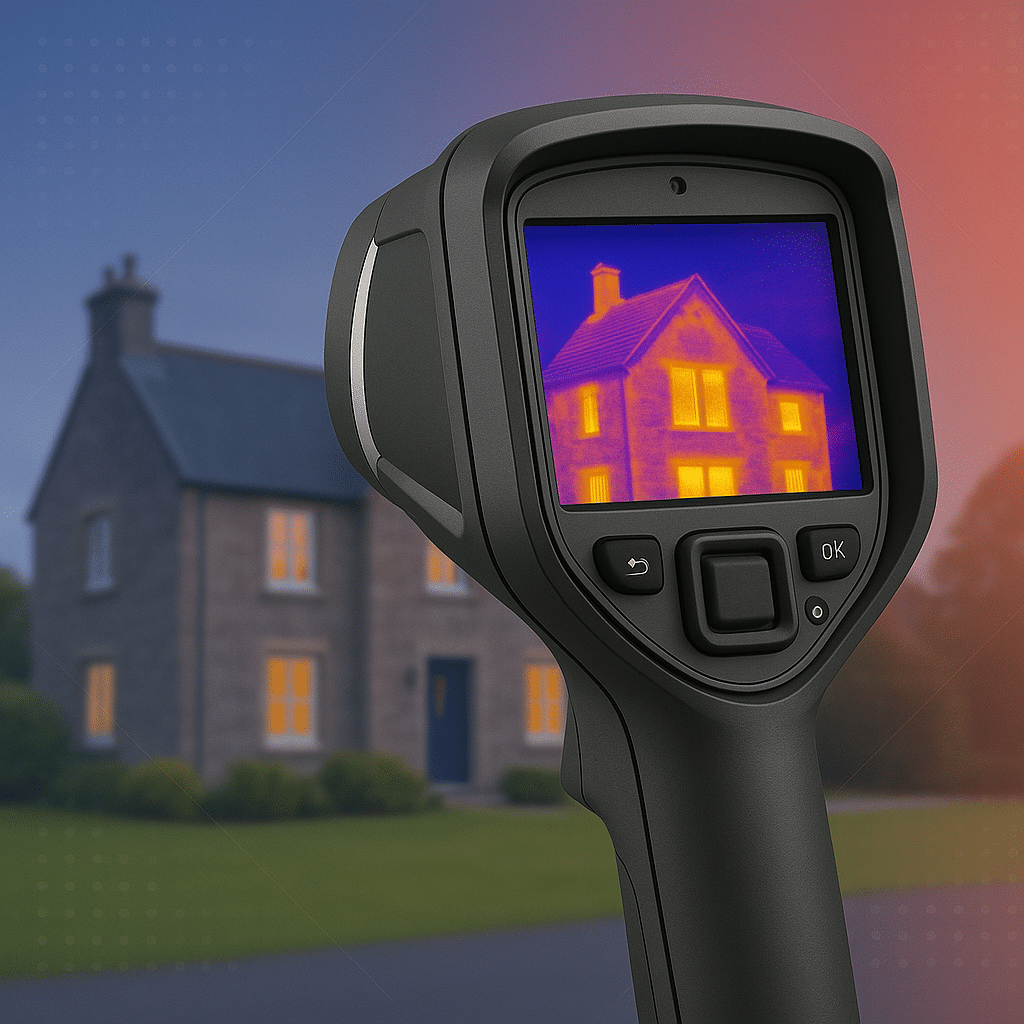
Reading a thermal scan on old stone
A thermal camera picks up subtle temperature differences at the wall surface caused by moisture underneath. On thick stone, those patterns take longer to develop and need a trained eye to interpret correctly against the wall's natural thermal behaviour, which is why experience with historic buildings specifically matters here, not just thermal imaging in general.
Lath and plaster: a leak's hiding place
Above the stone, most Scottish historic buildings use lath and plaster ceilings and internal partitions rather than modern plasterboard. Timber laths, nailed across joists, hold a lime plaster coat. It's a good system for its era, but it hides leaks well.
A leak above a lath and plaster ceiling can run along a joist or lath for a considerable distance before finding a weak point to drip through, so the visible stain is rarely directly below the source. Cutting a test hole in original lime plaster is also far more disruptive to repair than a plasterboard patch, since matching lime plaster texture and finish is a specialist job in itself.
Acoustic listening equipment can often trace a pressurised pipe leak through this kind of ceiling void without any cutting at all, by listening for the sound the escaping water makes as it travels through the structure.
The non-invasive methods that work here
Three methods do almost all the work on listed and historic buildings, usually in combination rather than alone.
| Method | Best for | Why it suits historic fabric |
|---|---|---|
| Thermal imaging | Surface temperature changes from moisture | No contact with the wall or ceiling at all |
| Acoustic listening | Pressurised pipe leaks, including underground | Traces sound through stone and timber without cutting in |
| Tracer gas | Confirming a specific pipe run | Uses a safe 5% hydrogen / 95% nitrogen mix introduced into the pipe, detected at the surface by a sensitive probe, with no need to expose the pipe first |
Our thermal imaging leak detection service is usually the starting point on a historic property, since it surveys a large area quickly without any contact. Where the source needs pinning down more precisely, acoustic and tracer gas methods narrow it to a specific point, often within a matter of centimetres rather than metres.
Got a leak in a listed or historic property?
We survey category A and B listed buildings, tenements and traditional stone properties across Scotland using methods that don't touch the fabric.
Consent and conservation considerations
Any work that alters a listed building's character, including some repairs, may need listed building consent from the local planning authority before it goes ahead. That's a separate process from the leak detection survey itself, but it's exactly why finding the leak precisely matters so much here. A confirmed, pinpointed leak location supports a minimal, targeted repair application. A vague "somewhere in this wall" report supports nothing and often leads to broader, more invasive work being proposed just to be safe.
Owners, factors and conservation officers all benefit from a clear, evidenced report showing exactly where the water is coming from and how it's travelling. That's also the kind of report insurers want to see before authorising repair work on a claim.
For buildings run as guest accommodation, hotels or care settings, some of this crosses over with broader commercial leak detection needs, particularly around minimising disruption to occupied rooms while a survey takes place.
What a survey involves
A typical listed building survey starts with a walk-through to understand the building's construction, age and any previous leak history, since a Georgian townhouse and a Victorian tenement flat behave differently even though both might be stone-built.
- Initial assessment. Reviewing where damp or staining has appeared and any pattern over time.
- Thermal survey. Scanning affected walls and ceilings to identify temperature anomalies consistent with moisture.
- Acoustic and tracer gas follow-up. Narrowing down a suspected pipe run to a precise point where thermal imaging alone isn't conclusive.
- Written report. An insurance-approved report setting out the findings, suitable for submission to insurers, factors or a conservation officer.
Same-day results are possible on most single-property surveys, which matters when a building is occupied, let out, or open to the public and downtime needs to be kept short.
Frequently Asked Questions
Thermal imaging reads surface temperature, not what's happening deep inside the wall. On very thick stone it can still detect moisture-related surface patterns, but it usually needs pairing with acoustic listening or tracer gas to confirm the exact source within a thick structure.
No. Thermal imaging, acoustic listening and tracer gas detection are all non-invasive and involve no cutting, drilling or removal of stone, plaster or timber. Any physical opening up happens afterwards, during repair, and only at the precise point the survey identifies.
Generally no, because the survey itself doesn't alter the building. Consent becomes relevant for the repair work that follows, particularly if it affects the building's listed character, so check with your local planning authority once the leak location is confirmed.
The detection method is the same, but responsibility and next steps differ. A leak in a common pipe usually falls to the building's title deeds or the statutory Tenement Management Scheme, and the resource Under One Roof recommends checking title deeds and notifying the factor before repair work begins.
Yes. Non-invasive methods let us survey most rooms while they're in use, which matters for guest houses, care settings or offices operating out of a historic building. Same-day results mean the disruption window is usually just the time the survey itself takes.
Report the escape of water as soon as you notice it, since prompt reporting matters for any claim. An insurance-approved detection report showing the exact source and extent of the leak supports the claim and helps ensure any authorised repair is scoped correctly from the start.
📍 Professional Leak Detection Across Scotland
Don't let a small problem become a big one
Old stone and original plaster deserve a careful hand. We find the leak first, with non-invasive methods and an insurance-approved report, so any repair work is precise rather than exploratory.