
Care home leak detection relies on non-invasive methods, thermal imaging, acoustic listening and tracer gas, so engineers can find the source of a leak without lifting floors, disturbing residents or closing off rooms in daily use. Surveys are usually planned around meal times, medication rounds and quiet periods, with out-of-hours visits available where a room genuinely cannot be accessed during the day.
In This Guide
- Why care homes need a different approach
- Non-invasive methods and why they matter here
- Planning a survey around residents
- Out-of-hours and low-disruption visits
- Common leak sources in care settings
- Why speed matters more in these buildings
- What a report gives your management team
- Frequently Asked Questions
Why care homes need a different approach
Care home leak detection is not the same job as finding a leak in an empty office or a vacant flat. Every room is potentially occupied by someone who cannot easily be moved, and every corridor may be a route staff need clear for mobility aids, trolleys or wheelchairs throughout the day. A leak search that would be routine in an unoccupied building needs a different plan here.
The building itself often works against a quick fix too. Many care homes are large, older properties, sometimes converted from a country house or built in phases over decades, with pipework running through walls and floors in ways that are not always documented. Finding a leak in that kind of layout needs a method that does not depend on opening up walls speculatively room by room.
Non-invasive methods and why they matter here
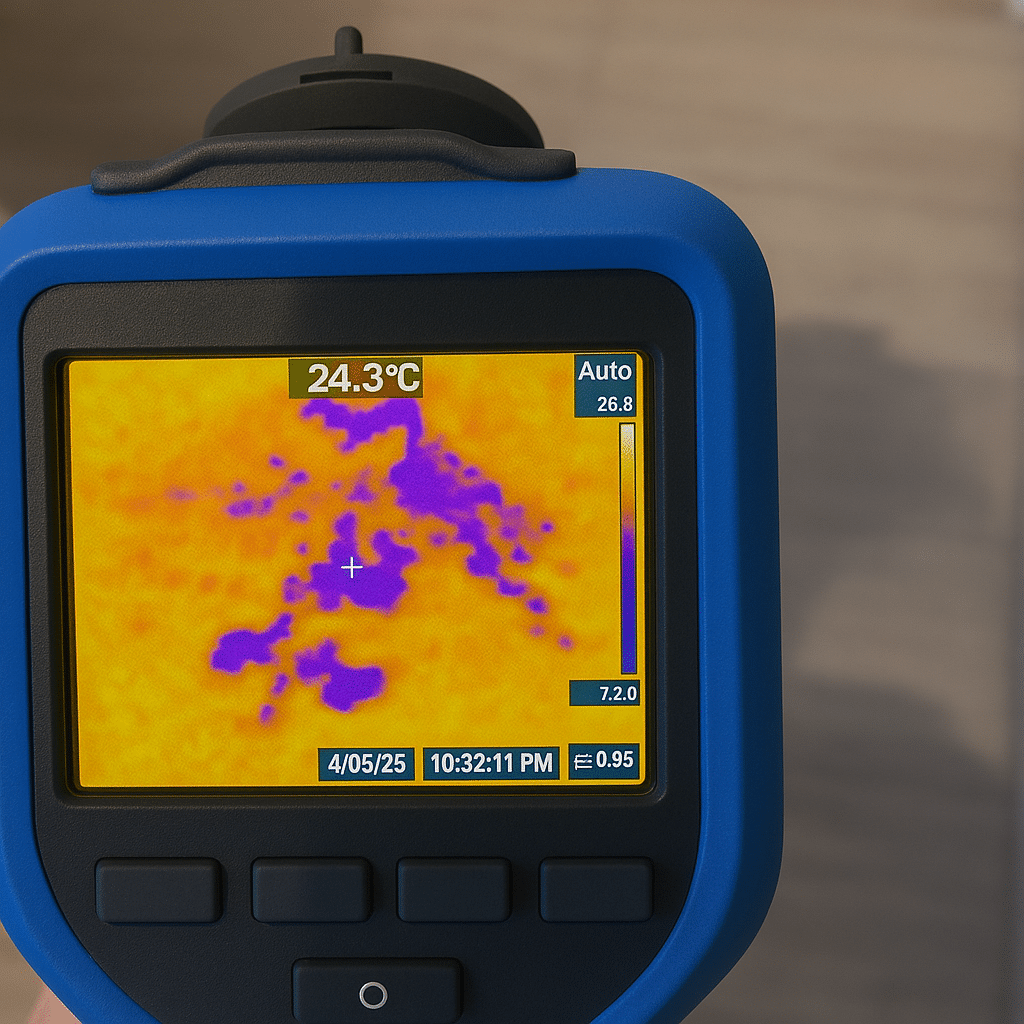
Thermal imaging, acoustic listening and tracer gas all locate a leak’s likely position without cutting into a wall or lifting a floor first. In a care home, that difference is not just convenient, it is often the only realistic way to investigate a room a resident is actively using.
Working quietly in an occupied room
A thermal camera survey can often be carried out from a doorway or the edge of a room, without moving furniture, a bed, or personal belongings. That matters enormously for a resident who relies on familiar surroundings, and it means staff are not pulled away from care duties to help clear a room first.
We see this most weeks in commercial and care settings where a resident’s room has a persistent damp patch that nobody wants to investigate the obvious way, by pulling up flooring while the room is in use. Non-invasive detection avoids that entirely, confirming the leak’s location first and only opening up the exact spot once the source is known.
Planning a survey around residents
A good survey in a care home starts with a conversation with the manager, not with equipment. Which rooms are occupied. Which residents are more easily disturbed by noise or unfamiliar visitors. When meal times, medication rounds and quiet rest periods fall. That information shapes the whole visit before an engineer sets foot on site.
Step 1: Confirm access windows with management
The home tells us which rooms are free to access at which times, and which residents would be unsettled by an unfamiliar visitor during personal care or rest periods.
Step 2: Survey communal and service areas first
Corridors, sluice rooms, kitchens and plant rooms are usually accessible straight away, and checking these first often narrows down the search before a resident’s room needs to be entered at all.
Step 3: Schedule resident-room access around care routines
Where a specific room does need checking, we work to the times the home confirms as least disruptive, moving quickly and quietly once inside.
Out-of-hours and low-disruption visits
Some rooms are never genuinely free during the day, and some care homes prefer investigative work to happen overnight or during a planned quiet period rather than around residents at all. Out-of-hours visits are a normal part of commercial leak detection work, and the same non-invasive equipment and methods apply regardless of the hour.
Daytime survey suits
- Communal areas, kitchens and plant rooms
- Rooms currently unoccupied due to hospital stays or respite
- Homes with flexible staffing to support access
Out-of-hours suits
- Occupied resident rooms with no daytime access window
- Homes running at full capacity with tight daily routines
- Areas needing extended, uninterrupted survey time
A damp patch that cannot wait for a convenient time?
We plan every care home visit around your residents and your routine, including out-of-hours where that works better. Same-day capability means a fast response when a leak cannot be left running.
Common leak sources in care settings
Care homes tend to have a higher density of bathrooms, wet rooms and assisted washing facilities than an equivalent domestic building, simply because of how many residents need level access showers and en-suite facilities. More wet rooms means more waste connections, more shower trays and more sealant joints, each one a potential source.
Kitchens serving a whole home run harder and longer than a domestic kitchen, so commercial dishwashers, ice machines and catering equipment see more wear on their connections. Laundry rooms handling washing for dozens of residents daily put similar strain on washing machine and dryer plumbing. And older care homes converted from large residential houses often still carry original pipework in walls that were never designed with today’s usage in mind.
| Area | Typical leak source |
|---|---|
| En-suite wet rooms | Shower tray seals, waste connections |
| Commercial kitchen | Dishwasher and catering equipment connections |
| Laundry room | Washing machine hoses and waste pipes under heavy daily use |
| Original building fabric | Ageing pipework in converted older properties |
Why speed matters more in these buildings
A slow leak in an empty commercial unit is an inconvenience. A slow leak in a care home affects real people living there day to day, and it can create genuine hazards: a damp patch on a corridor floor is a trip risk for residents using frames or wheelchairs, and mould developing from a hidden leak is a health concern for people who may already have respiratory vulnerabilities.
Finding the source quickly, without days of speculative opening-up, matters more here than almost anywhere else we work. Our same-day capability and 99% success rate reflect why non-invasive methods, not trial and error, are the right starting point in this kind of building.
Never leave a damp patch or water ingress in a care setting unreported, even a small one. Beyond the building damage, standing water and rising damp create slip and mould risks that matter more where residents have limited mobility or health vulnerabilities.
What a report gives your management team
A written, insurance-approved report matters just as much in a care setting as anywhere else, arguably more, since care homes answer to regulators, insurers and often a head office alongside the day-to-day running of the building. A clear report showing exactly where a leak was found, how it was traced and what remedial work is needed gives management something concrete to act on and to show anyone who asks.
If your leak has already caused a stain or a claim is being considered, our guide on checking for leaks behind a high water bill at a Scottish business covers the financial side of a hidden leak in more detail, which applies just as much to a care home as any other commercial property.
- Non-invasive first. Confirm the source before anything gets opened up.
- Plan around the home’s routine. Meal times, medication rounds and rest periods shape the visit.
- Out-of-hours where needed. Not every room has a convenient daytime window.
- Insurance-ready reporting. Clear documentation for management, regulators and insurers.
Frequently Asked Questions
Yes, in most cases. Thermal imaging and acoustic listening are non-invasive and can often be carried out from the doorway or edge of a room without disturbing the resident or moving furniture.
Yes. Where a room cannot be accessed conveniently during the day, we can carry out the same non-invasive survey overnight or during another quiet period, working around the home’s routine rather than against it.
Care homes usually have a higher number of en-suite wet rooms, commercial kitchen equipment and laundry facilities running heavier daily use than a typical office or shop, all of which increase the number of connections and joints that can eventually fail.
We offer same-day capability for urgent cases. Given the safety and health considerations in a care setting, a leak affecting a resident’s room or a corridor should be reported and investigated as soon as possible.
Yes. Our reports are insurance-approved and document exactly where and how the leak was traced, giving care home management clear evidence to share with insurers, regulators or head office as needed.
Usually not. Non-invasive methods are designed to work around an occupied room wherever possible. If a room genuinely needs to be cleared for a specific check, we agree that with management in advance rather than on the day.
📍 Professional Leak Detection Across Scotland
Protect residents and the building alike
Don’t let a small problem become a big one. Our non-invasive surveys find the source of a care home leak with minimal disruption, backed by insurance-approved reports your management team can act on straight away.