

Lead water pipes in Scotland are most common in homes built before the 1970s, when lead was the standard material for supply pipes. You can spot one by its dull grey colour, soft surface (a coin will mark it) and lack of a seam. The pipe from the boundary into your home is the owner’s responsibility, per Citizens Advice Scotland, and replacing old lead pipework with copper or plastic is the only permanent fix.
In This Guide
Why lead pipes are still around
Lead was the go-to material for water supply pipes in the UK for most of the last two centuries. It bends easily, joins without much fuss, and lasts a long time before it fails outright. Plumbers only started switching to copper and later plastic from the 1970s onward, and even then, replacement was never compulsory. Nobody came round and ripped out the old pipe once the new standard arrived.
That means a huge amount of Scotland’s older housing stock, tenements in Glasgow and Edinburgh, Victorian terraces, farmhouses, stone cottages, still has some lead pipework somewhere in the system. Not always the whole run. Sometimes it’s just the short stretch under the pavement, sometimes it’s most of the internal plumbing. You genuinely don’t know until you look.
We get called out to older properties across Scotland fairly often where the owner has no idea what’s behind their walls until a leak forces the question. Age of the building is the single biggest clue. If your home was built before 1970, treat lead as a real possibility rather than a remote one.
How to identify a lead pipe
You don’t need special equipment to get a first read on this. A few simple checks at the point where the pipe enters your home, usually near the stopcock, will tell you most of what you need to know.
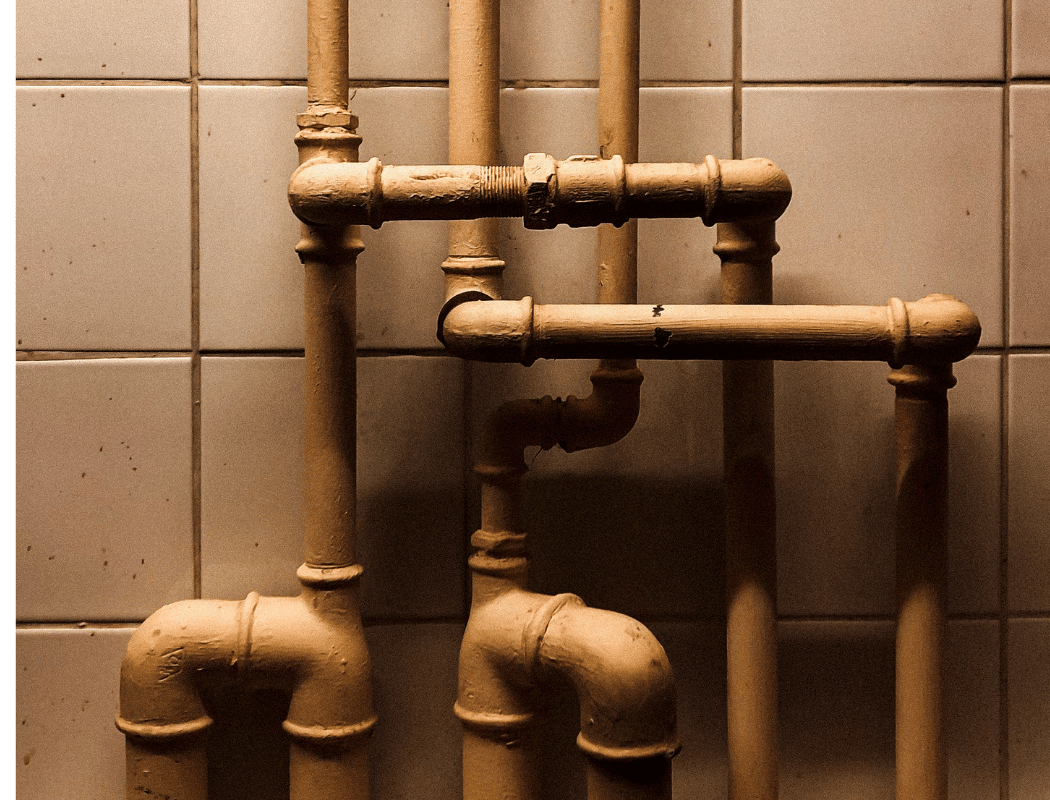
What older pipework looks like
Lead pipe is a dull, dark grey, almost matte, quite different from the shinier, more orange-toned look of copper. It’s also noticeably soft. Copper and plastic hold their shape under light pressure; lead doesn’t.
- Colour: dull grey to almost black, not the bright orange-brown of copper.
- The scratch test: scratch the surface gently with a coin or key. Lead reveals a shiny, silvery metal underneath. Copper stays copper-coloured.
- Softness: tap it gently with something metal. Lead gives a dull thud, copper rings slightly.
- No seam: lead pipe was drawn as a single piece with no visible joint line running along its length, unlike some copper.
- Bulging joints: where lead pipe meets a fitting, you’ll often see a swollen, rounded joint rather than a neat soldered connection.
If in doubt, a magnet is a quick elimination test. Lead isn’t magnetic, so if a magnet grips the pipe, you’re looking at steel, not lead.
Where lead pipe tends to hide
The most common spot is the supply pipe running from the street into the property, sometimes called the communication pipe or the owner’s supply pipe once it crosses the boundary. In tenements this section often runs under a shared close or stair, which is one reason common pipe disputes get complicated fast.
Inside the house, look at any pipework that predates a kitchen or bathroom refit. Extensions and renovated rooms usually get modern pipe, but the original bathroom, the airing cupboard, or a pipe run behind a chimney breast can still be original lead from when the house was built.
Cellars, crawl spaces and the underside of ground-floor timber suspended floors are worth checking too. These areas rarely get disturbed, so pipework there tends to be whatever was fitted originally.
Who’s responsible for replacing it
The rule in Scotland is straightforward on paper. Scottish Water looks after the mains pipe up to the property boundary. From the boundary, usually the stopcock, into and through the home, responsibility sits with the property owner, according to Citizens Advice Scotland. That includes any lead section on your side of that line.
Tenements complicate this. Where a supply pipe is shared between flats, owners share responsibility for maintaining it, and costs are usually split according to the title deeds. Where the deeds don’t say, the statutory Tenement Management Scheme fills the gap. Worth digging out your title deeds before you assume a shared pipe is someone else’s problem.
If you’re a tenant rather than an owner, the responsibility shifts again. Landlords have to repair leaks from pipes and fixtures inside the property, per Shelter Scotland, so a lead pipe replacement in a rented home is generally the landlord’s job, not yours.
Read our full breakdown of who is responsible for water pipes in Scotland if you want the complete picture, including shared supplies and boundary disputes.
Lead pipes and leaks
Lead is soft, which is exactly why it was so easy to work with a century ago, and exactly why it’s more prone to failure now. Ground movement, frost, and decades of pressure cycling all take their toll on a metal that was never meant to last forever. Splits tend to be small and slow rather than dramatic, which is part of the problem. A pinhole leak in lead pipe under a solid floor or behind a wall can run for months before anyone notices, usually as damp patches, a musty smell, or a water meter that keeps turning when nothing’s on.
Because lead pipe is often buried, boxed in, or run through a wall you don’t want to open speculatively, this is exactly the kind of job where professional water leak detection earns its keep. We use acoustic listening equipment and thermal imaging to narrow down the leak’s location before anyone lifts a floorboard or takes a hammer to plaster.
If you notice a sudden drop in water pressure, a damp patch that keeps reappearing, or your water meter spinning when every tap in the house is off, treat it as a leak until proven otherwise. Old lead pipe rarely announces a failure loudly. It seeps.
Not sure what’s behind your walls?
If you suspect an old lead pipe is leaking, we can pinpoint it without digging up the garden or opening up a wall on a guess.
Planning a replacement
Once you’ve confirmed lead pipe on your side of the boundary, the sensible move is to plan a full replacement rather than patching the same section repeatedly. A plumber or pipe-laying contractor will usually run new copper or MDPE plastic pipe alongside or in place of the old lead, either by digging a new trench or, where the ground allows, using moling to pull a new pipe through with minimal excavation.
1. Confirm the full run
Get a leak detection survey or a plumber’s inspection to map the full run of lead, including the sections you can’t see near the stopcock.
2. Check for a live leak first
If the pipe is already leaking, get that pinpointed and repaired before committing to a full replacement plan, so you know exactly what you’re dealing with.
3. Get quotes for the full length
Ask contractors to quote for replacing the entire lead section, boundary to property, rather than just the failed part, so you’re not back in the same position in a year.
4. Consider timing
If you’re already having floors lifted or a garden landscaped for another job, that’s the cheapest moment to run new pipe alongside it.
We see this fairly often with older stone-built properties: the owner books us for a leak, and once we’ve traced it, they ask about the rest of the run. It’s a reasonable question to ask at the same time rather than waiting for the next failure.
When to get a survey done
If your property was built before 1970 and you’ve never had the supply pipe checked, a leak detection survey is a sensible one-off step even without an obvious problem. It tells you what material you’re dealing with, roughly how it’s routed, and whether there’s any early sign of a leak forming. That’s useful information whether you’re planning a renovation, buying a property, or just tired of guessing.
Our water mains leak detection service covers exactly this ground, from the boundary through to the internal stopcock, using non-invasive methods so nothing gets dug up unless we’re confident about where the fault actually is.
Frequently Asked Questions
Check the pipe near your stopcock or where it enters the property. Lead is dull grey, soft enough to scratch with a coin to reveal shiny metal beneath, and has no visible seam. If your home was built before 1970, treat lead as likely until you’ve checked.
Generally yes. Scottish Water is responsible for mains pipes up to the property boundary; from there into the home, it’s the owner’s responsibility, according to Citizens Advice Scotland. Shared pipes in tenements follow the title deeds or the Tenement Management Scheme.
Yes, during a survey we can usually identify the pipe material at accessible points and trace the run using acoustic and thermal methods, which helps confirm how much of the supply is old lead versus later copper or plastic.
Not necessarily. Many properties have sound lead pipe that isn’t leaking. It’s a judgement call based on the pipe’s age and condition, but it’s worth having a survey rather than leaving it unchecked indefinitely.
Lead is softer and older on average, so it’s more prone to splitting from ground movement, frost and long-term wear. Leaks in lead pipe also tend to be slow and hidden rather than sudden, which is why they often go unnoticed for a while.
Lead is dull grey, soft, and easily marked. Copper is a shinier orange-brown, rigid, and rings slightly when tapped. A quick scratch test with a coin will usually settle which one you’ve got.
Call Scottish Water’s 24/7 leak line on 0800 077 8778. They handle anything on their side of the boundary; a leak on your own supply pipe is your responsibility to get repaired.
📍 Professional Leak Detection Across Scotland
Get a proper answer on your pipework
We’ll tell you what’s actually leaking and where, using non-invasive methods, with a report you can hand straight to your plumber or insurer.