
To repressurise a boiler, open both valves on the filling loop until the gauge reads around 1 to 1.5 bar, then close both valves fully. Most boilers need this every few months as pressure naturally drifts down. If you find yourself repressurising every few weeks, that usually means water is escaping somewhere and it is worth getting checked.
In This Guide
Before you start
Learning how to repressurise a boiler is one of those jobs that looks intimidating the first time and takes two minutes once you have done it once. Most combi boilers have a filling loop, a short braided flexible hose with a valve at each end, connecting the cold mains to the sealed heating system. Turning both valves briefly lets a controlled amount of water into the system, raising the pressure back to normal.
Find your boiler's pressure gauge first. It usually sits on the front of the unit and has a coloured band, often green, marking the normal range, typically around 1 to 1.5 bar when the system is cold. If the needle sits below that band, the system needs topping up. If it sits above roughly 2.5 to 3 bar, do not add more water. That is a different problem covered in our guide on boiler pressure that is too high.
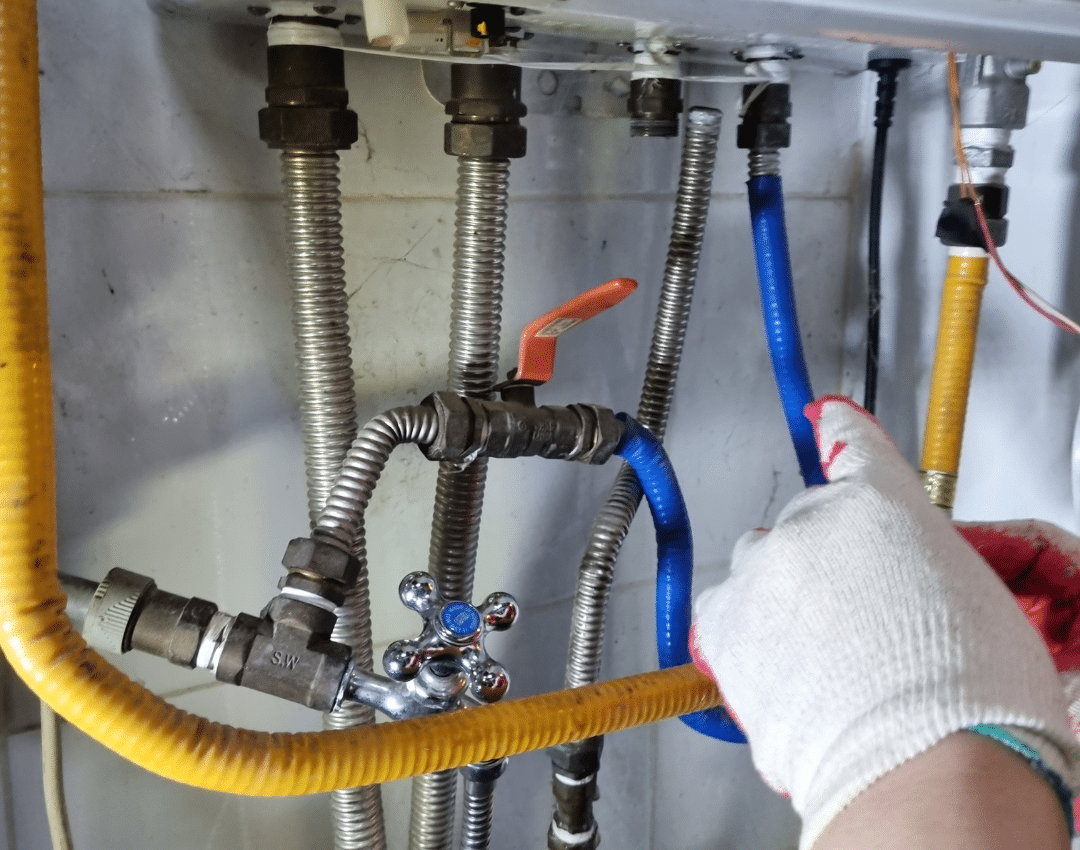
Locating the filling loop
The filling loop is usually tucked underneath or beside the boiler, connected between the cold water inlet and the heating system return pipe. Some boilers have it built in as an internal button or lever rather than an external hose, so check your manual if you cannot see one.
Step by step: using the filling loop
1. Turn off the boiler
Switch the boiler off and let it cool if it has been running. Working on a hot, pressurised system is uncomfortable and unnecessary.
2. Check both ends of the filling loop
Confirm the flexible hose is properly connected at both ends. If it is a detachable loop, make sure it is screwed on securely before opening any valves.
3. Open the first valve
Slowly open one valve, then the other. You should hear water moving into the system. Watch the pressure gauge continuously as you do this.
4. Stop at 1 to 1.5 bar
Close both valves as soon as the gauge reaches the middle of the green band, typically around 1 to 1.5 bar. It rises faster than expected, so go slowly near the target.
5. Close both valves fully
This is the step people most often get wrong. Both valves need to be turned fully shut, not left loosely in place, or pressure will keep creeping up over the following days.
6. Reset the boiler if needed
Some boilers need a reset button pressed after repressurising to clear a low-pressure fault code. Check your manual for the exact reset sequence for your model.
If you ever smell gas while working near your boiler, stop immediately, avoid touching any switches, leave the property and call the National Gas Emergency line on 0800 111 999. This is not something a leak detection specialist handles; it needs the gas network operator.
What if pressure won't rise, or won't stop rising
If you open the filling loop and the gauge barely moves, check the loop is actually connected and both valves are genuinely open, since a half-turned valve can restrict flow to almost nothing. If pressure rises too fast and overshoots past 2 bar, close the valves immediately and bleed a small amount back out through a radiator valve, following the method in our boiler pressure guide.
If the needle will not settle at all, climbing steadily even with the loop closed and the heating off, that is a different problem. It usually points to a fault in the expansion vessel or, less often, a leak somewhere in the sealed system letting pressure behave unpredictably.
How often should you need to do this
A healthy sealed central heating system loses pressure very gradually over months, mostly through tiny amounts of air release at radiator valves and normal wear at joints. Needing to repressurise once every few months, especially after bleeding radiators, is completely normal and nothing to worry about.
Honestly, most of the time when someone calls us about "the boiler keeps needing topped up", it turns out to be a normal seasonal pattern rather than anything wrong. The concern only starts when the gap between top-ups gets consistently shorter.
Topping up more often than you used to?
If your boiler needs repressurising every few weeks instead of every few months, something is letting water out of the system. We find central heating leaks without lifting floors, using thermal imaging and acoustic testing.
When repeated repressurising means a leak
Frequent top-ups are the clearest early warning sign of a hidden central heating leak. Central heating water often contains inhibitor, which can leave faint staining where it escapes, but under a solid floor or behind a wall that staining may never reach a surface you can see. The water simply disappears into the fabric of the building while the pressure gauge quietly falls, week after week.
Our related guide on detecting central heating leaks covers the signs to watch for in more depth, including damp floor patches, warm spots underfoot and unexplained boiler faults. When those show up alongside frequent repressurising, it is worth having a proper survey rather than continuing to top up indefinitely.
A central heating leak detection survey uses thermal imaging to trace warm water paths under floors and along pipe runs, backed up by acoustic listening where the pipe is pressurised. It is non-invasive, so nothing gets cut open until the exact point is confirmed.
- Top-ups every few months. Normal wear and tear; nothing to worry about.
- Top-ups every few weeks. Worth investigating; this pattern is unusual for a healthy system.
- Damp or warm patches on floors. A strong sign the leak is under a floor rather than at a joint you can see.
- Boiler faulting repeatedly for low pressure. Especially if a heating engineer has already reset it more than once.
Frequently Asked Questions
Aim for the middle of the green band on your gauge, typically around 1 to 1.5 bar when the system is cold. Check your specific boiler's manual, as the exact green zone can vary slightly between manufacturers.
Yes, most homeowners can safely do this themselves using the filling loop, since it does not involve gas components. Go slowly, watch the gauge closely, and make sure both valves are fully closed once you reach the correct pressure.
Occasional gradual drops are normal. If pressure drops noticeably within days of topping up, that suggests water is escaping somewhere in the system, either through a small leak or a fault such as a failing expansion vessel.
Some boilers have an internal filling mechanism, such as a button or lever, rather than an external braided hose. Check your boiler's manual for the model-specific method, since the process varies more between manufacturers than people expect.
It is better to let the system cool first. Working with a hot, pressurised system is uncomfortable and increases the risk of scalding if a connection is not fully secure. Switch the boiler off and wait before starting.
It depends entirely on where the leak is and how it needs to be accessed, so there is no single figure. Specialist firms across the UK typically publish prices between about £500 and £1,500 for a leak detection survey, depending on the job; a free quote is the quickest way to get a figure for your situation.
No, it only restores pressure temporarily. If a leak is causing the drop, topping up simply buys a bit of time before pressure falls again. Finding and repairing the actual leak is the only way to stop the cycle permanently.
📍 Professional Leak Detection Across Scotland
Don't let a small problem become a big one
If topping up your boiler has become a regular chore, we can find out why. Non-invasive testing, a 99% success rate across 5,000+ leaks detected, and an insurance-approved report at the end of every job.