

Detecting central heating leaks starts with the pressure gauge. Combi boiler cold pressure typically sits around 1 to 1.5 bar, so if it keeps dropping after repressurising, needs topping up every few weeks, or drops fast after bleeding a radiator, water is escaping somewhere in the sealed circuit, often under a floor where it can't be seen.
In This Guide
The first sign: pressure that won't hold
Most central heating leaks announce themselves through the boiler pressure gauge, not through a puddle on the floor. A sealed system is designed to hold a steady pressure, usually around 1 to 1.5 bar when the system is cold, and stay there. If you're repressurising every few weeks, or the needle drops noticeably within days of topping up, water is leaving the system somewhere.
The tricky part is that "somewhere" can mean anywhere along a network of pipes that runs under floors, behind walls, and up into radiators on every level of the house. A visible drip at a radiator valve is the easy case. A hairline split in a microbore pipe under a chipboard floor is the one that has people repressurising for months without finding anything.
We see this most weeks in winter, when a system that's coped fine all summer suddenly can't hold pressure once the heating's running hard every day. The leak was often there before, just too slow to notice until the system worked harder.
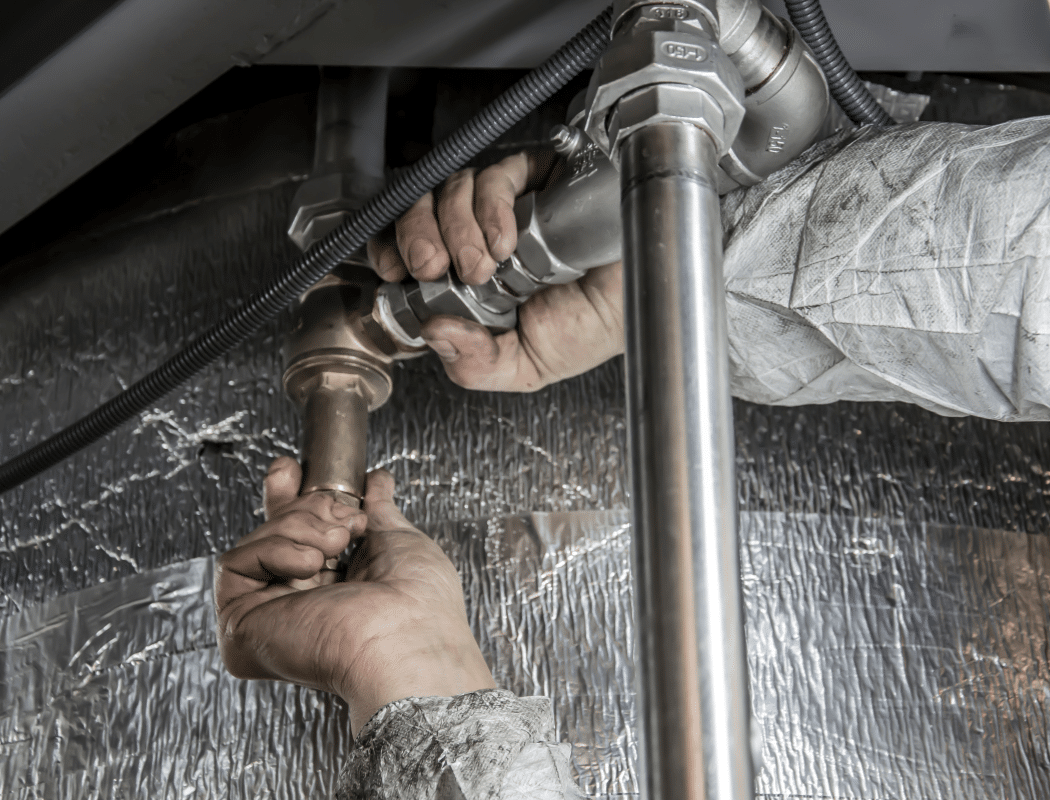
Why under-floor pipe runs are the hardest to check
Once a heating pipe disappears under floorboards or a screed, there's no way to inspect it by eye. A slow weep can sit there for months, staining the underside of the floor and slowly softening timber, long before anything shows on the ceiling below or the carpet above.
Other signs a heating leak is hiding somewhere
Pressure loss is the headline sign, but a handful of others usually show up alongside it, or sometimes before it.
- Warm patches on the floor that don't match where underfloor heating or a radiator run should be.
- A damp or musty smell in a room with no other obvious cause, particularly near a wall a heating pipe runs behind.
- Discoloured or bulging skirting boards where water has been sitting against timber for a while.
- Boiler firing more often than usual as the system tries to maintain pressure and temperature it keeps losing.
- Rusty or brown staining around a joint, valve or radiator connection, a sign corrosion has already started.
Why microbore pipes and corrosion make it worse
Many Scottish homes, particularly those with 1970s to 1990s heating upgrades, run on microbore pipework: narrow copper pipe, often just 6mm or 8mm across, snaking to each radiator individually rather than the wider pipe used in older gravity systems. Microbore is efficient to install but corrodes from the inside at a fairly predictable rate, and a pinhole leak in an 8mm pipe can be almost silent.
Corrosion is the other half of the problem. Sludge and rust build up inside a heating system over years, and that sludge is often acidic enough to eat through pipe walls and radiator seams from the inside. It tends to attack the weakest points first, joints, bends and the base of radiators, which is exactly where leaks then appear. Keeping the system properly dosed with inhibitor slows this process down considerably and is one of the cheapest preventative jobs a heating system ever gets.
DIY checks you can do first
1. Check the pressure gauge daily for a week
Note the reading each day at roughly the same time. A steady, slow decline over several days points to a genuine leak rather than a one-off top-up.
2. Look at every visible joint and valve
Run a dry tissue along radiator valves, pipe joints and the boiler's own connections. Even a small amount of limescale staining suggests a weep has been happening for a while.
3. Feel for warm patches on floors and walls
A pipe leaking under a floor often warms the surface directly above it slightly, noticeable barefoot before it's visible any other way.
4. Rule out the obvious culprits first
Check radiator bleed valves aren't weeping and the filling loop is fully closed after repressurising. Our guide on how to repressurise a boiler covers this step by step.
If you smell gas at any point, stop what you're doing, evacuate the property and call the National Gas Emergency line on 0800 111 999. Leak detection specialists deal with water, not gas emergencies, and a suspected gas leak needs the emergency line immediately.
Pressure keeps dropping and you can't find why?
We use thermal imaging and tracer gas to trace central heating leaks hidden under floors and behind walls, without lifting more than we need to. Insurance-approved reports as standard.
How thermal imaging and tracer gas find the leak
When DIY checks rule out the obvious spots, the next step is a proper survey using thermal imaging leak detection. A thermal camera reads the surface temperature of floors, walls and ceilings, and a leaking heating pipe usually shows up as a warm streak against the surrounding cooler surface, because the water inside is warmer than the room.
Tracer gas is the other tool in the kit, particularly useful once a system has been drained down. A safe mix of 5% hydrogen and 95% nitrogen is introduced into the empty pipe, and a sensitive probe detects exactly where that gas escapes at the surface. Because the gas is far lighter and more mobile than water, it finds its way out through even a hairline crack, giving a precise location rather than a general area.
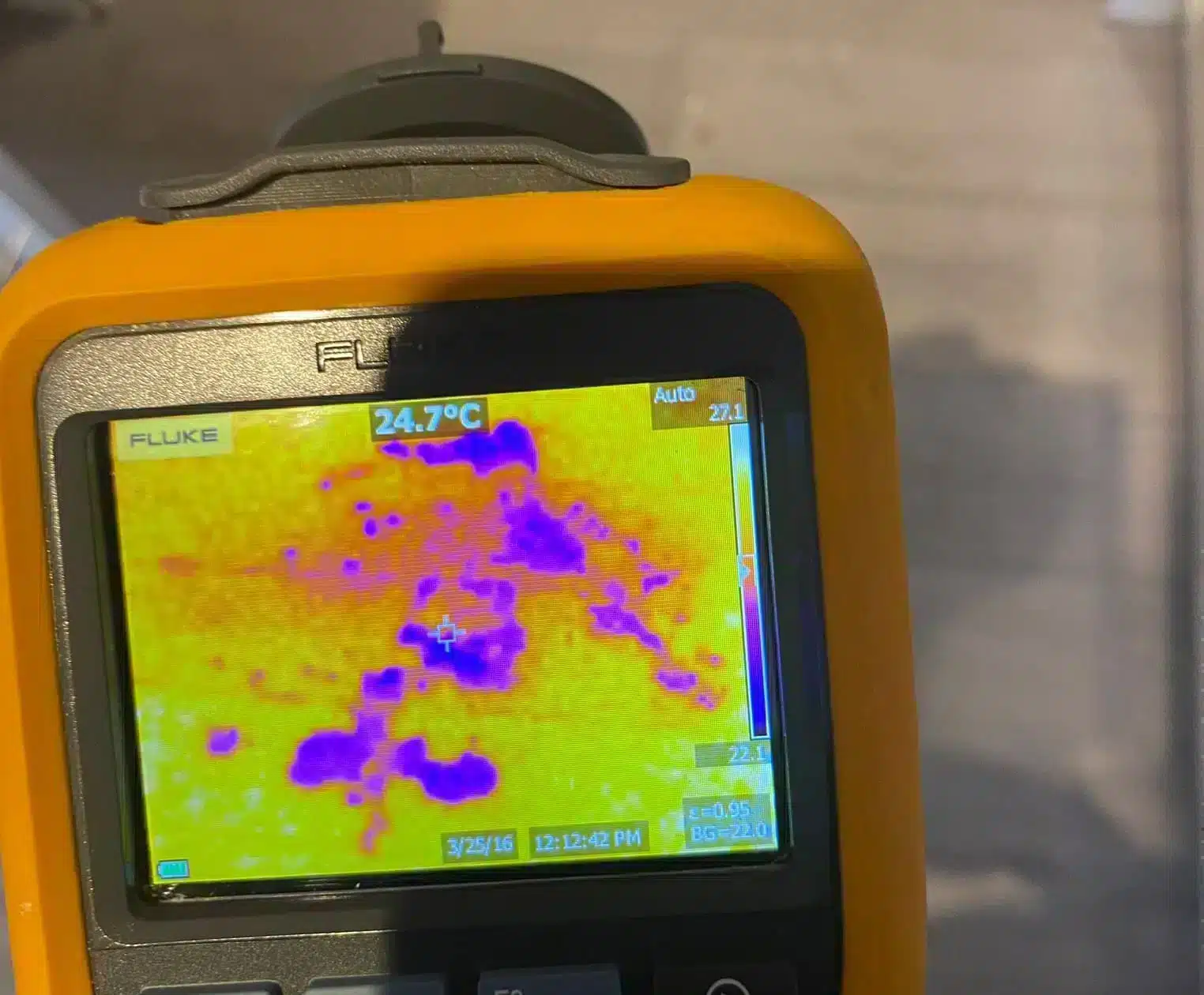
Reading the thermal signature of a hidden leak
A thermal imaging survey doesn't need the floor lifted first. The camera scans the surface and picks up the warm trail a leaking heating pipe leaves behind, letting us confirm the fault's rough position before deciding where, if anywhere, access needs to be opened up.
When to call in a specialist
If pressure keeps dropping after two or three repressurising attempts, or if you've checked every visible joint and radiator without finding a source, it's time to bring in a leak detection specialist rather than keep guessing. Lifting floors on a hunch is expensive and often wrong. A proper survey, whether that's central heating leak detection using thermal imaging or tracer gas, narrows the fault to a specific pipe run or joint before anyone opens anything up.
This matters even more where a system feeds underfloor heating, since access to those pipes is far harder and more disruptive than a standard radiator circuit. Getting the location right the first time keeps the repair, and the mess, to a minimum.
Frequently Asked Questions
Most combi boiler systems should hold a cold pressure of around 1 to 1.5 bar. If the gauge drops well below this within days of repressurising, or you're topping up repeatedly, that pattern usually points to a leak somewhere in the sealed circuit.
Yes. A slow leak under a floor or behind a wall can soak into timber or plaster for months before it shows on a visible surface, often appearing first as a musty smell, a warm patch, or discoloured skirting rather than standing water.
Microbore pipework, common in Scottish homes with older heating upgrades, corrodes from the inside over time and a pinhole leak can develop with very little visible warning. Sludge and inhibitor levels affect how quickly this happens.
Thermal imaging reads the warm trail a leaking pipe leaves on the surface above it, and tracer gas can be introduced into a drained system to pinpoint the exact escape point. Both narrow the search before any floor or wall is opened.
An occasional top-up, maybe once or twice a year, is generally normal. Needing to repressurise every few weeks is not, and points to water escaping somewhere in the system rather than natural pressure settling.
Yes, boiler pressure loss doesn't always mean a pipe leak. Internal boiler components, such as the expansion vessel or a seal, can also fail. Check our guide on boiler fault codes and low pressure if the boiler itself is showing an error alongside the pressure drop.
📍 Professional Leak Detection Across Scotland
Don't let a small drip become a big repair bill
A hidden central heating leak only gets worse the longer it runs. Our surveys pinpoint the source using thermal imaging and tracer gas, then hand you a clear report before any work starts.