

No, thermal imaging cannot see through walls. It reads the surface temperature of whatever is in front of the camera, not what's inside or behind it. What it can do is spot temperature changes on a wall or ceiling surface caused by water, damp or a leaking pipe underneath, which is how it gets used to find hidden leaks without any actual X-ray vision involved.
In This Guide
Where the "X-ray vision" idea comes from
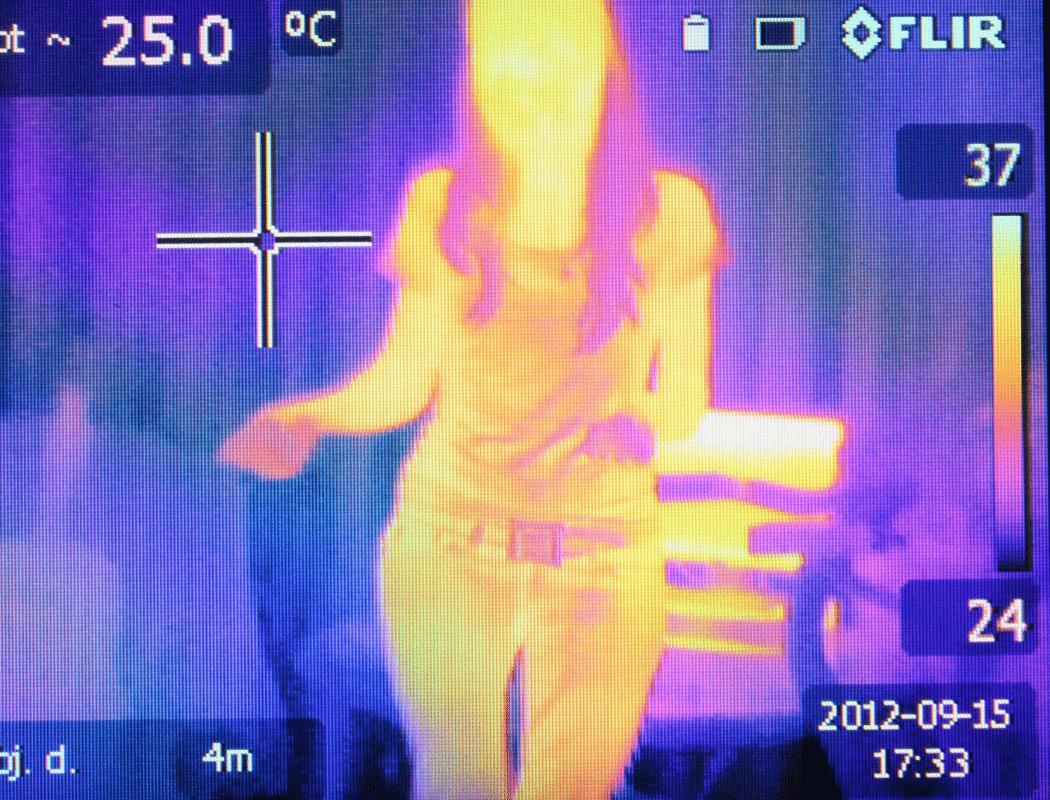
Thermal cameras look impressive on screen. A wall that looks perfectly normal to the eye suddenly shows a bright streak or a dark blob once the camera is switched on, and it's easy to assume the camera is somehow looking through the plaster to the pipe underneath. It isn't. Film and television haven't helped either — heat-vision goggles that reveal a person hiding behind a solid wall are a special-effects trick, not how infrared cameras behave in the real world.
The actual explanation is simpler and, honestly, still useful. A thermal camera detects heat radiating from a surface. If something behind that surface changes its temperature, the surface itself often changes temperature too, and that's what the camera picks up.
What a thermal camera actually detects
Every object above absolute zero gives off infrared radiation, and the amount depends on its temperature. A thermal imaging camera has a sensor tuned to that infrared band, and it converts what it detects into a visual image, usually shown as a colour gradient from cool to warm.
Point the camera at a wall and you get a map of that wall's surface temperature, nothing more. If the wall is uniform, dry and well insulated, the image looks flat and even. If something is going on behind it, warmer or cooler than the surrounding material, the surface temperature shifts enough for the camera to register a pattern.
Reading the pattern, not the pipe
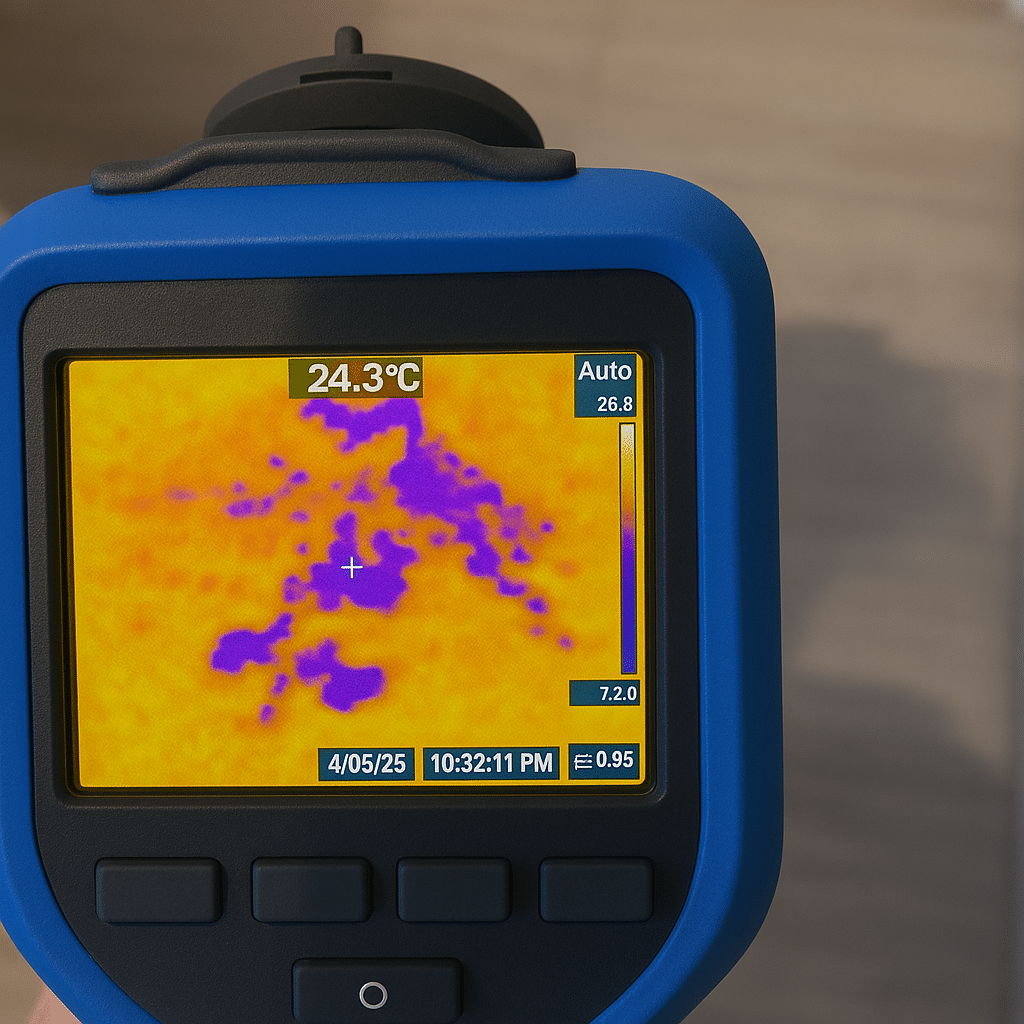
What shows on the display is a heat pattern on the surface, not an outline of the pipe itself. A trained eye reads the shape, the edges and how it compares to the surrounding wall to work out what's likely causing it.
How wet surfaces betray hidden pipes
Water is very good at moving heat around. A pipe leaking into a wall cavity soaks the plaster or insulation nearby, and wet material loses heat faster than dry material sitting next to it. That creates a cooler patch on the surface, roughly tracing the shape of the wet area behind it.
The same principle works with warm pipes. A leaking hot water pipe or a central heating pipe under a floor can create a warm patch on the surface above it, which is often easier to spot than a cold patch because it stands out more clearly against a room-temperature floor.
This is the entire basis of thermal imaging leak detection: not looking through the wall, but reading what the leak is doing to the surface in front of the camera.
What a genuine leak signature looks like
A real leak usually produces an irregular patch with a clear edge, often trailing downward with gravity, and it tends to sit near a known pipe run, joint or fitting rather than in a random spot on the wall.
Where thermal imaging hits its limits
Because the camera only reads the surface facing it, anything that stops heat reaching that surface cleanly limits what shows up. A thick stone or granite wall, common in older Scottish tenements, can absorb enough heat change from a leak behind it that very little reaches the visible surface. The same goes for a wall with a cavity, where trapped air acts as a buffer.
Distance from the source matters too. A pipe running centrally through a thick wall might not affect either surface enough to register, while a pipe close to the surface shows up clearly.
A thermal camera showing nothing does not mean there's no leak. It means the surface in front of the camera isn't showing a detectable temperature change, which is a different thing entirely.
Insulation and thick walls
Insulation is designed to stop heat moving, which is exactly what makes it awkward for thermal detection. A well-insulated cavity wall can mute the temperature signature of a leak enough that it takes longer to build up on the visible surface, especially with a slow drip rather than a steady leak.
This is one reason a single thermal pass isn't always enough. We sometimes recheck an area after a period of time, or combine the scan with a moisture meter reading, covered in more detail in our guide comparing thermal imaging and moisture meters.
Reflective surfaces and false readings
Glass, polished tile, chrome fittings and some painted surfaces reflect infrared from elsewhere in the room instead of showing their own true temperature. Point a thermal camera at a mirror or a shiny worktop and you might see a reflection of your own body heat or a nearby radiator, not the actual surface temperature of that object.
This is why we always check what a surface is made of before reading too much into a thermal pattern. A cold-looking patch on a glazed tile splashback is far more likely to be a reflection than a leak.
Why training matters more than the camera
Two people can point the same camera at the same wall and reach different conclusions. Knowing which patterns are draughts, reflections or pipe runs, and which are genuine leak signatures, comes from doing this job repeatedly, not from the equipment alone.
Got a cold or warm patch you can't explain
We combine thermal imaging with moisture meters and acoustic tools so a pattern on a screen gets confirmed properly before any wall gets opened.
What actually finds a leak behind a wall
Since thermal imaging can't see through the wall itself, professional leak detection stacks several methods together rather than relying on one. A thermal scan flags a likely area. A moisture meter confirms whether it's actually wet. Acoustic listening equipment can pick up the sound of water escaping a pressurised pipe, and tracer gas, a safe mix of hydrogen and nitrogen pushed through the pipe, can be traced at the surface with a sensitive probe when the leak point still isn't clear.
What thermal imaging is good at
- Scanning a large wall, floor or ceiling quickly
- Spotting patterns invisible to the naked eye
- Working without opening plaster or lifting floors
What it can't do
- See through thick stone, granite or cavity walls reliably
- Confirm water content on its own
- Ignore reflections from glass or shiny surfaces
We see this most weeks on tenement surveys, where a thick stone external wall shows almost nothing on camera while the leak is very real, just a few centimetres too far from the visible surface. That's when acoustic or tracer gas methods take over from the camera.
Frequently Asked Questions
No. Thermal cameras read surface temperature, not what's behind a wall. Thick brick, stone or granite walls can absorb so much of a leak's temperature signature that little or nothing shows on the visible surface, even though a leak is present.
There's no fixed depth, because it depends on the wall material, insulation and how much the leak has changed the surface temperature. A leak close to a thin plasterboard surface shows up far more easily than one behind thick stone or a well-insulated cavity.
Glass and other reflective surfaces often show a reflection of infrared from elsewhere in the room, rather than their own true temperature. This is a known limitation of thermal imaging and isn't usually a sign of a leak.
Because a leak changes the temperature of the surface directly above or around it, even without seeing through the wall. That surface change is what the camera picks up, and it's often enough to narrow down a search area before other tools confirm the exact spot.
It can flag a temperature difference, but consumer-grade attachments generally have lower resolution and sensitivity than professional equipment, making it harder to tell a genuine leak signature from a draught, insulation gap or reflection.
Yes, the same principle applies. A leak above a ceiling changes the surface temperature of the ceiling below it, showing as a cool or warm patch, though gravity often means the pattern trails toward the lowest point of the affected area.
📍 Professional Leak Detection Across Scotland
Don't let a small problem become a big one
Our surveys pair thermal imaging with moisture meters, acoustic listening and tracer gas, then back it up with an insurance-approved report.