

Office leak detection carried out out-of-hours, in the evening or over a weekend, finds hidden leaks in ceiling voids, server rooms and washroom risers before staff arrive, without disrupting the working day. Non-invasive methods like thermal imaging and acoustic detection let a facilities manager confirm a suspected leak, or run a preventative check, with desks dry and IT untouched by the time the office reopens.
In This Guide
Why offices are exposed at the wrong times
Office leak detection is a different problem to a domestic leak, mostly because of timing. A house is occupied most evenings and weekends, so a leak tends to get noticed within hours. An office can sit empty from six on a Friday evening until eight on a Monday morning, which gives a small leak sixty-two hours to run unchecked before anyone is even in the building to see it.
By the time the first person arrives on Monday, water has often tracked through a ceiling void, run down into a floor below, or pooled under raised flooring near cabling. What would have been a five-minute fix on Friday afternoon becomes a full drying-out job, a disrupted working week, and in the worst cases, damaged equipment.
The server room risk
Server rooms and comms cabinets are usually the highest-value risk in any office leak, because water and electronics do not mix, and downtime for a business system is rarely just an inconvenience. Server rooms often sit near washrooms, kitchens or plant rooms sharing the same floor plate, purely for pipework convenience when the building was designed, and that proximity means a leak two rooms away can still find its way to the one room you can least afford to flood.
If a server room shares a wall, floor or ceiling void with a washroom, kitchen or plant room, treat it as a leak risk worth checking proactively rather than waiting for a fault alarm. The cost of a preventative survey is small next to the cost of unplanned IT downtime.
Ceiling voids and suspended ceilings
Most offices run pipework, cabling and ventilation through a void above a suspended ceiling. That void is exactly where slow leaks like to hide, because water can travel a considerable distance sideways along a ceiling tile or cable tray before it finds a gap and drips down, meaning the wet patch on the ceiling tile is not necessarily above the actual leak.
Why this matters for open-plan offices
An open-plan floor with a shared ceiling void means a leak above one desk can show up as a stain three desks away, or not show up at all until the void has filled enough to overflow at the nearest low point. Thermal imaging is particularly useful here, since it can scan a wide area of ceiling in one pass rather than requiring tiles to be lifted speculatively.
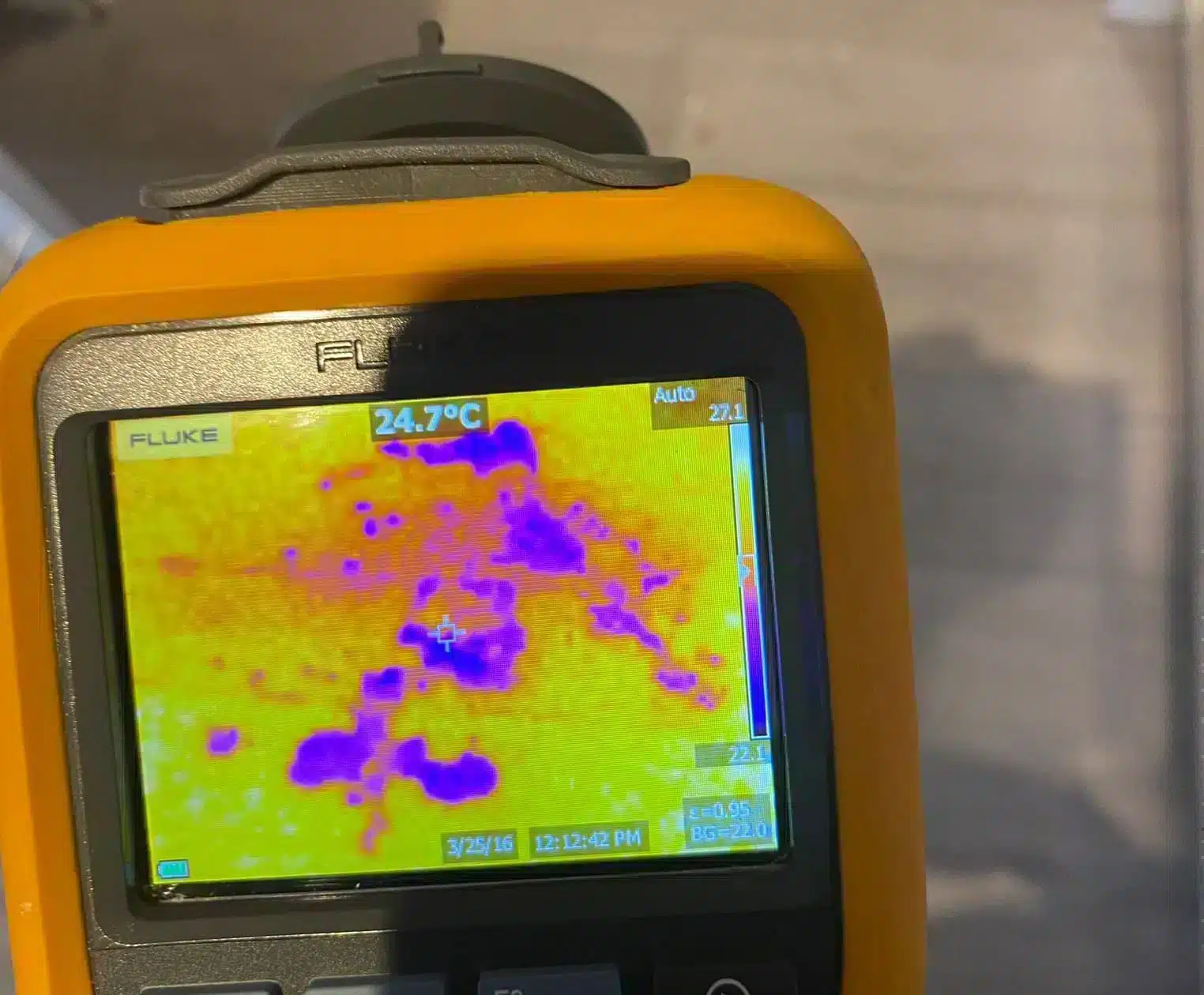
Scanning while the office is empty
An out-of-hours survey like the one shown here lets us scan ceiling voids, risers and plant areas without moving furniture around working staff or disrupting meetings. It also means any tiles that do need lifting for a closer look can be put back before anyone notices they were ever moved.
Why out-of-hours surveys make sense
Booking a survey for evenings or weekends solves two problems at once. It removes the disruption of engineers working around desks, meetings and foot traffic during the day, and it means any repair work identified can often be scheduled and completed before the next working day begins.
- No disruption to staff. Surveys run when desks are empty, with no need to relocate people or pause meetings.
- Faster access to risky areas. Server rooms, plant rooms and ceiling voids can be checked without working around live equipment in use.
- Quicker turnaround. Same-day capability means a Friday evening survey can identify a problem in time for a contractor to start first thing Saturday.
- Insurance-ready documentation. A written report supports any facilities budget sign-off or insurance claim that follows.
Protect your office before the next Monday morning surprise
We run evening and weekend surveys across offices in Scotland, using thermal imaging and acoustic detection to check ceiling voids, server rooms and washroom risers with zero disruption to your working week.
What an out-of-hours survey involves
1. Scoping call
We agree access arrangements, priority areas like server rooms, and any parts of the building that need particular care, before the survey date.
2. Thermal and acoustic scan
A full pass of ceiling voids, risers, plant rooms and washroom areas, using thermal imaging to spot temperature anomalies and acoustic detection to listen for pressurised pipe leaks behind walls.
3. Confirmation testing where needed
Where a suspect area needs confirming, tracer gas testing pinpoints the exact leak location without opening up ceilings or walls speculatively.
4. Report before opening time
You get a written, insurance-approved report setting out what was found, so facilities and any contractor booked for repair work know exactly where to go.
A facilities manager’s checklist
If you manage a commercial building, a short list of habits catches most leaks before they become a Monday morning problem.
| Check | Why it matters |
|---|---|
| Walk the ceiling void near server rooms quarterly | Spots staining or corrosion on cable trays before a full leak develops |
| Note any weekend fault alarms from BMS or fire systems | Water ingress can trigger unrelated alarms, an early warning sign |
| Book a survey before planned building closures | Confirms the building is leak-free before an extended empty period |
| Keep a record of past leak locations | Repeat leaks in the same run often point to an ageing section of pipe |
Offices that share a building with other tenants add another layer, particularly where a leak could affect a floor below occupied by a different business. Our guides on leak detection for hotels and guest houses and leak detection for schools and campuses cover similar out-of-hours logic for other commercial settings with the same empty-building risk.
Weekend surveys versus emergency call-outs
An emergency call-out, arriving after a leak has already caused visible damage, is a different job to a scheduled out-of-hours survey booked in advance. Both have their place, but a scheduled survey is the cheaper and calmer option whenever you have any reason to suspect a problem, whether that is a recent renovation, an ageing pipe run, or simply a building due to stand empty over a holiday period.
Scheduled out-of-hours survey
- Planned around your calendar, no urgency premium
- Catches slow leaks before damage occurs
- Ideal before extended closures or refurbishments
Emergency call-out
- Needed once damage or a fault alarm is already visible
- Focused on stopping active damage, not prevention
- Same-day response, but reacting rather than getting ahead
Whichever route applies to your building, our commercial leak detection service covers both scheduled and emergency work across office buildings of any size in Scotland.
Frequently Asked Questions
Yes, this is the main reason out-of-hours surveys exist for commercial buildings. Evening and weekend appointments let us access ceiling voids, server rooms and washrooms without disrupting staff, meetings or day-to-day operations.
Server rooms often share a floor, wall or ceiling void with washrooms, kitchens or plant rooms purely due to building layout. Water reaching electronic equipment risks costly downtime, so a proactive check is worth far more than the cost of the survey itself.
Thermal imaging scans a wide area of the ceiling in one pass, showing temperature anomalies that suggest moisture. This narrows the search considerably before any tiles are lifted, and tracer gas testing can confirm the exact spot if the picture needs clarifying.
Same-day capability means an evening or weekend survey can often be arranged with short notice, particularly useful if a fault alarm or suspected leak is spotted late on a Friday and needs checking before the working week resumes.
A preventative survey before a planned closure, refurbishment or ageing pipe replacement is good practice, particularly for server rooms or buildings that will stand empty for an extended period. It is far cheaper than an emergency response after the fact.
No. Thermal imaging and acoustic detection are non-invasive and do not require powering down or touching live equipment. Any confirmation testing on suspect pipework near IT areas is planned around the equipment, not through it.
You receive a written, insurance-approved report detailing what was found and where, which supports facilities budget approval, insurance claims, and gives any contractor booked for repairs a clear starting point.
📍 Professional Leak Detection Across Scotland
Book a survey around your working week, not against it
Don’t let a small problem become a big one. Our out-of-hours commercial surveys are non-invasive and give you a same-day, insurance-ready report before your team is back at their desks.