

A leak under a shared driveway usually means a single supply pipe serving two or more properties has failed underground. According to Citizens Advice Scotland, owners of a shared pipe share responsibility for repairs, split according to the title deeds, or the statutory Tenement Management Scheme where deeds are silent. Non-invasive detection finds the exact point of failure first, which then shows which section, and often which owner, the leak actually falls under.
In This Guide
Why shared driveway pipes cause disputes
A shared driveway leak sits at the intersection of two problems people generally do not enjoy: unexplained water loss and an unclear bill. Two or more properties often share a single supply pipe running under a driveway, particularly in older developments and semi-detached or terraced properties built before individual supplies became standard practice. When that pipe fails, working out who is responsible is rarely as simple as pointing at whoever’s driveway the wet patch appears on.
The wet patch itself can be misleading. Water travelling underground follows the path of least resistance, not necessarily a straight line from the failure point to the surface. A leak might show up on one owner’s section of driveway while the actual failure sits under the neighbour’s half of the pipe entirely.
Who is responsible under Scots law
According to Citizens Advice Scotland, Scottish Water is responsible for mains pipes up to the property boundary, and the property owner is responsible for pipes within the boundary, from the boundary or stopcock into and through the home. Where a single pipe serves more than one property, as is common with shared driveways, both owners share responsibility for maintaining it.
How the cost of a repair splits between owners depends first on the title deeds. If the deeds set out how a shared pipe’s costs should be divided, that agreement governs. Where the deeds are silent on the point, the statutory Tenement Management Scheme steps in to provide a default split, according to Citizens Advice Scotland.
If a leak is wasting water and an owner ignores it, Scottish Water can send a warning letter and, according to Citizens Advice Scotland, can obtain a warrant from a Justice of the Peace to force entry after 24 hours and repair the leak itself, then bill the owner for the work. Ignoring a known shared-pipe leak is not a neutral option.
Checking the title deeds first
Before any repair conversation with a neighbour gets difficult, it is worth finding out exactly what the title deeds say about the shared pipe. Deeds for older properties sometimes include a specific clause dealing with shared services, water, drainage, occasionally shared driveways themselves, and that clause can save weeks of back-and-forth about who owes what.
If the deeds are silent, the Tenement Management Scheme applies by default in tenement contexts, and similar shared-cost principles tend to apply to other shared-pipe arrangements even outside a tenement close specifically. A solicitor can confirm exactly how the scheme applies to your specific deeds if the position is not obvious from a read-through.
How detection identifies the exact section
This is where leak detection earns its place in a dispute rather than just a repair. A confirmed, precise location for the failure, backed by a report, takes the argument out of guesswork about whose side it is on and replaces it with an exact position relative to the boundary or the midpoint of the shared pipe run.
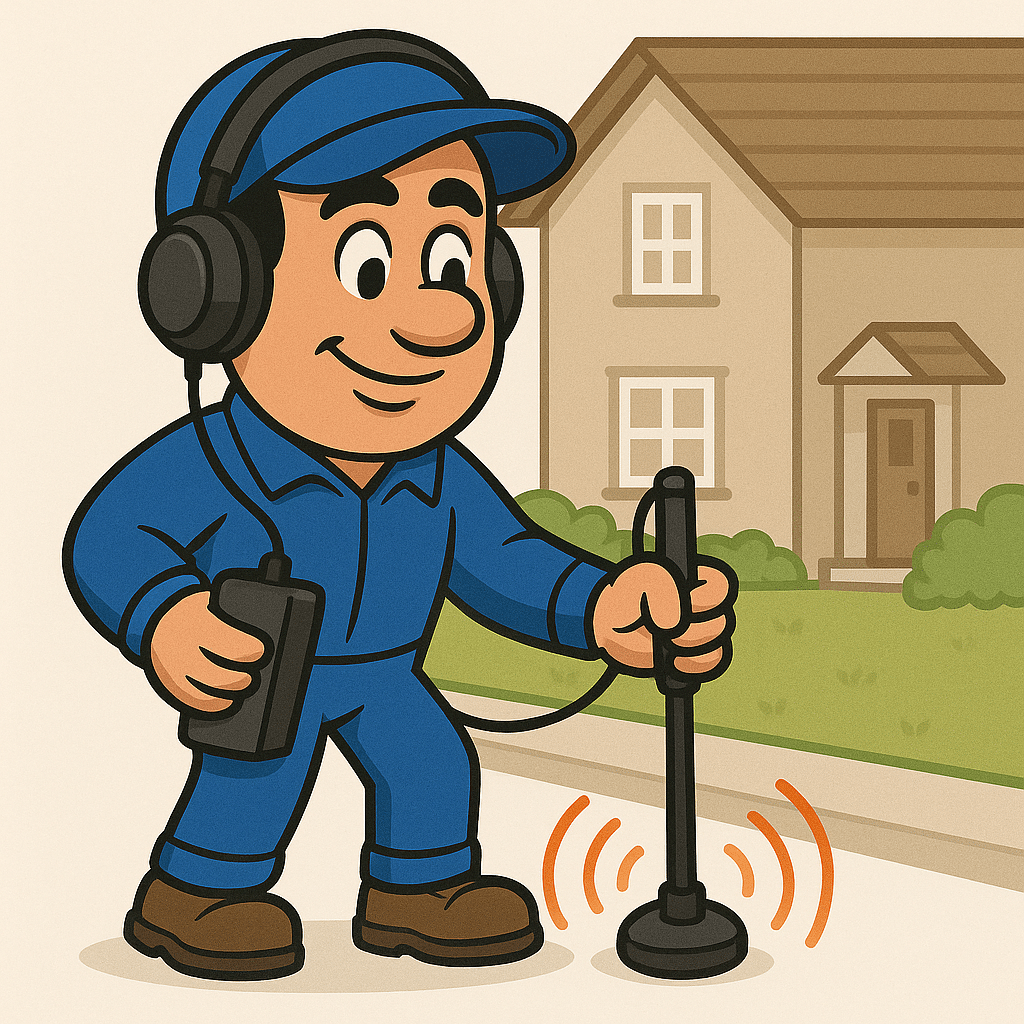
Listening for the leak along the pipe run
Acoustic listening equipment picks up the distinct sound a pressurised leak makes as it escapes underground, and an engineer can move along the driveway pinpointing where that sound is loudest. Combined with knowledge of where the pipe crosses the property boundary, that gives a specific, defensible answer to which section the leak sits in.
Non-invasive methods matter enormously here, because nobody wants to dig up half a shared driveway on a guess, only to find the failure was ten feet further along under the neighbour’s section entirely. Our underground water leak detection service uses acoustic listening and, where needed, tracer gas to locate the failure point before any digging starts, which avoids unnecessary excavation on either side.
If the leak sits on the supply side closer to the street rather than between the properties themselves, it is worth also reading about who fixes a leak between the meter and your house, since that is a related but distinct responsibility question.
Water loss under a shared driveway you cannot explain?
A precise, documented location for the leak makes splitting the cost with a neighbour far easier than guesswork. Our non-invasive surveys pinpoint exactly where a shared pipe has failed, without unnecessary digging.
Splitting the cost fairly
Once the failure point is confirmed, cost-splitting usually follows one of a few patterns. If the leak sits clearly on one owner’s exclusive section of pipe, past the point where the shared section ends, that owner typically covers the repair alone. If the failure sits within the genuinely shared section, the title deeds or Tenement Management Scheme default usually points to an equal split, or a split proportional to whatever the deeds specify.
| Leak location | Typical cost responsibility |
|---|---|
| Within one owner’s exclusive pipe section | That owner alone |
| Within the genuinely shared section | Split per title deeds or Tenement Management Scheme |
| Detection and survey costs | Often shared, or agreed case by case between owners |
Specialist leak detection firms across the UK typically publish prices between about £500 and £1,500 depending on the job, so agreeing upfront how a survey’s cost will be split, alongside the repair itself, avoids a second dispute once the first is resolved.
When a neighbour will not engage
Honestly, the hardest part of a shared driveway leak is rarely the plumbing, it is getting a neighbour to take the problem seriously when there is a bill attached. A written, dated survey report showing exactly where the leak sits removes a lot of the prove-it back-and-forth that stalls these situations for months.
If a neighbour still will not engage despite clear evidence, and the leak is genuinely wasting water rather than just running up costs, reporting it to Scottish Water on their 24/7 leak line, 0800 077 8778, brings a third party into the picture. Continued inaction can eventually lead to the warrant and forced-entry process described earlier, which tends to concentrate minds.
Where a factor manages the property or development, involving them early is usually worthwhile too. Many shared driveway arrangements sit within a wider factored development, and a factor often has both the authority and the existing relationship with all owners to broker a resolution faster than two neighbours negotiating directly.
Reporting and next steps
If you suspect a shared pipe leak, start by reporting it. Scottish Water’s 24/7 leak line, 0800 077 8778, is the right first call if you are not sure whether the leak is on the mains side or your shared supply. If it becomes clear the leak sits on your side of the boundary, arranging a survey to confirm the exact location before contacting your neighbour puts you in a much stronger position for that conversation.
- Check the title deeds first. They may already set out exactly how costs should split.
- Get a precise location before talking to your neighbour. A documented survey removes guesswork from the conversation.
- Report to Scottish Water if unresolved. Their 24/7 line is 0800 077 8778.
- Involve a factor early if one exists. They can often mediate faster than two owners alone.
Our guide to how to find a water leak underground covers the detection methods in more depth if you want to understand the process before booking a survey.
Frequently Asked Questions
According to Citizens Advice Scotland, owners sharing a supply pipe share responsibility for its maintenance. How repair costs split between them depends on the title deeds, or the statutory Tenement Management Scheme where the deeds do not specify.
Check your property’s title deeds, which often describe shared services including water pipes. If the position is unclear, a solicitor can review the deeds, or a leak detection survey can help confirm the pipe’s actual route and connections.
Yes. Acoustic listening and tracer gas methods locate the precise point where a pipe has failed. That position, checked against the property boundary or the shared pipe’s midpoint, gives a documented basis for deciding responsibility.
Start with a documented survey report to remove any doubt about the leak’s location. If a neighbour still will not engage, involving a factor if one exists, or reporting continued water waste to Scottish Water, can help move things forward.
No. Non-invasive methods such as acoustic listening and tracer gas locate the leak’s position before any digging starts, so only the confirmed section of driveway needs to be opened up for the repair itself.
Yes, particularly if you are unsure whether the leak sits on the mains side or the shared supply. Scottish Water’s 24/7 leak line, 0800 077 8778, can advise, and reporting also creates a record if the leak needs escalating later.
📍 Professional Leak Detection Across Scotland
Get an exact answer before splitting the bill
Don’t let a small problem become a big one. Our non-invasive surveys confirm exactly where a shared driveway leak sits, with insurance-approved reports to support a fair conversation with your neighbour.