

A leak between meter and house sits on the property owner's side of the boundary, so the repair is your responsibility, according to Citizens Advice Scotland. Scottish Water is only responsible for the mains pipe up to the boundary. Metered businesses can apply for a leak allowance from their water retailer once the leak is fixed. Non-invasive detection finds the exact spot first, often avoiding a full trench dig.
In This Guide
The boundary rule explained
The most common question about a leak between meter and house is simply: is this mine to fix? According to Citizens Advice Scotland, Scottish Water is responsible for the mains pipe up to the property boundary. From that boundary, or the stopcock, into and through the home, responsibility for the pipe sits with the property owner.
That means a leak on the supply pipe running from the meter (which often sits at or near the boundary) to the house is almost always on your side of that line. Scottish Water won't repair it, and the cost, and usually the job of finding it, falls to you as the owner.
Signs the leak is on your side
A few signs point specifically to this section of pipe rather than a fault inside the house or on the Scottish Water main itself.
- A positive water meter test, where the meter still moves with every tap and appliance in the house switched off.
- A wet or soft patch of ground tracing the likely line between the meter box and the house, rather than near a specific internal fixture.
- A pressure drop indoors with no obvious internal cause, such as a recently fitted fixture or a known internal leak.
- An unexplained rise in usage for metered customers, without a change in how much water is actually being used inside.

Starting with the meter itself
Checking the meter with everything off is the simplest way to confirm water is escaping somewhere in the system. It won't tell you exactly where along the run the fault sits, but it's the starting point before any further investigation.
Why this pipe run is easy to miss
The section between a meter and a house is often the most neglected part of a property's plumbing, simply because nobody looks at it. It's buried, it's usually outside the boundary of what a plumber checks during routine work indoors, and unless the meter box itself is flooding, there's rarely a visual clue above ground.
Rural and larger properties feel this more than most. A long supply run from a meter near the road to a farmhouse or cottage set well back from it means more buried pipe, more potential joints, and more distance for water to travel sideways through soil before it ever reaches a surface where you'd notice it.
Business and metered properties
Most Scottish households pay for water through council tax rather than a meter, so this exact scenario, a leak between meter and house, most often comes up for businesses and other metered non-household customers. If your water bill has jumped and you're on a meter, this stretch of pipe is one of the first places worth checking.
Business Stream, which supplies retail water services to non-household customers in Scotland, runs a leak or burst allowance process for metered customers. The leak has to be repaired first, meter readings taken roughly a week apart, and a repairer's report supplied; if approved, the wholesaler grants an allowance for the excess water lost. Confirming the leak and getting it properly documented matters here, since that report is what supports the claim.
Don't ignore a suspected leak on this pipe run because it's outside. Left unfixed, it wastes water continuously and can undermine paths, driveways or foundations nearby over time, and Scottish Water can act against wasteful leaks that are ignored.
Confirming the exact location
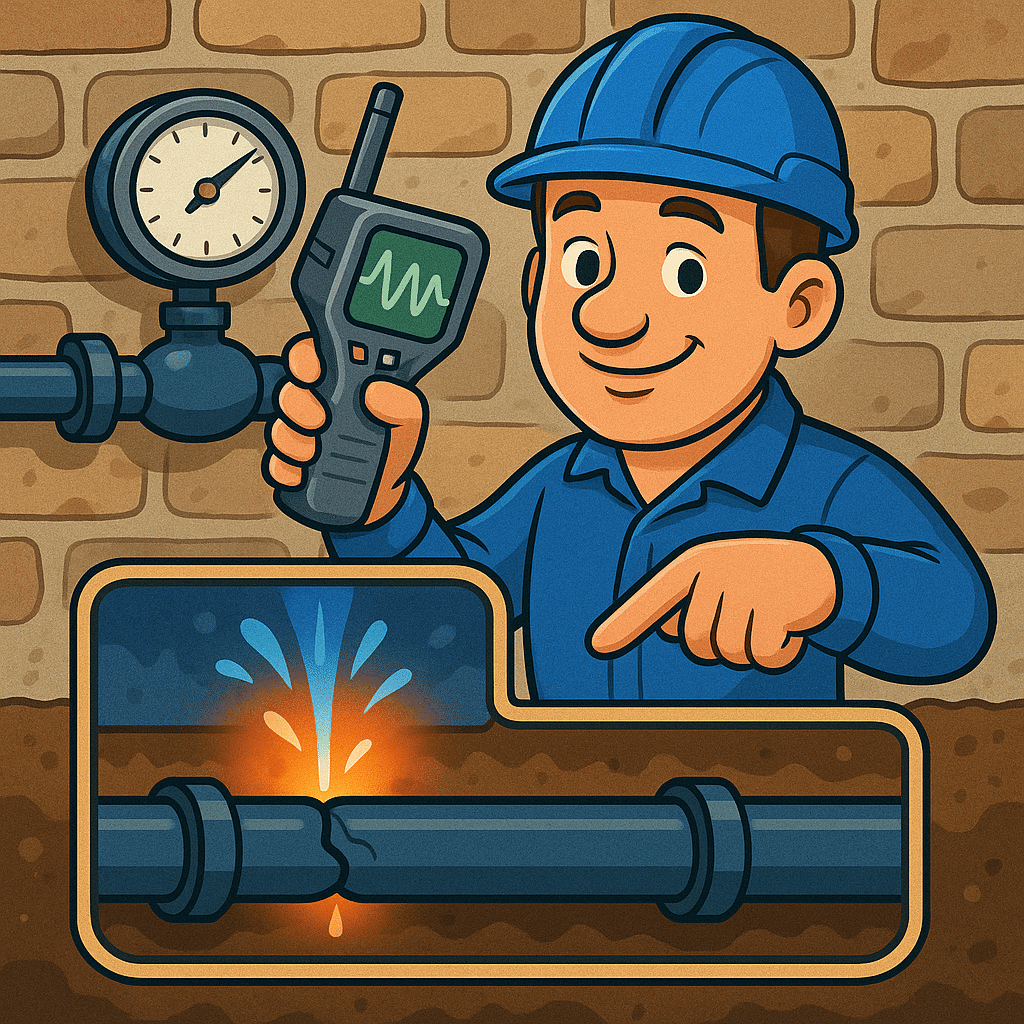
Once you know the leak is likely on this stretch of pipe, the next question is exactly where. Acoustic listening equipment picks up the sound of water escaping under pressure and narrows the search along the pipe run. Where the pipe is deep, or background noise makes acoustic listening unreliable, tracer gas is introduced into the pipe instead: a safe mix of 5% hydrogen and 95% nitrogen that rises through soil and gets picked up by a sensitive detector directly above the fault.
Our full guide on how to find a water leak underground walks through both these methods and the DIY checks worth trying first, and applies directly to this section of pipe.
What a confirmed fault looks like
Once tracer gas or acoustic listening has narrowed the fault to a specific point, any excavation is targeted rather than exploratory. That matters most on a long meter-to-house run, where digging blind could mean opening up metres of driveway or garden unnecessarily.
Moling: fixing it without a full trench
Once the leak is confirmed, the repair doesn't always mean digging a full trench along the pipe's entire length. Moling is a technique where a new pipe is pulled through the ground using a small entry and exit pit, guided underground rather than dug up along the whole route. It works well for replacing a failed supply pipe between a meter and a house, particularly under driveways, patios or established gardens where a full trench would mean significant reinstatement work afterward.
Whether moling is suitable depends on ground conditions, existing services nearby, and the exact pipe route, which is part of why confirming the leak's location precisely first matters. Guessing at a route and moling blind risks hitting other buried services.
What to do once it's confirmed
With the leak located, you've got a clear decision to make: repair or replace that section of pipe. For an older or corroded supply pipe, especially in older Scottish properties where lead or aging pipework may be present, a full replacement of the affected run is often the more sensible long-term option rather than a single-point repair.
Our underground water leak detection service covers this whole process, from initial confirmation through to a clear, insurance-approved report you can hand to whoever carries out the repair. Where the fault might actually be closer to the mains than your own supply, our water mains leak detection team can confirm which side of the boundary the problem sits on.
Suspect a leak between your meter and your house?
We'll confirm exactly where the fault is using acoustic listening or tracer gas, so any repair work is targeted rather than a guess.
Frequently Asked Questions
The property owner is. Scottish Water is only responsible for the mains pipe up to the boundary, according to Citizens Advice Scotland. From the boundary or stopcock into the home, the pipe and any leak on it are the owner's responsibility.
A positive water meter test with everything off, a wet patch tracing the line between the meter and the house, or a pressure drop with no internal cause all point to a leak on your side. A survey can confirm exactly where the fault sits.
Only if you're a metered customer, typically a business. Business Stream and other retailers run a leak or burst allowance process: repair the leak first, take meter readings about a week apart, and supply a repairer's report to apply.
Not necessarily. Acoustic listening and tracer gas narrow the fault down to a specific point first, so any digging is targeted. Moling can then often replace the pipe through small entry and exit pits rather than a full trench.
Moling pulls a new pipe through the ground using small pits at either end, avoiding a full trench along the pipe's route. It's commonly used to replace a failed supply pipe between a meter and a house, especially under driveways or gardens.
Not with the repair cost. If an owner ignores a leak that's wasting water, Scottish Water can send a warning letter and, after 24 hours, get a warrant to force entry and carry out the repair itself, then bill the owner for the work.
Most surveys on this type of pipe run are completed in a single visit, combining a meter check with acoustic listening and, where needed, tracer gas, to give a confirmed location before the engineer leaves.
📍 Professional Leak Detection Across Scotland
Get your meter-to-house pipe checked properly
Non-invasive detection confirms the exact fault on your supply pipe, with insurance-approved reports available where you need one for a claim.