
A boiler keeps losing pressure when water is escaping the sealed heating circuit somewhere, or when a component like the pressure relief valve or expansion vessel is faulty. Normal pressure is typically 1 to 1.5 bar when cold. If you're topping up every week or two, treat it as a sign of a leak, not routine maintenance.
In This Guide
What normal boiler pressure looks like
Most combi boilers run at somewhere between 1 and 1.5 bar when the heating is cold, with the gauge climbing a little once the system heats up. That's the range manufacturers design for, and it's printed on most boiler casings or in the manual if yours isn't marked clearly.
A boiler that keeps losing pressure is dropping below that range repeatedly, not just once after a service or a radiator bleed. One drop after bleeding a radiator is normal. A drop every week, with no obvious cause, is not.
Honestly, most of the time it's the filling loop left slightly open, but it's worth ruling that out properly before assuming the worst.
Check the filling loop first
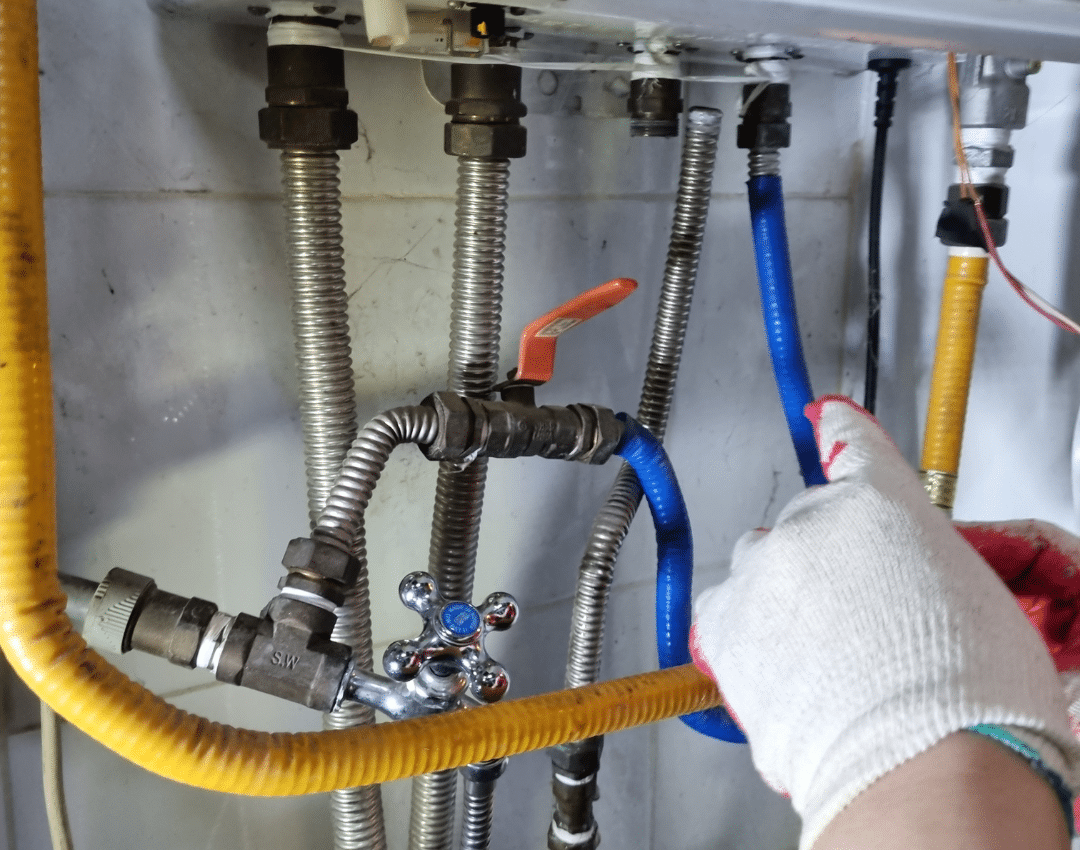
The filling loop is the braided hose that connects your mains water to the heating system, usually with two taps. If it's left even slightly open, or the valve doesn't seal fully, water bleeds into the system slowly and the pressure climbs and falls in an odd pattern rather than dropping steadily.
Common causes of pressure loss
There are a handful of usual suspects behind a boiler that won't hold pressure. Working through them in order saves calling out an engineer for something you can rule out yourself in five minutes.
- Filling loop not sealed properly, letting water trickle into the system
- A leak somewhere in the sealed heating circuit, pipework, radiators or valves
- A faulty pressure relief valve letting water escape, often via an external overflow pipe
- A failed expansion vessel, which can't absorb pressure changes correctly as water heats and cools
- A leaking radiator or valve, sometimes visible, sometimes not
Radiator valves are worth checking directly. A drip at a valve or joint is one of the easiest causes to rule out before assuming the leak is buried somewhere less accessible.
Is it a fault or a leak
A faulty part usually causes a fairly predictable pattern, pressure rising too high when heating, or dropping the same amount each time in a way that matches a known symptom. A leak tends to be less predictable and gets gradually worse over weeks.
Signs it's a fault
- Pressure climbs too high on heating (see our guide on boiler pressure too high)
- Water visibly dripping from a valve or pipe
- Consistent, predictable drop after each top-up
Signs it's a hidden leak
- No visible water anywhere
- Drop gets gradually worse over weeks
- Warm patches on flooring or damp on a wall near pipework
If you're seeing warm patches on the floor alongside the pressure drops, that combination points fairly strongly towards a leak in the pipework rather than a part wearing out. Our article on detecting a central heating leak covers the signs in more depth.
Combi versus system boilers
The diagnosis is broadly the same whichever type you have, but the plumbing around each differs slightly. A combi boiler heats water on demand and holds the whole heating circuit under sealed pressure, so any leak in that circuit shows up as a pressure drop fairly quickly. A system boiler works with a separate hot water cylinder, which adds more pipework and joints where a slow leak can develop, and sometimes hides a drop behind the cylinder's own header tank rather than showing on the boiler gauge straight away.
Either way, the underlying rule holds: a genuine leak in a sealed system rarely fixes itself, and the pressure gauge is often the only early warning you'll get before damp or a warm patch shows up somewhere else in the house.
Topping up safely
Step 1: Turn off the boiler
Let it cool before touching the filling loop, to avoid scalding and to get an accurate cold reading.
Step 2: Open both filling loop valves slowly
Watch the pressure gauge climb towards the middle of the normal range, roughly 1 to 1.5 bar.
Step 3: Close both valves firmly
A loop that isn't fully closed is one of the most common reasons pressure creeps back down over the following days.
Full instructions with photos are in our guide on how to repressurise a boiler.
Topping up every week? That's not normal
If your boiler needs regular top-ups, our engineers can find a hidden central heating leak without draining or dismantling your system.
When repeated top-ups mean a hidden leak
Topping up once isn't a problem. Topping up on a schedule is. If you find yourself doing it every week or two, water is leaving the system somewhere, and it has to be going somewhere. Sometimes that's an obvious drip under a radiator. Often it's a joint or a length of pipe buried under a floor or behind a wall, in which case the pressure gauge is the only visible symptom you'll get until damp or a warm patch shows up separately.
A persistent, unexplained pressure drop is one of the clearer hidden water leak signs worth acting on rather than working around. It's easy to fall into a routine of topping up every Sunday and calling it maintenance, but that habit usually means a small leak has become a permanent fixture rather than a fault that got fixed.
Keep a rough note of how often you're topping up and by how much. A boiler that needed one top-up in six months and now needs one a week has changed for a reason, and that reason is worth finding rather than working around indefinitely.
Finding a heating leak without lifting floors
Sealed heating systems are awkward to inspect because the pipework is buried in floors and walls by design. Our central heating leak detection service uses thermal imaging and tracer gas to trace the leak's path before any flooring comes up, then confirms the exact point so a plumber can go straight to it.
Thermal imaging picks up the temperature difference where hot water has escaped into a floor or wall cavity, showing the rough shape and direction of the leak. Tracer gas, a safe mix of 5% hydrogen and 95% nitrogen, can then be introduced into the system and picked up at the surface with a sensitive probe, narrowing the search to a specific joint or section of pipe rather than an entire room. Between the two methods, most heating leaks are pinpointed without a single floorboard coming up on a guess.
If your pressure has dropped to zero suddenly and you can hear a hissing or bubbling sound, switch the boiler off and call a heating engineer. That's beyond a slow leak and needs immediate attention.
Frequently Asked Questions
Most combi boilers run at around 1 to 1.5 bar when the heating is cold, rising slightly once it warms up. Check your specific boiler's manual or casing, since the exact range can vary slightly by manufacturer. Anything consistently below 1 bar usually needs topping up or investigating.
Weekly pressure loss almost always means water is escaping somewhere, either through a visible drip at a valve or radiator, or through a hidden leak in the sealed pipework. It's not something to keep topping up indefinitely; the underlying cause needs finding before it causes further damage.
You can safely top up the pressure yourself using the filling loop. Finding the source of a leak in sealed pipework, especially one buried in a floor or wall, generally needs a heating engineer or a leak detection specialist with thermal or acoustic equipment.
Most boilers will lock out or show a fault code once pressure drops too low, usually below around 0.5 bar, to protect the system. If your heating has stopped working alongside a low pressure reading, that's usually the cause.
A failing expansion vessel tends to cause pressure that swings too high during heating and too low once cool, rather than a steady decline. A genuine leak usually shows a gradual, one-direction drop over days or weeks, often with no visible water anywhere in the property.
A slow drop over weeks is not usually an emergency, but it shouldn't be ignored. A sudden drop to zero, especially with a hissing sound or visible water, should be treated urgently: switch off the boiler and get it checked the same day.
📍 Professional Leak Detection Across Scotland
Don't let a small problem become a big one
A boiler that keeps losing pressure is often the first clue to a hidden heating leak. Get it checked properly with a non-invasive survey.