

Water main replacement means digging in a new pipe, usually MDPE (medium-density polyethylene), to replace an old lead, galvanised steel or cast iron supply pipe that keeps failing. It's the right call once a pipe has burst more than once or the material itself is the problem, rather than a single isolated fault. Detection first confirms exactly where the pipe is failing before anyone digs.
In This Guide
Why old water mains fail
Scotland has a lot of housing stock with supply pipes that predate modern plastic pipework by decades. Lead pipes were standard until well into the 20th century. Galvanised steel followed, and it corrodes from the inside out in a way that's often invisible until the pipe splits. Both materials have a working life, and once they're past it, patch repairs become a losing game.
A galvanised pipe that's corroding doesn't usually fail in one place. The corrosion is happening along the whole run, so a repair at one point often just buys a few months before the next section gives way nearby. Lead pipes fail differently, through soft, thin walls that split under ground movement or pressure changes rather than rust.
MDPE, the blue or black plastic pipe used in modern water mains, doesn't corrode and flexes rather than cracks under ground movement. That's why it's the standard replacement material for domestic water main renewal today.
Repair or renew: how to decide
Not every failing main needs full replacement. The decision usually comes down to pattern and material, not just how bad the current leak looks.
Signs that point to renewal
- Second or third burst on the same run within a few years
- Pipe material is lead or galvanised steel
- Corrosion visible at any exposed section
- Persistent low pressure across the whole property
Signs a repair may be enough
- First failure on a modern MDPE main
- Damage clearly caused by external impact (digging, frost heave)
- Rest of the pipe run tests sound
- Failure is at a joint or fitting, not the pipe itself
We see this most weeks: a homeowner has had the same stretch of lead pipe repaired twice already, and the third failure turns up a few metres further along. At that point, another spot repair is rarely money well spent. Renewing the whole run in MDPE, even though it costs more upfront, tends to be the one that actually stops the callouts.
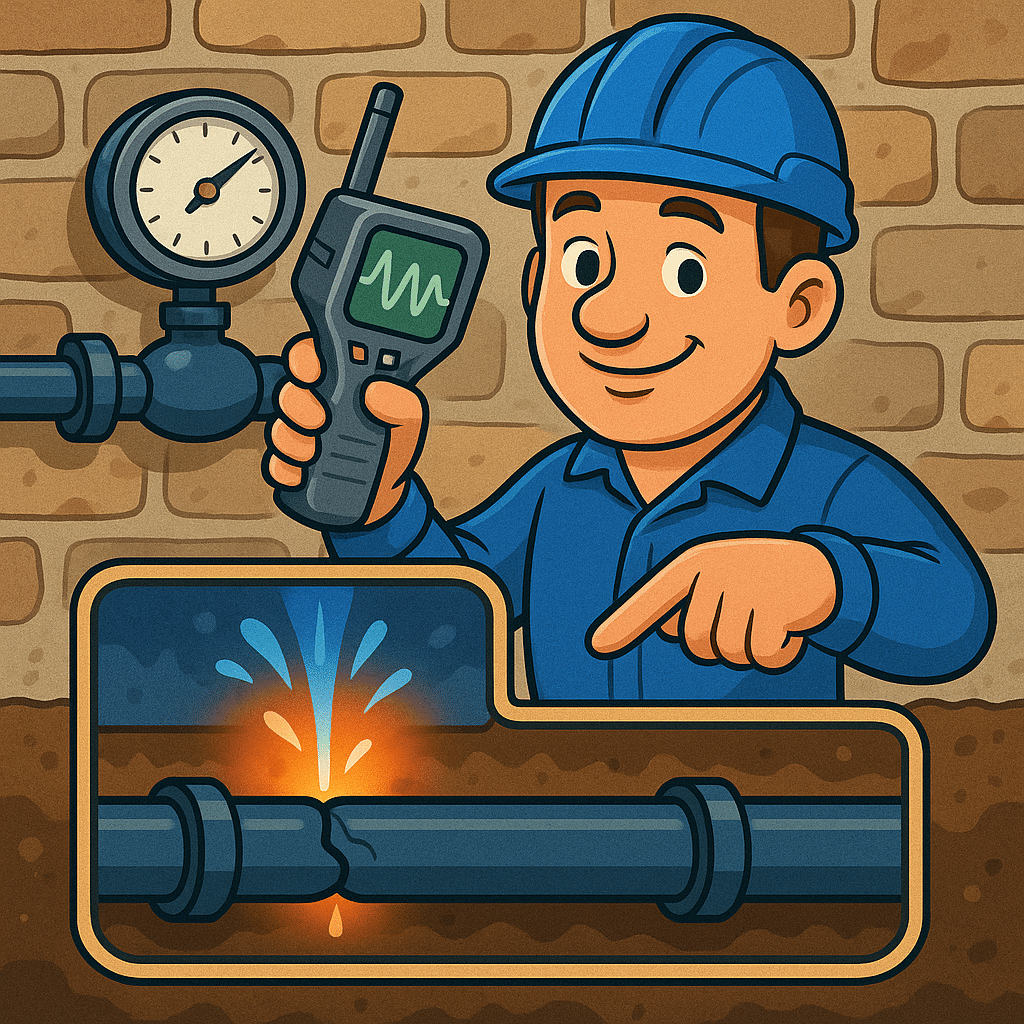
What a failing main looks like underground
Underground bursts rarely show themselves at the surface straight away. Water tracks along the pipe trench or through surrounding soil before it reaches ground level, which is why the wet patch on the lawn is often metres from the actual failure point.
What MDPE renewal actually involves
A typical domestic water main renewal follows a fairly standard sequence, whether the job is a Victorian tenement in Glasgow or a detached house in Perthshire.
Step 1: Confirm the route and depth
The old pipe's route is traced and its depth checked, along with the location of other underground services (gas, electricity, telecoms) that might sit near the new run.
Step 2: Excavate entry and exit points
Rather than digging up the entire garden or driveway, most renewals only need small excavation pits at each end of the run, plus at the property boundary and the point of entry to the house.
Step 3: Install the new MDPE pipe
The new pipe is pulled or pushed through from one pit to the other, following the same general route as the old main, or a new route if the old one runs somewhere impractical.
Step 4: Connect, pressure test and reinstate
The new pipe is connected at both ends, pressure tested to confirm there are no leaks in the new installation, and the excavation pits are reinstated.
Moling versus open-trench
How the new pipe gets from A to B is where most of the disruption difference lies.
Moling (sometimes called pipe bursting or directional drilling, depending on the exact technique) pulls the new MDPE pipe through the ground from small pits at each end, without digging up the ground in between. It's faster, leaves lawns, driveways and paths largely intact, and is the preferred method wherever the ground allows it.
Open-trench digging is the fallback where moling isn't practical: very rocky ground, a route that has to change significantly from the old pipe's path, or where other buried services are too close together to risk a mole run. It's more disruptive and takes longer to reinstate, but sometimes it's unavoidable.
Most residential jobs on reasonably clear ground use moling. Tenement backcourts and shared driveways sometimes need a mix of both, particularly where the route has to dodge existing drains or cables.
Who's responsible for the pipe
According to Citizens Advice Scotland, Scottish Water is responsible for the mains pipe up to the property boundary. The property owner is responsible for everything from that boundary, sometimes marked by the stopcock, into and through the home. That's the section covered by this article, and it's the homeowner's cost to repair or replace.
Tenements complicate this. A shared supply pipe serving several flats is common in older Scottish tenement stock, and responsibility for maintaining it is shared between the owners, according to their title deeds, or under the statutory Tenement Management Scheme where the deeds don't say. That means a full water main renewal on a shared supply usually needs agreement and cost-sharing across the building, not just one flat owner acting alone.
If a leak is being ignored and wasting water, Citizens Advice Scotland notes that Scottish Water can send a warning letter and, if nothing changes, can get a warrant from a Justice of the Peace to force entry after 24 hours, carry out the repair, and bill the owner. It rarely gets that far, but it shows why letting a known leak sit unrepaired is a poor strategy.
Thinking about renewing your water main?
Before any digging starts, we can confirm exactly where and how badly the existing pipe is failing, so the renewal is sized and routed correctly the first time.
Why detection comes before renewal
It sounds obvious, but plenty of renewal jobs still start with a guess rather than a confirmed leak location. That's an expensive way to work, since digging in the wrong spot means digging again.
Our water mains leak detection service uses acoustic listening and tracer gas methods to pinpoint the failure point (or points, if there's more than one) along the run before any excavation is planned. That confirms whether you're looking at a single repairable fault or a pipe that's failing at multiple points along its length, which is the clearest signal that renewal, not another repair, is the sensible option.
For longer or more complex underground runs, particularly where the pipe crosses under a driveway, path or neighbouring property, our broader underground water leak detection service maps the whole route so the renewal contractor knows exactly what they're dealing with before they dig.
Honestly, most of the renewal jobs we get called into started with someone digging a test hole in the wrong place first. A proper survey beforehand usually costs less than one wrong excavation.
Frequently Asked Questions
A straightforward moled renewal on a typical house connection is usually completed within a day or two, including pressure testing and reinstatement. Open-trench jobs, or those needing to navigate other buried services, take longer.
Work within your own property boundary generally doesn't need permission from Scottish Water, though any connection work at the boundary or into the public main should go through a licensed provider. A contractor carrying out the renewal will advise on the specific notifications needed for your job.
Moling keeps disruption to small pits at each end rather than a continuous trench, so most gardens and driveways are left largely intact. Open-trench work, needed on some sites, is more disruptive and takes longer to reinstate.
Lead pipe is a recognised water quality concern as well as a leak risk, since lead can leach into drinking water over time. Combined with its tendency to split with age, it's one of the strongest cases for renewal rather than repair.
Cost is shared between the owners served by that pipe, according to the title deeds, or under the statutory Tenement Management Scheme where the deeds are silent, according to Citizens Advice Scotland. Getting agreement across owners is usually the slowest part of the process, not the physical work.
Yes. A survey confirms how many failure points exist along the pipe and their condition, which is the clearest evidence for deciding between a targeted repair and a full renewal. Guessing without that information often leads to repeated digging.
📍 Professional Leak Detection Across Scotland
Don't let a small problem become a big one
A confirmed leak location before you renew means the right pipe gets replaced, in the right place, first time. Non-invasive detection, insurance-approved reports, and a free quote to start.