

A pipe dripping outside your house near the boiler is almost always the pressure relief valve discharge pipe, releasing water because the heating system pressure has gone too high. Occasional drips after topping up are normal. Frequent or constant dripping usually means the expansion vessel has failed or the valve seat is worn, and a heating engineer should check it. Never cap or block this pipe.
In This Guide
What the PRV actually does
The pressure relief valve, or PRV, is a safety device fitted to sealed central heating systems, meaning most combi boilers and many system boilers. If pressure inside the system climbs too high, the valve opens automatically and releases water through a small copper or plastic pipe that runs outside the property, usually ending a short distance above ground level near an outside wall.
That pipe is the discharge pipe, and the drip you are seeing is the system doing exactly what it is designed to do: protecting the boiler and pipework from a dangerous pressure build-up. The question is not whether the pipe should ever drip. It is why it is dripping now, and how often.
Why it drips occasionally
A single drip or two after you have topped up the system using the filling loop is normal and nothing to worry about. Overfilling slightly during a top-up, or a brief spike in pressure as the heating warms through, can push a small amount of water out through the valve.
After topping up
If you or an engineer has just repressurised the system and it drips once or twice within the hour, that is usually just settling. Our guide on how to repressurise a boiler covers the correct target range.
During the heating cycle
Water expands as it heats, and a system running close to its upper pressure limit can vent a small amount as it warms up, then stop once it cools. This is usually a sign pressure is set slightly high rather than a fault.
Genuinely isolated incidents
One drip that never returns is rarely worth acting on. A pattern that repeats every day, or every heating cycle, is not.
Why it drips constantly
Constant or frequent dripping, rather than the odd drop, points to one of two things. Either the system pressure is genuinely too high and staying there, or the valve itself has a worn seat and is no longer sealing properly even at normal pressure.
Combi boiler cold pressure typically sits around 1 to 1.5 bar. If your pressure gauge is regularly reading well above that, or climbing on its own without you touching the filling loop, that supports the first explanation. If pressure looks normal on the gauge but the pipe still drips, the valve seat itself is the more likely culprit.
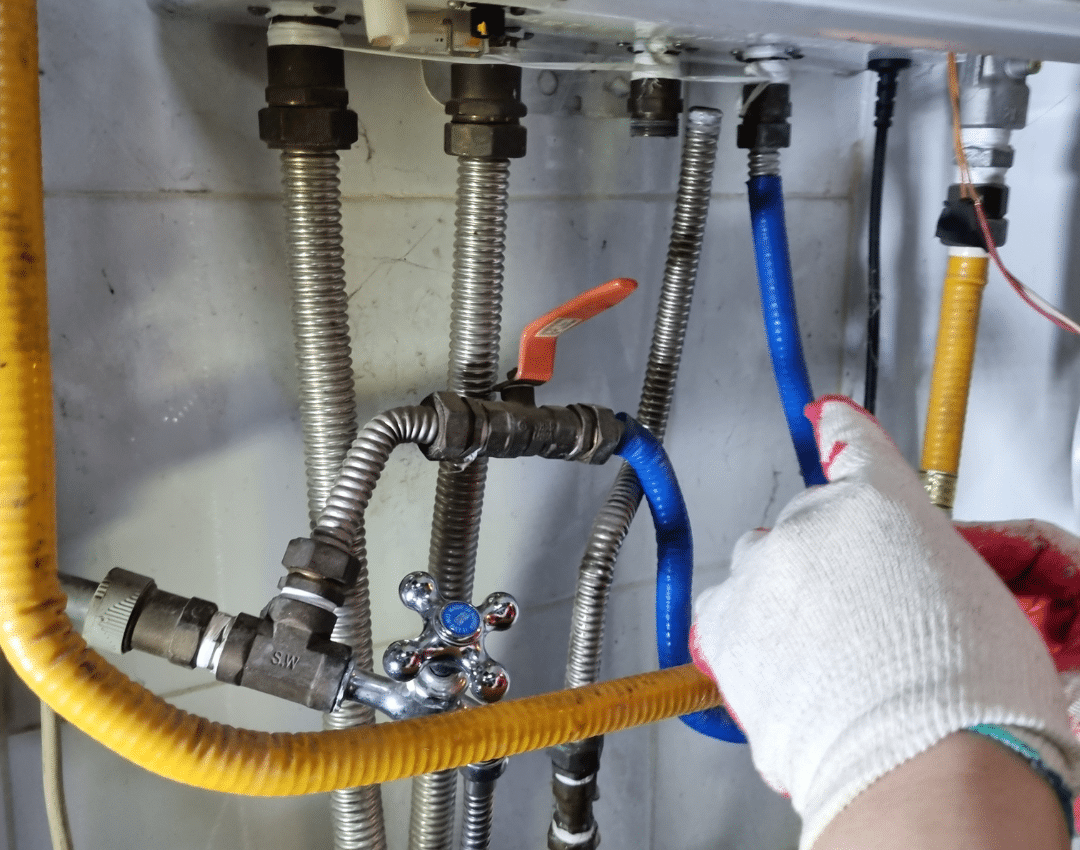
Where the filling loop fits in
The filling loop is how pressure gets topped up in the first place. If you find yourself needing to use it every few days, something is losing water somewhere in the system, and that is worth investigating before it becomes a bigger repair.
The expansion vessel connection
Most sealed systems rely on an expansion vessel to absorb the natural expansion of water as it heats, cushioning the pressure rise so the PRV does not need to open every cycle. Inside the vessel is a rubber diaphragm backed by an air charge. When that diaphragm fails or the air charge leaks away, the vessel can no longer absorb the expansion, and pressure spikes hit the PRV directly instead.
This is one of the most common root causes behind a PRV that has started dripping more often than it used to. Our related guide on why a boiler keeps losing pressure covers how a failing expansion vessel and a dripping PRV often show up together.
Never cap, plug or bend the discharge pipe to stop it dripping. It is a safety valve. Blocking it means pressure has nowhere to go in an emergency, which is a genuine safety risk, not just a nuisance drip.
Not sure if it's the valve or something else?
A dripping PRV can mean a failed expansion vessel, a worn valve seat, or a hidden leak elsewhere in the heating system pushing pressure up. We can trace exactly what is happening without guesswork.
Why you must never cap it
We mention this twice because it matters. Some homeowners, understandably tired of a dripping pipe staining the brickwork, are tempted to fit a cap or divert the pipe somewhere less visible. Do not do this. If the valve needs to release pressure and cannot, the result is pressure building inside the sealed system with no safe outlet.
If the drip bothers you, or ice is forming on the discharge pipe in winter and could block it, the fix is finding and treating the cause, not restricting the pipe itself. A boiler engineer can check whether the pipe route and termination meet current standards too, since older installations sometimes have the pipe finishing somewhere it shouldn't.
Likely a simple fix
- Drips only right after a top-up
- Pressure gauge reads within the normal range
- Stops within a day of repressurising
Needs an engineer
- Drips daily or continuously
- Pressure keeps climbing on its own
- You are topping up the system often
Getting it checked properly
A heating engineer will typically check three things on a call-out for a dripping PRV: the current system pressure, the condition of the expansion vessel, and whether the valve itself is holding when isolated. That usually resolves the dripping on its own, since most cases come down to one of those three.
Where pressure keeps rising and there's no obvious top-up or vessel fault, the harder question is whether the sealed system itself has a leak somewhere in the pipework, feeding pressure up gradually as it tops itself up from the mains via a faulty filling loop. That is where our central heating leak detection service comes in, tracing hidden leaks in the heating circuit using acoustic and thermal methods rather than opening up pipework speculatively.
We see this fairly often in winter, when a system that has coped fine for years suddenly starts needing weekly top-ups. Usually it's the vessel, but it's always worth checking the pipework too before assuming that.
Underfloor heating circuits and older radiator systems with a lot of pipework are the trickiest to check by eye, since a small leak can sit under a floor or behind plaster for months while the system simply keeps topping itself up through the filling loop. That masks the symptom without fixing the cause, and the PRV ends up carrying the load of a system that is slowly losing water somewhere else entirely.
A boiler engineer can rule out the boiler and its immediate fittings fairly quickly. Confirming the wider pipework is sound, especially in a house with solid floors or an older heating layout, is where non-invasive detection earns its keep instead of opening up floors on a hunch.
Frequently Asked Questions
An occasional drip is not dangerous, it is the valve working as designed. What matters is never blocking or capping the pipe. If it drips constantly, get it checked, since that usually means a fault that will worsen over time.
Checking and correcting your system pressure via the filling loop is something most homeowners can do safely. Replacing the valve itself or the expansion vessel is heating engineer work, since it involves the sealed system.
Most combi boilers run at around 1 to 1.5 bar when cold, rising slightly as the system heats. Check your specific boiler's manual for the exact range, since it can vary slightly between models.
Cold weather can make an existing pressure issue more noticeable, since the system works harder. Freezing is also a separate risk: if the pipe itself freezes and blocks, the valve cannot vent safely, so get it checked promptly.
Not necessarily. A worn valve seat or failed expansion vessel are both common causes without any leak. However, if you are topping up the system regularly with no other explanation, a hidden leak becomes more likely.
No. The pipe is a safety device, and capping it removes the system's safe route for releasing dangerous pressure. Fix the underlying cause instead, whether that is pressure, the valve, or the expansion vessel.
📍 Professional Leak Detection Across Scotland
Don't let a small problem become a big one
If your boiler keeps losing pressure or the discharge pipe won't stop dripping, our non-invasive surveys can trace a hidden leak in the heating system before it causes real damage.