

A leak detection report insurance claim relies on should state the leak’s exact location, the method used to find it, dated photo evidence, and the confirmed cause. Insurers and loss adjusters use this to approve trace-and-access costs, which commonly cover up to around £5,000 per Confused.com, without arguing over whether a leak exists at all.
In This Guide
Why the report matters more than the leak
Most homeowners think the hard part of an escape-of-water claim is finding the leak. It isn’t. The hard part is proving to an insurer that the leak existed, where it was, and what caused it. A leak detection report insurance assessors can act on does that job for you. Without one, you’re asking a loss adjuster to take your word for it, and that rarely ends well.
Escape of water is one of the most common causes of home insurance claims in Scotland, and it costs insurers heavily nationwide. The Association of British Insurers estimates that escape of water costs insurers about £1.8 million in payouts every day. With that kind of exposure, insurers do not pay out on a hunch. They pay out on evidence.
We see this most weeks in older tenement flats, where nobody can agree whose pipe is leaking until someone brings in equipment and writes down what it found. A report turns a dispute into a fact.
What a proper report contains
A leak detection report is not a scrap of paper saying "found leak, fixed leak". Insurers and loss adjusters expect a structured document that stands up to scrutiny, because it often forms the basis of a payout worth thousands of pounds.
The core sections of an insurance-ready report
- Precise location: a description and, where possible, a marked diagram showing exactly where the leak sits, such as under a kitchen floor, behind a bathroom wall, or within a shared tenement supply pipe.
- Method used: which detection technique found it: thermal imaging, acoustic listening equipment, or tracer gas.
- Evidence photos: dated images from the survey, including thermal readouts or damp patterns that support the written findings.
- Identified cause: whether it’s a failed joint, corroded pipe, worn seal, or a specific fitting, described in plain terms.
- Access recommendations: what needs to be opened up to reach the pipe, and how much of that work is directly caused by the search itself.
This is exactly the kind of documentation covered by our trace and access service, which is built around producing paperwork insurers actually accept, not just finding water.
How thermal imaging builds the paper trail
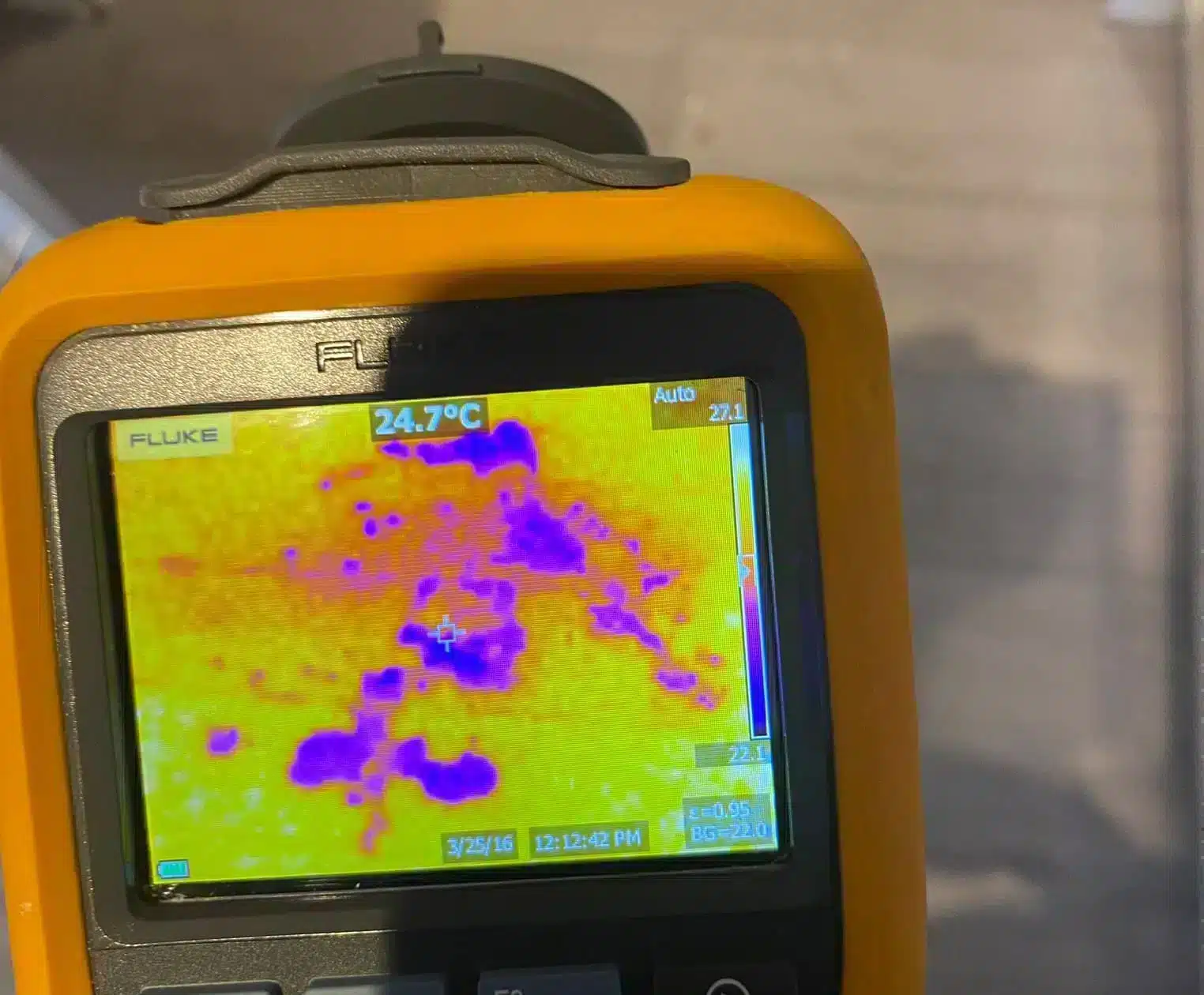
A thermal camera reads surface temperature differences across a wall, ceiling or floor. Where water is tracking through a structure, it shows up as a cooler or warmer patch depending on conditions. That image becomes part of the report, giving the loss adjuster something visual to match against the written description of the fault.
How the evidence is gathered
Getting from "we think there’s a leak" to a report an insurer will act on takes a structured survey, not a quick look with a torch.
Step 1: Initial assessment
We start with a conversation about symptoms, damp patches, pressure drops, unexplained damage, then a visual inspection of the property to narrow down the likely area.
Step 2: Non-invasive detection
Thermal imaging, acoustic listening devices, or tracer gas (a safe mix of 5% hydrogen and 95% nitrogen) locate the leak without opening up the whole property first.
Step 3: Confirmation and documentation
Once the leak is pinpointed, we photograph the evidence, record the method used, and note the probable cause before any repair work begins.
Step 4: Report delivery
The finished report goes to the homeowner, and to the insurer or loss adjuster directly if requested, ready to support the claim.
Because the methods are non-invasive, the property isn’t torn apart just to find the source. That matters for the claim too, since any damage caused during the search itself normally falls under trace and access cover rather than general repair costs.
Trace and access cover explained
Trace and access is the part of a buildings insurance policy that pays for finding and reaching a hidden leak, not for repairing the pipe once it’s found. Price-comparison service Confused.com notes most policies cover up to about £5,000 of trace-and-access costs, and this is usually included as standard in buildings insurance, though it’s worth checking your own schedule.
That distinction confuses a lot of homeowners. Confused.com is clear that trace and access pays for lifting floors, cutting into walls, and making good the damage caused by the search, while the actual pipe repair is a separate cost, sometimes covered elsewhere in the policy and sometimes not covered at all.
A detailed trace and access cover claim depends entirely on being able to show what the search involved and why it was necessary. That’s precisely what the report is for.
How the report speeds up settlement
Claims stall for one main reason: the insurer isn’t satisfied they know what happened. Every question they raise adds days, sometimes weeks, to a claim that could otherwise move quickly.
Why documented evidence shortens the process
A report with a location, a method, and photos answers the questions before they get asked. The loss adjuster doesn’t need to send someone out to double-check your story, because the story is already backed by evidence gathered on the day. Insurance-approved reports remove the guesswork from that conversation, and guesswork is what slows claims down.
We’ve had cases where a homeowner had already opened up a section of flooring themselves before calling us in, and the lack of dated evidence from before that point made the loss adjuster question the extent of the damage. A survey carried out first, with photos taken as the leak was found rather than after, avoids that entirely.
Get an insurance-ready report, not just a leak found
If you’re making a claim, the paperwork matters as much as the plumbing. Our surveys are built to hold up with insurers and loss adjusters, using non-invasive methods with same-day capability across Scotland.
Preventing disputes with loss adjusters
Loss adjusters are not being difficult when they ask for evidence. Their job is to check that a claim matches what actually happened, and a written, photographed report gives them exactly what they need to sign it off without a site visit turning into an argument.
| Without a report | With an insurance-approved report |
|---|---|
| Claim relies on the homeowner’s account alone | Claim is backed by dated evidence and a stated cause |
| Loss adjuster may request a second inspection | Loss adjuster can often approve from the paperwork |
| Disagreement over extent of trace-and-access work | Access work is documented and justified in writing |
| Claim can stall for weeks awaiting clarification | Settlement moves ahead once the report is reviewed |
This applies just as much in tenement flats, where responsibility for a shared pipe can be split under the title deeds or the statutory Tenement Management Scheme where the deeds are silent, according to Citizens Advice Scotland. A report that identifies the leak as coming from a common supply pipe rather than a private one gives owners something solid to take to a common block policy or to their factor, instead of arguing it out on the stair.
What insurance-approved actually means
"Insurance-approved" doesn’t mean a specific insurer has personally signed off on a company. It means the reports are written in the format and level of detail that insurers and loss adjusters routinely accept, covering location, method, cause and evidence in a way that supports a claim rather than raising more questions.
We’ve built our reporting around 30+ years of combined experience dealing with exactly this kind of claim, which means the report is written with the loss adjuster’s checklist in mind, not just the homeowner’s.
What a strong report gives you
- Clear evidence to support a trace-and-access claim
- A documented cause, useful even outside insurance
- Faster answers from loss adjusters
What a weak or missing report risks
- Requests for further inspection or proof
- Disputes over how much access work was necessary
- Delays to repair while the claim is queried
If you suspect a leak and plan to claim, avoid opening up floors or walls yourself before a survey. Once the evidence is disturbed, it’s much harder for any report to show the loss adjuster what the property looked like when the leak was found.
Most Scottish households pay for water through their council tax bill rather than a meter, so a leak here often doesn’t show up as a spike on a water bill the way it might in England. Structural damage and a stalled claim are usually the first sign something’s wrong, which is another reason the report needs to carry the full weight of proof on its own.
Frequently Asked Questions
Most insurers expect some form of evidence before approving a trace-and-access claim. A written report with location, method and photos makes approval far more straightforward, and many policies effectively require it before releasing funds for the search-related costs.
Often yes, as part of trace and access cover, which Confused.com notes commonly covers up to around £5,000 and is usually included as standard in buildings insurance. Always check your own policy schedule, since terms vary between insurers.
No. Trace and access pays for finding the leak and reaching it, including lifting floors or cutting walls, and making good that access damage. The pipe repair itself is a separate cost, which may sit under a different part of your policy.
Look for the exact location of the leak, the detection method used, dated photo evidence, and a clearly stated cause. If any of these are missing, ask for them before you send the report to your insurer or loss adjuster.
It depends whether the pipe serves one flat or is shared. Citizens Advice Scotland explains that owners share responsibility for common pipes, split according to title deeds or the statutory Tenement Management Scheme where the deeds don’t cover it.
We offer same-day capability across Scotland in most cases. Getting the survey done quickly matters for a claim too, since evidence gathered close to when the leak was found is more convincing to a loss adjuster than a delayed inspection.
It’s uncommon when the report is thorough, but not impossible. A clear report with method, location, cause and photos removes most grounds for dispute, though the final decision always rests with the insurer against your specific policy wording.
📍 Professional Leak Detection Across Scotland
Don’t let a small problem become a big one
A same-day, non-invasive survey gives you the insurance-approved report your claim needs, with the location, method, and cause set out clearly for your insurer or loss adjuster.