

Most domestic leak detection surveys take two to four hours, and we can often confirm the leak's location the same day. Straightforward jobs with clear access can be quicker. Complex properties, multiple suspect pipe runs, or underground and commercial work can extend a survey to a full day or occasionally longer.
In This Guide
The short answer, by scenario
How long does leak detection take is one of the first things anyone asks once they have accepted they need a survey rather than another guess. The honest answer is that it depends on the property, but there is a useful pattern once you have seen a few hundred of these jobs.
A standard domestic survey, one suspected leak, reasonable access to lofts and under-sink cupboards, typically takes two to four hours from arrival to a confirmed location. That covers the walk-through, the non-invasive scanning, and a clear conversation about what we found before we leave.
| Scenario | Typical time on site |
|---|---|
| Single house, one suspected leak | 2 to 4 hours |
| Tenement flat, shared pipework involved | Half a day, sometimes longer if neighbouring flats need access |
| Underground supply pipe or garden leak | Half a day to a full day |
| Commercial premises or multiple units | A full day, occasionally split across two visits |
We built our reputation on same-day capability, and in the large majority of domestic cases we can tell you where the leak is before we leave, even if the repair itself is booked in separately with a plumber.
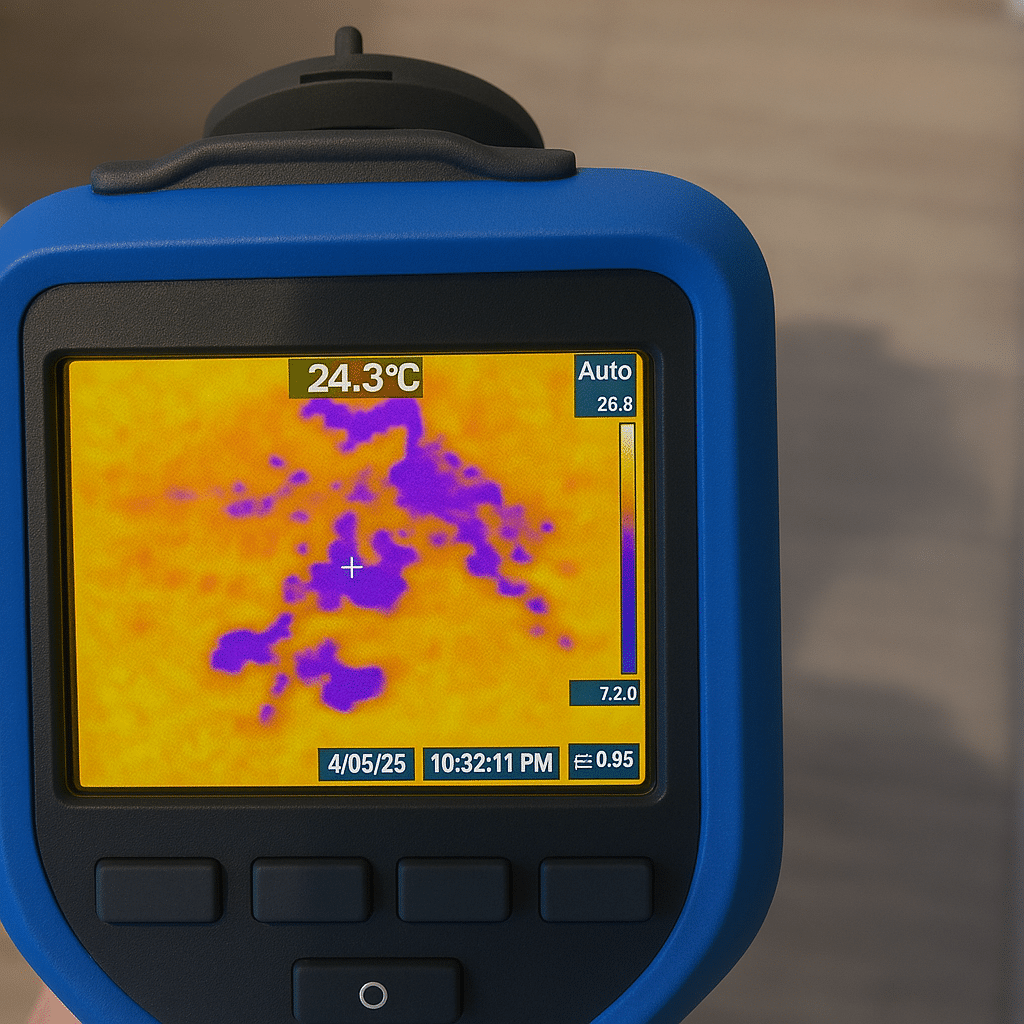
Scanning is faster than most people expect
Thermal imaging cameras cover a wall or ceiling area in minutes, not hours. The camera itself is the quick part of the visit; most of the time on site goes into methodically ruling areas in and out before we commit to an answer.
What happens during the visit
A survey is not one test, it is a sequence, and each stage narrows the search before the next one starts.
1. Walk-through and history
We ask what you have noticed, when, and where, damp patches, sounds, pressure drops, a rising bill. This shapes where we look first.
2. Non-invasive scanning
Thermal imaging picks up temperature differences from escaping water; acoustic listening equipment picks up the sound of water moving under pressure through pipework.
3. Tracer gas where needed
On sealed systems or underground pipes, we can introduce a safe tracer gas and detect where it surfaces, pinpointing the leak without digging test holes at random.
4. Confirmation and report
We confirm the location, explain what we found in plain terms, and provide an insurance-approved report if you need one for a claim.
Full detail on each stage is in our guide to what happens during a leak detection survey, if you want to know exactly what to expect before we arrive.
What extends a survey
Several things push a job from a couple of hours towards a full day, and most of them are about access rather than difficulty.
- Restricted access: boxed-in pipework, fitted furniture over suspect areas, or a loft that needs clearing before we can get in.
- Multiple possible sources: an older property with several pipe runs, or more than one plumbing system (heating and mains supply both under suspicion).
- Shared pipework in tenements: if the source could be a neighbouring flat's supply, we may need access to more than one property, which takes coordinating.
- Background noise: acoustic detection needs relative quiet; a busy commercial kitchen or a house full of running appliances can slow things down.
- Large or complex sites: bigger footprints simply take longer to scan properly, whatever the method.
None of these make a leak undetectable, they just add time. We would rather take the extra hour and be right than rush a guess that sends someone lifting the wrong floor.
Wondering how long your survey will take?
Every property is different. Tell us what you have noticed and we will give you a realistic estimate before we book the visit.
Underground leaks take longer
A leak in a supply pipe running under a garden, driveway or path is a different job to a leak inside a house. There is more ground to cover, and the pipe is not visible at any point along its run, so we rely more heavily on acoustic listening equipment and, where the pipe route is uncertain, tracer gas introduced at an accessible point.
Weather, ground type and how deep the pipe sits all play a part. A short run in dry, accessible ground can be traced within a couple of hours. A longer run under paving, or ground that has been saturated for weeks, understandably takes longer to narrow down. Either way, the method stays non-invasive until we know exactly where to dig, which saves a lot of unnecessary reinstatement work afterwards.
Commercial and multi-unit properties
Commercial sites are bigger, and often have more pipework, more plant, and more people using water at once, which affects acoustic detection. A single retail unit might take half a day. A larger site with multiple floors, a commercial kitchen, or several suspect zones can run to a full day, and we will sometimes recommend splitting a very large or complex site across two visits so we can work around business hours and avoid disrupting trade.
For businesses watching a rising water bill without an obvious cause, our guide on a high water bill at your Scottish business covers the checks worth doing before booking a full survey.
Same-day results, what that really means
Same-day capability means we aim to confirm the leak's location during the visit itself, not that every job is quick. For most domestic surveys that is exactly what happens: you get an answer, in plain language, before we leave the property.
For more complex jobs, same-day usually still means same-day for the diagnosis, even if the follow-up repair is booked separately with a plumber or contractor. What we will not do is rush a scan just to hit a clock. Honestly, most of the time the extra half hour spent ruling something out is what stops someone opening up the wrong wall.
If you are weighing up whether to call a specialist at all versus getting your usual plumber to have a look first, our comparison of a leak detection specialist vs plumber sets out when each makes sense. And if the leak search is happening ahead of buying a property rather than fixing an existing problem, see our guide on buying a home in Scotland and a leak survey, since timing works a little differently on those jobs.
Frequently Asked Questions
Most domestic surveys with one suspected leak and reasonable access take between two and four hours from arrival to a confirmed location. Straightforward cases can be quicker; restricted access or multiple pipe runs can push it closer to half a day.
In the large majority of domestic cases, yes. We aim to confirm the leak's location before we leave the property. Some complex jobs need a second visit, but that is the exception rather than the rule.
There is more ground to cover and the pipe is not visible along its length, so we rely on acoustic listening and tracer gas rather than a direct look. Depth, ground type and weather all affect how long tracing takes.
Usually, yes, simply because there is more to scan. But access matters more than size in most cases. A large house with open access can be quicker to survey than a small flat with boxed-in pipework everywhere.
Clearing access to lofts, under-sink cupboards and any boxed-in pipework beforehand helps a lot. Having a rough timeline of when you first noticed signs of a leak also helps us narrow the search faster.
Not necessarily. It usually reflects the property's layout or access rather than the difficulty of the leak itself. We would rather spend the extra time confirming the right spot than rush to a guess.
📍 Professional Leak Detection Across Scotland
Don't let a small problem become a big one
Book a survey and get a same-day answer in most cases, using non-invasive methods and a report you can hand straight to your insurer.