

Call a plumber for a leak you can see and reach, like a dripping tap or a burst pipe under a sink. Call a leak detection specialist for a hidden leak, under a floor, wall or driveway. A specialist locates the exact point first using thermal imaging, acoustic listening or tracer gas, and the report supports an insurance trace-and-access claim.
In This Guide
Leak detection specialist vs plumber: two different jobs
A plumber fixes pipes, taps, cisterns and joints. A leak detection specialist finds where a hidden leak actually is before anyone touches a wall or a floor. Both trades matter, and most water problems only need one of them. The confusion starts because a lot of folk assume any tradesman with a van and a toolbox can locate a leak that isn’t visible. Some can have a good guess. Fewer carry the equipment to confirm it without digging.
This matters most when the leak is hidden: under a solid floor, inside a cavity wall, beneath a driveway, or somewhere in a run of pipe you can’t see any part of. That’s when the question of leak detection specialist vs plumber stops being academic and starts affecting how much disruption your home takes, and possibly how your insurance claim gets treated.
We’ll go through what each trade is actually equipped to do, when a plumber is the right and only call you need to make, and why a specialist survey earns its keep once a leak goes underground, under a slab, or behind plaster.
What a plumber does well
A good plumber is the right first call for anything visible and accessible. A dripping tap, a leaking overflow pipe, a burst flexi-hose under the kitchen sink, a cistern that won’t stop filling, a radiator valve weeping at the joint. These jobs have a leak you can point at. There’s nothing to find, because you’ve already found it. The job is simply to fix it, and that’s exactly what plumbers are trained and equipped for.
Plumbers also handle the repair stage after a specialist has pinpointed a hidden leak. Once our team marks the exact spot and hands over a report, a plumber (sometimes us, sometimes your own trusted plumber) does the actual pipe repair or replacement. The two trades work together more often than people expect. We’re not trying to replace plumbers. We do a different, narrower job that most plumbers aren’t set up to do themselves.
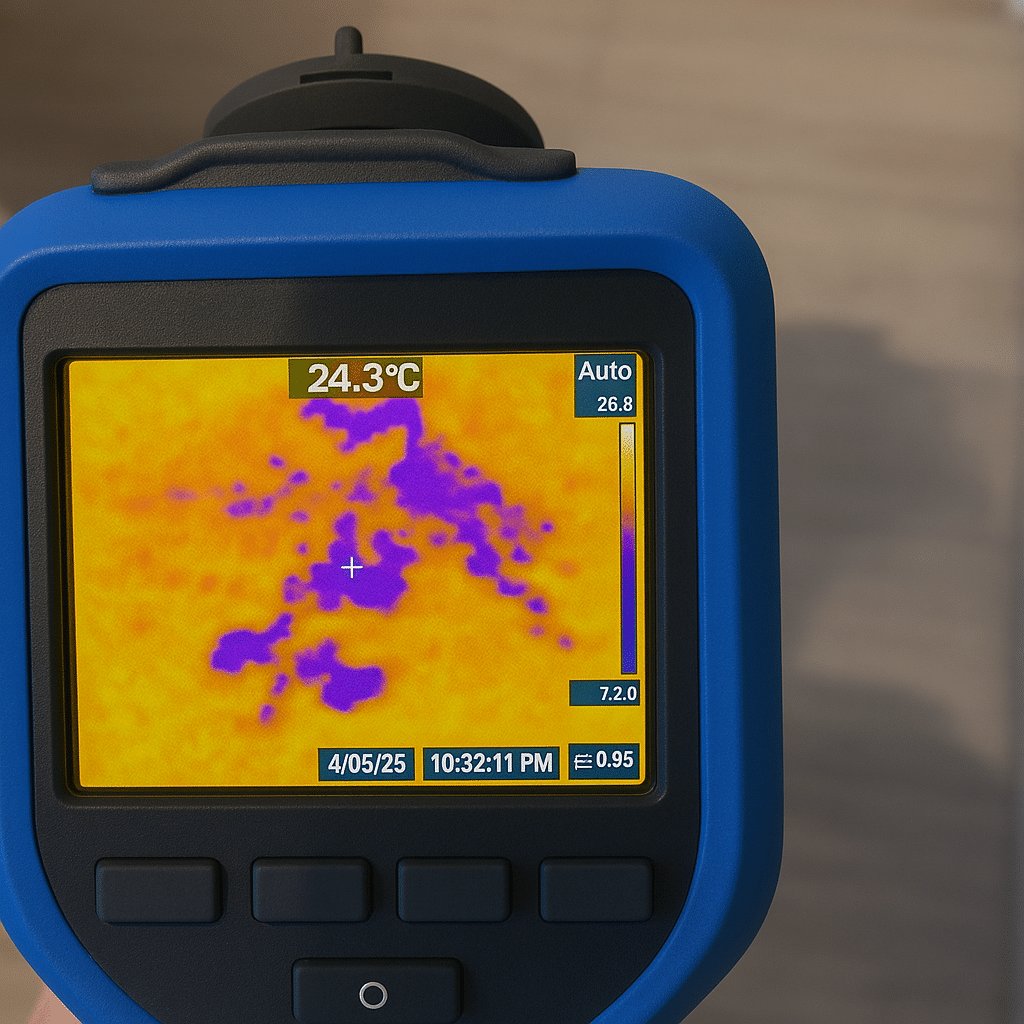
Equipment a general plumber usually doesn’t carry
A thermal imaging camera reads surface temperature differences across a wall or floor. Water escaping from a heating pipe or a hot water supply changes the temperature pattern where it’s tracking, and the camera picks that up without a single tool touching the surface. It’s one of a handful of methods that let us narrow down a search area before anyone lifts a floorboard.
Why hidden leaks need different equipment
Here’s the practical difference. A plumber without leak-detection equipment, faced with a leak they can hear or suspect but can’t see, generally has one option: start opening things up. Lift a section of floor. Cut a hole in plasterboard. Dig a trial hole in the garden or driveway near where the water seems to be coming up. Then check if that’s the spot. If it isn’t, they move along and try again.
That approach can work. It’s also slow, and every wrong guess is a hole that needs made good afterwards, on top of the actual repair. A tenement flat with solid floors, a granite-built cottage, a new-build with underfloor heating pipework cast into a screed floor: none of these forgive a scattergun search.
A leak detection specialist uses equipment built specifically to locate water before any opening-up work starts:
- Thermal imaging: spots temperature differences at the surface caused by escaping water tracking through a wall, floor or ceiling void.
- Acoustic listening: picks up the sound signature of water under pressure escaping from a pipe, even through concrete, tarmac or several inches of soil.
- Tracer gas: a safe mix of 5% hydrogen and 95% nitrogen is introduced into the empty pipe, and a sensitive probe detects where the gas escapes at the surface, pinpointing the leak to within a small area.
None of these methods involve breaking into the structure to find the source. They involve confirming exactly where the source is, so that when someone does open something up, it’s the right something.
If you smell gas at any point during a leak investigation, this isn’t a job for a plumber or a leak detection specialist. Call the National Gas Emergency line on 0800 111 999 and get everyone out of the property first.
The find-first economics
Find-first is the whole argument for using a specialist on a hidden leak. If you know exactly where the leak is before any tool touches the fabric of the building, only the necessary access work happens: one controlled opening, sized to the job, in the right place. Compare that to a search-by-elimination approach, where each guess that misses becomes another hole, another patch, another day.
Cost is the part everyone wants a number for, and we’ll stay within what’s actually published rather than guess. Specialist leak-detection firms across the UK typically publish prices somewhere between about £500 and £1,500 depending on the size and complexity of the job. That’s market context, not a quote from us. Scotland Leak Detection doesn’t publish a fixed price list because every property and every leak is different. If you want an actual figure for your situation, a free quote is the way to get one.
What that survey cost buys is confidence before any damage is done to your home. Set against a burst-pipe claim (insurer NFU Mutual puts the average burst-pipe home insurance claim at around £10,000, as reported by STV News), a targeted search that avoids unnecessary opening-up work is a small outlay against a much larger one.
The insurance report angle
Most buildings insurance in Scotland includes trace-and-access cover as standard. Price-comparison service Confused.com notes that this pays for the cost of finding the leak and accessing it, including lifting floors or cutting into walls, and for making good the damage that search causes. It doesn’t pay to repair the pipe itself, and most policies cover up to around £5,000 of the finding-and-accessing costs. Check your own schedule to confirm what your policy allows.
This is where the choice between a specialist and a plumber can matter for your claim as well as your walls. An insurance-approved leak detection report documents the method used, the location pinpointed and the evidence behind it, in a format insurers recognise for a trace-and-access claim. A plumber’s invoice for an exploratory hole doesn’t carry the same weight, because it wasn’t produced as trace-and-access evidence in the first place.
The Association of British Insurers estimates that escape of water costs insurers around £1.8 million in payouts every day, so insurers are used to seeing these claims and know what a properly evidenced one looks like. Getting a specialist survey done first, before any repair work starts, gives you the paperwork to make that claim cleanly.

Finding a leak under a driveway or garden pipe
Acoustic listening equipment picks up the sound of pressurised water escaping underground, even through tarmac, paving or several inches of soil. It’s one of the more common jobs we’re called out for once a water bill or a damp patch on a drive raises a question mark, and it avoids digging up an entire run of pipe to find one join that’s failed.
Specialist vs plumber, side by side
Here’s a straightforward comparison, so you can see where each trade earns its place.
Leak detection specialist
- Finds hidden leaks without breaking into walls or floors first
- Uses thermal imaging, acoustic listening and tracer gas
- Produces insurance-approved reports for trace-and-access claims
- Non-invasive, with same-day capability in most cases
General plumber
- Best for leaks you can already see and reach
- May need to open up floors or walls to search for a hidden source
- Handles the pipe repair once a leak is located
- Not usually equipped for trace-and-access style reporting
| Situation | Who to call |
|---|---|
| Dripping tap or visible burst under a sink | Plumber |
| Damp patch on a wall or ceiling with no obvious source | Leak detection specialist |
| Rising water bill with no visible cause | Leak detection specialist |
| Boiler pressure dropping repeatedly (typically 1–1.5 bar when healthy) | Leak detection specialist, then plumber for the repair |
| Wet patch appearing on a driveway or garden path | Leak detection specialist |
| Repairing a pipe once the leak location is confirmed | Plumber |
Leak detection specialist vs plumber: still not sure?
Tell us what you’re seeing and we’ll tell you honestly whether it’s a specialist job or a straightforward plumbing call.
How to tell which one you need
Ask one question first: can you see the leak, or point to within a few centimetres of where it is? If yes, that’s a plumbing job. A dripping tap, a weeping valve, a burst flexi-hose, a cistern overflow. There’s nothing to locate, so a specialist survey would be an unnecessary step.
If the answer is no, if you’ve got a damp patch with no clear source, a water bill that’s climbed for no obvious reason, or a boiler that keeps losing pressure and nobody can say why, that’s when our water leak detection service is the right first call, ahead of any repair work. We locate the source non-invasively, hand over a report, and then either we or your own plumber carries out the actual fix.
Tenement flats deserve a specific mention here. If you’re not sure whether a leak is coming from your own pipework or a neighbour’s, or from a shared supply pipe, a specialist survey gives you evidence to take to a factor, an insurer, or the other owner, rather than a guess. According to Citizens Advice Scotland, owners in a tenement share responsibility for shared supply pipes according to their title deeds, or the statutory Tenement Management Scheme where the deeds are silent, so knowing exactly where a leak originates matters before anyone agrees to split a bill.
Honestly, most weeks we get at least one call from someone who’s already had a plumber out, spent money on an exploratory hole that didn’t find anything, and then rings us as the next step. We’d rather be the first call than the second.
Frequently Asked Questions
If you can see the leak, such as a dripping tap or a burst pipe under a sink, call a plumber. If the leak is hidden, under a floor, in a wall or under a driveway, call a leak detection specialist first so the exact location is confirmed before any opening-up work begins.
Some can make an educated guess, but without thermal imaging, acoustic listening or tracer gas equipment, a plumber typically has to open up floors or walls at likely spots to search. A leak detection specialist confirms the exact location first, so only necessary access work follows.
Yes. An insurance-approved leak detection report documents the method used and the confirmed location in a format insurers recognise for trace-and-access claims. Most buildings policies cover up to around £5,000 of finding-and-accessing costs, according to Confused.com, though the repair itself is separate.
Trace-and-access cover pays for locating a leak and accessing it, including lifting floors or cutting into walls, plus making good the damage that search causes. It does not pay for repairing the leaking pipe itself. Check your own policy schedule, since cover levels vary between insurers.
Yes. Thermal imaging, acoustic listening and tracer gas methods all locate a leak from the surface, without breaking into walls, floors or driveways to search. Once the source is pinpointed, any necessary opening-up work is limited to that one confirmed spot.
Scotland Leak Detection doesn’t publish a fixed price list, since every property and leak differs. Specialist firms across the UK typically publish prices between about £500 and £1,500 depending on the job. Request a free quote for a figure based on your own property and situation.
According to Citizens Advice Scotland, owners share responsibility for shared supply pipes, with costs split according to the title deeds or the statutory Tenement Management Scheme where deeds are silent. Confirming the exact leak source first helps establish which pipe, and whose responsibility, is involved.
Our focus is locating the leak accurately and producing a report. Once the source is confirmed, the repair can be carried out by us or by your own plumber, whichever suits you. Many customers use their existing plumber for the repair once we’ve pinpointed the problem.
📍 Professional Leak Detection Across Scotland
Don’t let a small problem become a big one
If a leak is hidden, our non-invasive equipment finds it first, and our reports are built for insurance trace-and-access claims. If it’s visible, we’ll tell you straight and point you to a plumber instead.