

A leaking fire ring main or sprinkler system can be traced without draining or decommissioning it, using tracer gas or acoustic methods on the pressurised, water-filled system. Facilities teams need the leak found and repaired quickly because a system running below its design pressure may fail its next inspection or, worse, fail to perform when it’s needed.
In This Guide
Why you can’t just switch it off to look
A fire ring main or sprinkler system is a live safety system. Draining it down to go hunting for a leak takes the whole building’s fire suppression offline, sometimes for days, and that’s rarely something a facilities manager can authorise without serious justification and sign-off. Most sites simply can’t accept that level of risk, especially anywhere with an occupied building, stored stock, or a fire certificate that depends on the system staying charged.
That’s the core problem with fire ring main leak detection. The system has to stay pressurised and full while you find the fault, which rules out most of the standard tricks a plumber would use on ordinary domestic pipework. You need methods built for exactly this constraint.
It’s also why this work sits closer to a specialist detection job than a routine maintenance task. Getting it wrong, either by decommissioning the system unnecessarily or by guessing at a repair location, carries real compliance and safety consequences that a missed radiator leak simply doesn’t.
Signs your ring main or sprinkler system is leaking
Most leaks on these systems show up first as a pressure problem rather than visible water, because the pipework is usually boxed in, buried, or run through service ducts you don’t see day to day.
- Pressure that won’t hold between scheduled tests, dropping faster than the system’s normal tolerance.
- The jockey pump cycling more often than usual, topping up pressure the system is quietly losing.
- Damp patches or staining near ductwork or risers carrying the ring main.
- A failed or borderline result on a routine pressure test, without an obvious cause.
- Unexplained water appearing in plant rooms or riser cupboards along the main’s route.
A sprinkler or ring main system that keeps failing pressure tests is a compliance issue. Get the leak found and fixed before the next scheduled inspection, rather than waiting to see if it gets worse.
Why compliance is the real pressure
Fire suppression systems in commercial and industrial buildings are typically maintained and tested against British Standards and manufacturer schedules, and a system that can’t hold its design pressure is a system that may not perform correctly if it’s ever called on. That’s the stakes facilities managers are working against, well beyond the cost of the water itself.
Insurers take this seriously too. Water damage cover is one thing, but a fire suppression system that’s been quietly failing pressure checks is a different category of risk for a building’s overall insurance position. Getting a fault found, documented, and repaired promptly protects both the safety case and the paperwork.
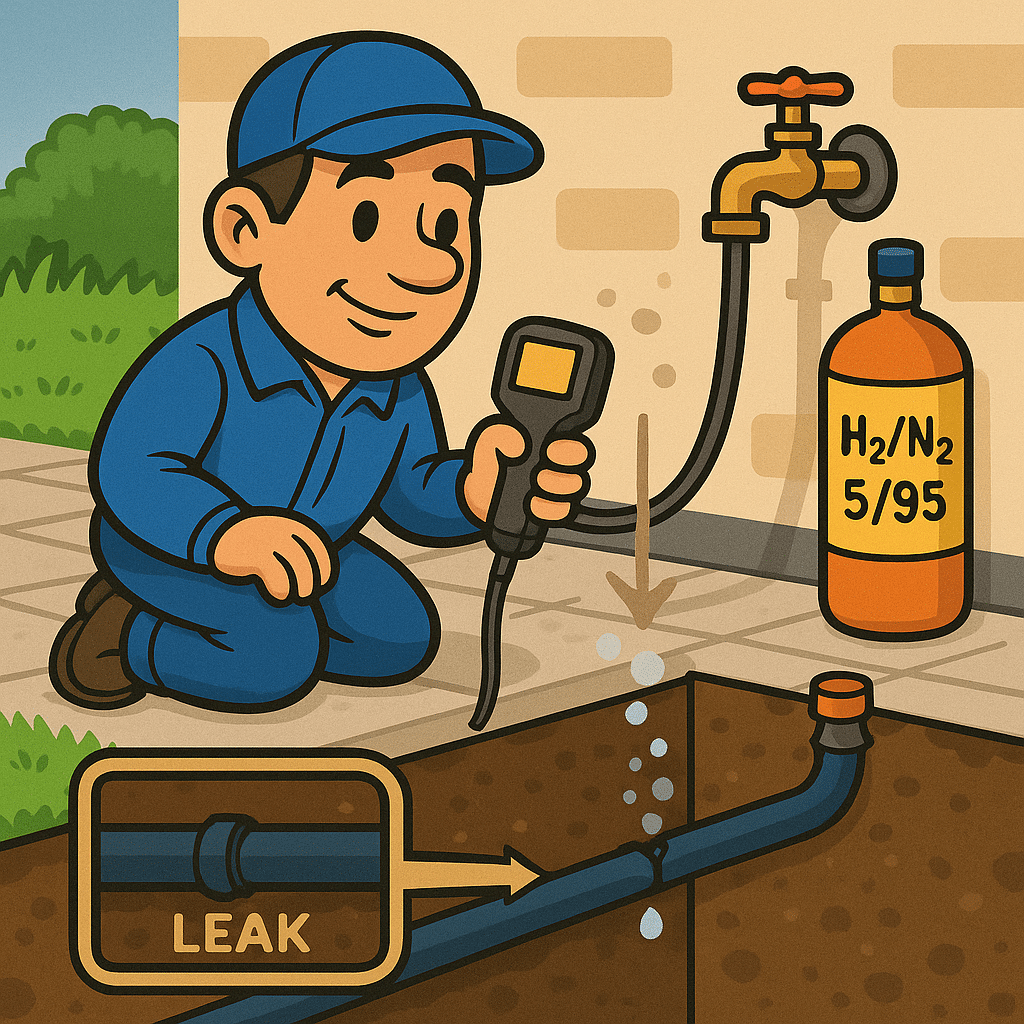
How tracer gas works on a live system
A safe mix of 5% hydrogen and 95% nitrogen is introduced into the system alongside the water. Where the pipe has a fault, the gas escapes to the surface and is picked up by a sensitive handheld probe, pinpointing the leak without draining the main.
Tracer gas on a charged system
Tracer gas is the method most suited to fire ring mains and sprinkler pipework because it works on a system that’s still full of water and under pressure. The gas mix is introduced into the line, migrates through the ground or building fabric to any point where the pipe has failed, and is detected at the surface using a handheld sensor. It doesn’t require the system to be drained, and it doesn’t rely on ambient noise the way acoustic listening sometimes does.
1. Confirm the pressure loss
We start by verifying the rate of pressure loss against the system’s baseline, ruling out valve or fitting issues before assuming a pipe fault.
2. Introduce tracer gas
The safe gas mix is added to the system without decommissioning it, then given time to migrate to any leak point.
3. Survey the route
We trace the pipe’s route with a handheld probe, checking accessible surfaces above and around the suspected line.
4. Confirm and report
Once the leak is pinpointed, we provide a report your maintenance contractor or fire safety assessor can act on directly.
This is one of the core techniques behind our tracer gas leak detection service, and it’s particularly well suited to fire systems because it works without touching the system’s operational status.
Ring main or sprinkler system losing pressure?
We find leaks in charged fire suppression systems without decommissioning them, with a report your fire safety assessor or insurer can use.
Thermal imaging as a first pass
Where a section of ring main runs through an accessible ceiling void, riser, or wall, thermal imaging is often used as a quick first pass before committing to a full tracer gas survey. Water escaping from a pressurised system changes the surface temperature of the surrounding material, and a thermal camera picks up that difference even when nothing is visible to the eye.

Scanning ceiling voids and risers
A thermal survey along the visible route of the ring main can narrow the search area substantially before any more detailed work begins, especially useful in large commercial or industrial buildings where the pipe run covers a lot of ground.
Thermal imaging works best as a scoping tool. It tells us where to focus the tracer gas survey, rather than replacing it, particularly where the pipe is buried in solid construction and the temperature signature is weaker.
What a facilities manager should expect from a survey
A proper survey should be planned around your building’s operational needs, not the other way round. That means agreeing access times, understanding whether any part of the system needs to be temporarily isolated for testing, and being clear about what happens if the fire system needs to stay live throughout, which it usually does.
You should get a written report at the end, insurance-approved and specific enough that a contractor can go straight to the repair without another investigation. That’s the standard we work to on commercial leak detection jobs generally, and it matters even more on a fire safety system where the paperwork trail is part of your compliance record.
Honestly, most of the fire ring main jobs we get called to are found in a single visit once tracer gas is in the system. The harder part is usually coordinating access around a live building, not the detection itself.
Frequently Asked Questions
Yes. Tracer gas detection works on a system that stays full of water and pressurised throughout. A safe gas mix is introduced alongside the water and detected at the surface wherever it escapes, so the system never needs to be decommissioned to find the fault.
Yes. The tracer gas method uses a safe mix of 5% hydrogen and 95% nitrogen, introduced into the pipe and detected at the surface with a sensitive probe. It’s a standard, low-risk technique used across occupied commercial buildings.
A recurring pressure test failure usually points to a leak somewhere on the pipe run rather than a faulty gauge or valve, especially if the jockey pump is cycling more often than normal. A tracer gas or thermal survey will confirm the exact cause.
It depends on the size of the building and the pipe run, but many jobs are completed in a single visit, with same-day results once tracer gas has had time to migrate to the leak point.
Yes, we provide an insurance-approved report detailing the leak’s location and how it was confirmed, which you can pass to your fire safety assessor, maintenance contractor or insurer as part of your compliance record.
That’s unrelated to leak detection tracer gas, which is odourless. If you smell gas anywhere in a building, call the National Gas Emergency line on 0800 111 999 and evacuate immediately. Leak detection firms do not handle gas emergencies.
📍 Professional Leak Detection Across Scotland
Get your fire system checked without the downtime
Tracer gas and thermal imaging on live, pressurised systems, with insurance-ready reporting for your compliance file.