

Swimming pool leak detection starts with the bucket test, which separates normal evaporation from a genuine leak. If the pool loses noticeably more water than the bucket, the leak is usually in the liner, a skimmer, or the pipework feeding the pump and filter. Specialists confirm the exact point using tracer gas and acoustic listening rather than draining the pool to guess.
In This Guide
How to run the bucket test
The bucket test is the standard first check for swimming pool leak detection, and it costs nothing but a bit of patience.
1. Fill a bucket and place it on the pool steps
The water level inside the bucket should sit at roughly the same level as the pool around it.
2. Mark both water lines
Use tape or a marker on the inside of the bucket and on the pool edge, at the same height.
3. Leave it for 24 hours
Keep the pump running on its normal cycle, since turning it off changes the test conditions.
4. Compare the two marks
If the pool has dropped noticeably more than the bucket, evaporation is not the explanation, something is leaking.
If both marks have dropped by roughly the same amount, that drop is evaporation, which is normal and not a leak at all. If the pool mark has dropped well beyond the bucket, you have a genuine leak worth investigating further.
Evaporation vs a genuine leak
Pools lose water to evaporation all the time, more on hot, windy or low-humidity days, and more from an uncovered pool than one with a cover on overnight. This is completely normal and not something to chase as a leak.
What separates evaporation from an actual leak is the bucket test result and the pattern of loss. Evaporation tracks with weather and cover use. A genuine leak keeps losing water at roughly the same rate regardless of conditions, and it often shows up alongside other clues: a consistently damp patch on the surrounding paving, a section of lawn near the pool that stays soggier than the rest, or a filtration system that needs topping up more than it used to.

What escaping water looks like around a pool
Water lost to a genuine leak has to go somewhere. It often shows up as a persistently wet or soft area near the pool surround, distinct from the general dampness you would expect after rain, as pictured above.
Liner leaks vs pipework leaks
Once the bucket test confirms a real leak, the next question is where. Broadly, pool leaks fall into two categories, and they need different approaches to find.
Liner or shell leaks
- Often near skimmer boxes, light fittings or steps
- Can sometimes be spotted visually with careful inspection
- Tend to cause a steadier, more visible water loss
Pipework leaks
- Hidden underground between the pool and the plant room
- Not visible from the pool itself at all
- Need acoustic or tracer gas testing to locate
Skimmer boxes and light niches are common weak points on liner pools, since they involve a seal that can degrade over years of chemical exposure and temperature change. Pipework leaks are the harder problem, because the pipe run between the pool and the plant room is buried and completely out of sight.
Tracer gas on pool circuits
Pool pipework is a good candidate for tracer gas testing because, like a central heating circuit, it is a closed loop that can be isolated and pressurised for testing. A safe mix of 5% hydrogen and 95% nitrogen is introduced into the pipe, and any gas escaping at a leak point rises to the surface, where a sensitive probe detects it precisely.
This matters a great deal for pool leaks specifically, because excavating around a pool to search for a pipe leak is disruptive and expensive, often involving breaking through paving or decking. Confirming the exact location first means only that section needs to be dug up, rather than tracing the whole pipe run by trial and error.
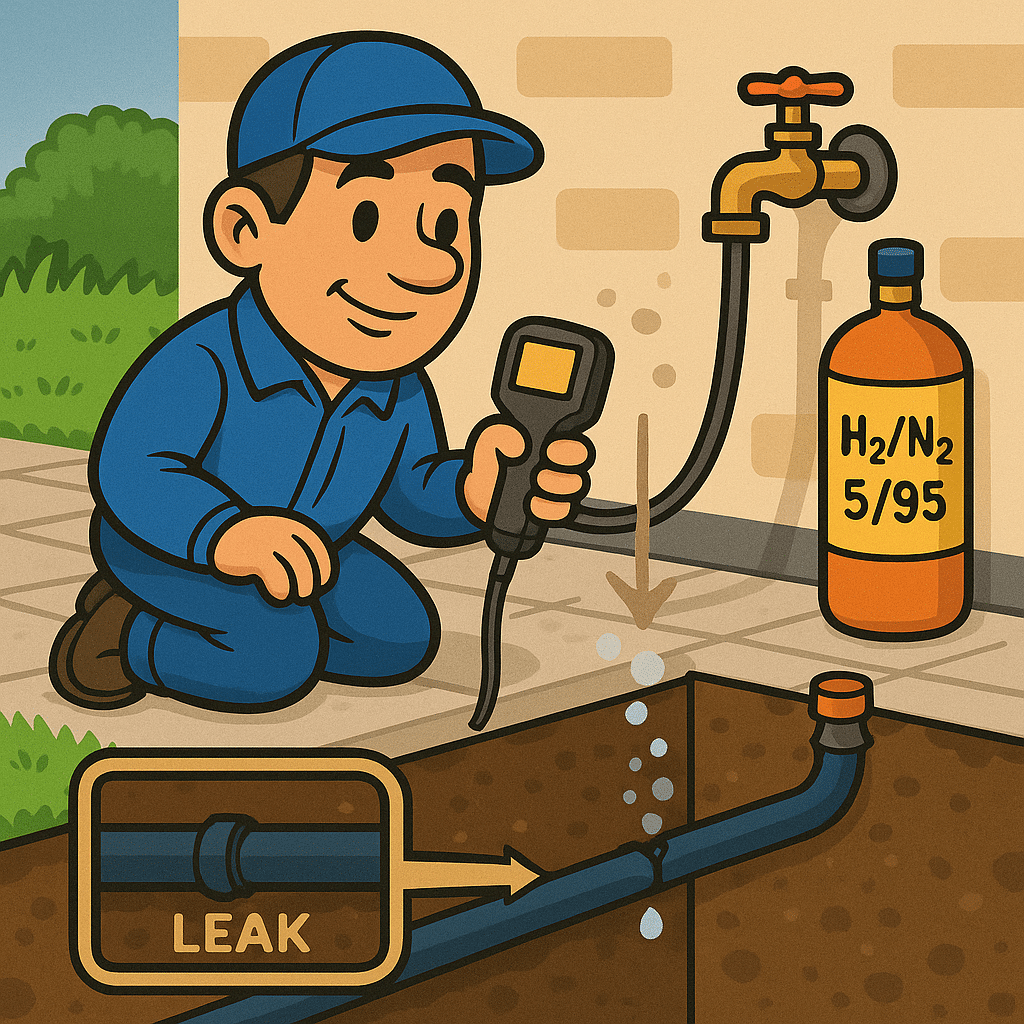
Tracer gas testing in practice
The equipment shown above introduces gas into the pipe circuit at an accessible point, then a handheld probe detects any that escapes at the surface, pinpointing the failed section without excavation first.
Pool losing more water than it should?
We use tracer gas and acoustic testing to trace pool pipework and liner leaks without unnecessary excavation.
Hotels and leisure facilities in Scotland
For hotels, spas and leisure centres, a pool leak is a bigger problem than the water itself. A pool that keeps losing water disrupts the chemical balance, adds heating costs to replace warm water with cold mains water, and in commercial settings can eventually raise questions with health and safety inspections if levels are not kept within range.
Downtime matters too. A hotel cannot easily close its pool for days while a plumber traces pipework by digging test holes. Our commercial leak detection service is built around minimising disruption: non-invasive testing first, and excavation only once the leak point is confirmed, which keeps facilities open for longer during the diagnosis phase.
If the pool sits within a wider commercial building that has also seen a rising water bill, it is worth reading our guide on a high water bill at your Scottish business, since pool loss and a general site leak can sometimes be confused with each other until tested separately.
What a professional survey covers
A full swimming pool leak detection survey usually covers more ground than the bucket test alone.
- Skimmer boxes and fittings: checked for degraded seals or hairline cracks around the housing.
- Pool shell or liner: inspected for damage, particularly around steps, lights and returns.
- Pipework between pool and plant room: tested with tracer gas or acoustic listening if underground.
- Pump and filtration system: checked for leaks at seals and unions, which can look identical to a pool leak from the water level alone.
Honestly, we see a fair few cases where the actual loss turns out to be the pump housing or a valve union rather than the pool itself, so ruling that out early saves a lot of unnecessary digging around the pool surround. For a broader look at how tracer gas is used across different jobs, our guide on tracer gas leak detection explains the method in more depth.
Frequently Asked Questions
There is no fixed figure since it depends on weather, wind, sun exposure and cover use, which is exactly why the bucket test matters: it compares your pool's loss against a control sample under the same conditions rather than relying on a generic number.
No. Tracer gas and acoustic testing can locate pipework leaks with the pool full and the system running as normal. Draining is rarely necessary and adds cost and time you do not need to spend.
Liner leaks often show near skimmers, lights or steps and can sometimes be spotted visually. Pipework leaks are underground and invisible from the pool, so they need acoustic or tracer gas testing to confirm.
Yes. A leaking seal or union on the pump or filtration system can cause water loss that looks identical to a pool leak from the water level alone. A full survey checks the plant room as well as the pool itself.
Non-invasive testing means the pool can often stay in use, or only close briefly, during the diagnosis phase. Excavation is limited to the confirmed leak point once tracer gas or acoustic testing has pinpointed it.
Yes. It uses a safe mix of 5% hydrogen and 95% nitrogen, introduced into an isolated section of pipework and detected at the surface with a sensitive probe, with no effect on pool water chemistry or safety.
📍 Professional Leak Detection Across Scotland
Don't let a small problem become a big one
Whether it is a hotel pool or a private one, we can confirm the exact source of water loss with non-invasive testing and a report ready for insurers or facilities management.