

The expansion vessel is a sealed metal canister with a rubber diaphragm that absorbs the extra volume water takes up as it heats. When the diaphragm splits or the vessel loses its air charge, you get pressure that climbs too high, swings up and down, or a boiler that keeps losing pressure and dripping from the pressure relief valve. A low-charge vessel can often be recharged; a split diaphragm needs replacing.
In This Guide
What the expansion vessel actually does
Every sealed central heating system needs somewhere for water to go as it heats up and expands. Water does not compress, so without an expansion vessel, that extra volume would have nowhere to go and pressure would spike every time the boiler fires. The vessel solves this with a rubber diaphragm splitting the canister in two: water on one side, a fixed charge of air or nitrogen on the other.
As the system heats, water pushes against the diaphragm and compresses the air charge on the far side, giving the extra volume somewhere to go without the overall system pressure climbing dangerously. As the system cools, the air charge pushes back and the water returns to the pipework. Done correctly, this cycle repeats for years without the vessel ever needing attention.
Most combi boilers have the expansion vessel built into the casing. System boilers and older setups often have a separate vessel plumbed in nearby, sometimes tucked into a cupboard or loft space where it is easy to forget about entirely.
Signs your vessel is failing
An expansion vessel rarely announces itself directly. Instead it shows up as symptoms elsewhere in the system, which is exactly why so many people chase a phantom leak for weeks before anyone checks the vessel itself.
- Pressure gauge creeping up when the heating is on, then dropping back once it cools.
- Pressure that will not settle even after repressurising correctly.
- Water dripping from the pressure relief valve (PRV) discharge pipe outside the property, especially after the heating has been running.
- Boiler losing pressure gradually over days or weeks with no visible leak anywhere in the system.
- A knocking or gurgling noise from the vessel itself when the system pressure changes quickly.
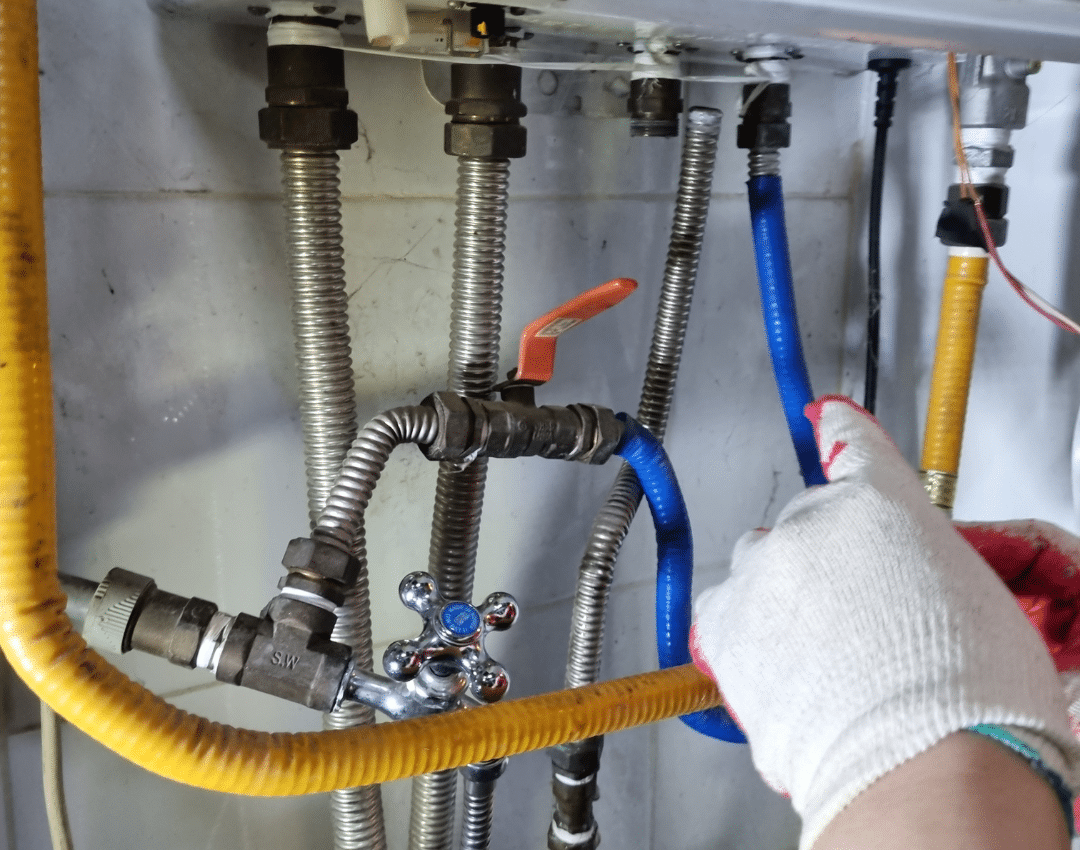
Where the filling loop fits into this
The filling loop is how you top the system back up after pressure has dropped, but topping up repeatedly without finding the cause just masks a failing vessel or a genuine leak elsewhere. If you find yourself using the filling loop every few days, that is the system telling you something needs a proper look, not another quick top-up.
Why the diaphragm splits
The rubber diaphragm inside the vessel is a wear part. It flexes every single time the system heats and cools, thousands of cycles a year, and like any rubber component under constant flex it eventually perishes, cracks or splits. Age is the main driver: a vessel that has been in service for eight or ten years is well within the window where this starts to happen.
Heat is the other factor. Vessels mounted close to the boiler casing run warmer than ones plumbed further away, and higher average temperatures shorten rubber’s working life. Water quality plays a smaller part too. Systems that have not been treated with an inhibitor tend to carry more dissolved oxygen and debris, which can accelerate wear on internal components generally, the vessel included.
Once the diaphragm splits, the air charge and the water side mix. The vessel can no longer cushion the expanding water properly, so the system behaves as if the vessel is not there at all, and pressure climbs with every heating cycle.
Recharging vs replacing the vessel
Not every vessel problem needs a full replacement. If the diaphragm is still intact but the air charge has simply leaked away slowly over years through the valve, a heating engineer can recharge it using a pump and gauge through the Schrader valve on the vessel, similar in principle to topping up a car tyre. This is a straightforward job and often solves pressure-creep symptoms on its own.
Recharging makes sense when
- Pressure creeps up slowly rather than swinging suddenly
- No water is coming from the vessel itself or its connections
- The vessel is relatively young for its expected working life
Replacement is needed when
- Water appears at the vessel’s air valve when pressed
- The vessel has been recharged before and failed again quickly
- The vessel is old and the diaphragm has likely perished
A simple test an engineer will use: press the little pin in the air valve on top of the vessel. If water sprays out rather than air, the diaphragm has split and recharging will not fix it. That vessel needs replacing.
Pressure swings that will not settle down?
An expansion vessel problem can look identical to a hidden pipe leak from the pressure gauge alone. We help confirm which one you are actually dealing with before any pipework gets opened up.
The Gas Safe point people miss
Anyone doing work on a gas boiler in the UK, including replacing or recharging an expansion vessel that is integral to the boiler casing, needs to be Gas Safe registered. This applies even though the vessel itself is a water-side component rather than a gas part, because opening the boiler casing brings you into contact with the gas-carrying parts inside.
An external vessel plumbed into the system away from the boiler is a different matter and can usually be replaced by a competent heating engineer without Gas Safe registration, since no gas components are involved. Always check which type you have before assuming either way, and never let anyone without the right registration open a boiler casing.
If you ever smell gas at any point during this kind of work, stop immediately, evacuate the property and call the National Gas Emergency line on 0800 111 999. Leak detection specialists do not handle gas emergencies, and neither should anyone without the right training.
When it looks like a leak but isn’t
Honestly, most of the time when someone calls us worried about a mystery leak linked to pressure problems, the cause turns out to be the expansion vessel rather than a pipe. The pattern is distinctive once you know what to look for: pressure that rises specifically when the heating is running, a PRV that drips only after the system has been hot for a while, and no damp patch anywhere near visible pipework.
This matters because chasing a phantom pipe leak based on pressure symptoms alone can mean lifting floorboards or opening walls that did not need touching at all. A failing vessel pushes the extra expanded water somewhere, and the PRV discharge pipe outside the house is usually where it shows up, not a crack in the pipework itself.
If your PRV discharge pipe is dripping outside, that is often the first visible clue that the vessel, not the pipework, is where the problem sits.
When it genuinely is a leak
A failing vessel and an actual pipe leak can produce overlapping symptoms, which is exactly why this gets confusing. Both can cause a boiler that keeps losing pressure. The difference is in the detail: a vessel problem usually comes with pressure that climbs too high under heat, while a genuine leak tends to show pressure dropping steadily regardless of whether the heating is on or off.
If you have already had the vessel checked, recharged or replaced and the boiler still loses pressure over days without any visible sign of water, that points to a hidden leak somewhere in the sealed system, possibly under a floor or behind a wall. This is where central heating leak detection comes in, using non-invasive methods to trace exactly where the missing water is going rather than opening up pipework speculatively.
It is also worth reading up on cold spots on radiators, since a hidden heating leak often shows up there too, alongside the pressure symptoms.
| Symptom | More likely cause |
|---|---|
| Pressure rises only when heating is on | Failing expansion vessel |
| Pressure drops steadily, heating on or off | Genuine pipe or component leak |
| PRV drips after heating has been running | Failing expansion vessel |
| Damp patch or stain appears near pipework | Genuine pipe or component leak |
Never ignore a boiler that repeatedly needs repressurising. Whether the cause is the vessel or a hidden leak, running a heating system on low or fluctuating pressure for weeks can trigger boiler fault lockouts and, in the case of a genuine leak, lets damage build up unseen behind walls or under floors.
Frequently Asked Questions
The clearest sign is pressure that climbs while the heating runs, then settles once it cools. An engineer can confirm it by pressing the valve pin on top of the vessel. Air means the vessel is fine; water spraying out means the diaphragm has split.
Recharging needs a pump and pressure gauge used correctly through the vessel’s Schrader valve, and on combi boilers the vessel sits inside the gas-appliance casing, so this work should be left to a Gas Safe registered engineer.
There is no fixed lifespan, but the rubber diaphragm is a wear part that flexes with every heating cycle. Vessels around eight to ten years old are within the typical window where diaphragm failure becomes more common.
This is a classic expansion vessel symptom, but it can also mean a hidden leak in the sealed system. If recharging or replacing the vessel does not stop the pressure loss, the next step is tracing the system for a genuine leak.
Not always, but it is one of the most common causes. A failing vessel pushes expanded water out through the pressure relief valve when the system gets hot. Other causes include a faulty PRV itself or genuinely excessive system pressure.
On a combi boiler, expansion vessel problems affect the sealed heating circuit rather than the mains-fed hot water you draw from taps, so hot water flow is usually unaffected even while heating pressure misbehaves.
If the vessel is built into the boiler casing, yes, because that work involves the gas appliance itself. An external vessel plumbed away from the boiler can usually be replaced by a competent heating engineer without Gas Safe registration.
📍 Professional Leak Detection Across Scotland
Rule out a hidden leak with confidence
Don’t let a small problem become a big one. If pressure keeps dropping after your expansion vessel has been checked, our non-invasive surveys can trace a genuine heating system leak without opening up walls or floors on a hunch.