

Low water pressure in your house is usually a part-closed stopcock, a restricted or scaled supply pipe, or Scottish Water carrying out mains work nearby. If pressure has dropped gradually with no known cause, and especially if it's paired with a damp patch, high heating bills or a spinning water meter, a hidden leak losing water before it reaches your taps is worth ruling out.
In This Guide
Whole house or just one tap
The first useful question with low water pressure is whether it affects one outlet or the whole house. A single weak tap points to something local: a clogged aerator, a part-closed isolation valve, or a fault in that tap itself. Weak pressure everywhere, including outside taps and the shower, points further back, towards the stopcock, the supply pipe, or something happening on the mains.
Test it properly before assuming anything. Run one tap at a time and compare. Then check if hot and cold are both affected, since a hot-only problem often sits with the boiler or cylinder rather than the incoming supply.
Check the stopcock first
This is the cause we rule out first on almost every low-pressure call-out, and it takes two minutes to check. The internal stopcock, usually under the kitchen sink, and the external stopcock at the property boundary both need to be fully open. A stopcock that has been part-closed, whether from previous work or simply being knocked, restricts flow to the entire house without anything actually being broken.
Find the internal stopcock
Usually under the kitchen sink, sometimes in a utility room or under stairs. Turn it fully anti-clockwise to open it completely.
Find the external stopcock
Often in a small chamber near the boundary of the property, sometimes under a metal cover in the pavement or driveway. Our guide on finding and using your stopcock covers exact locations and how to operate it safely.
Recheck pressure after opening both
If pressure returns to normal immediately, that was the cause. If it stays low, move on to the supply pipe itself.
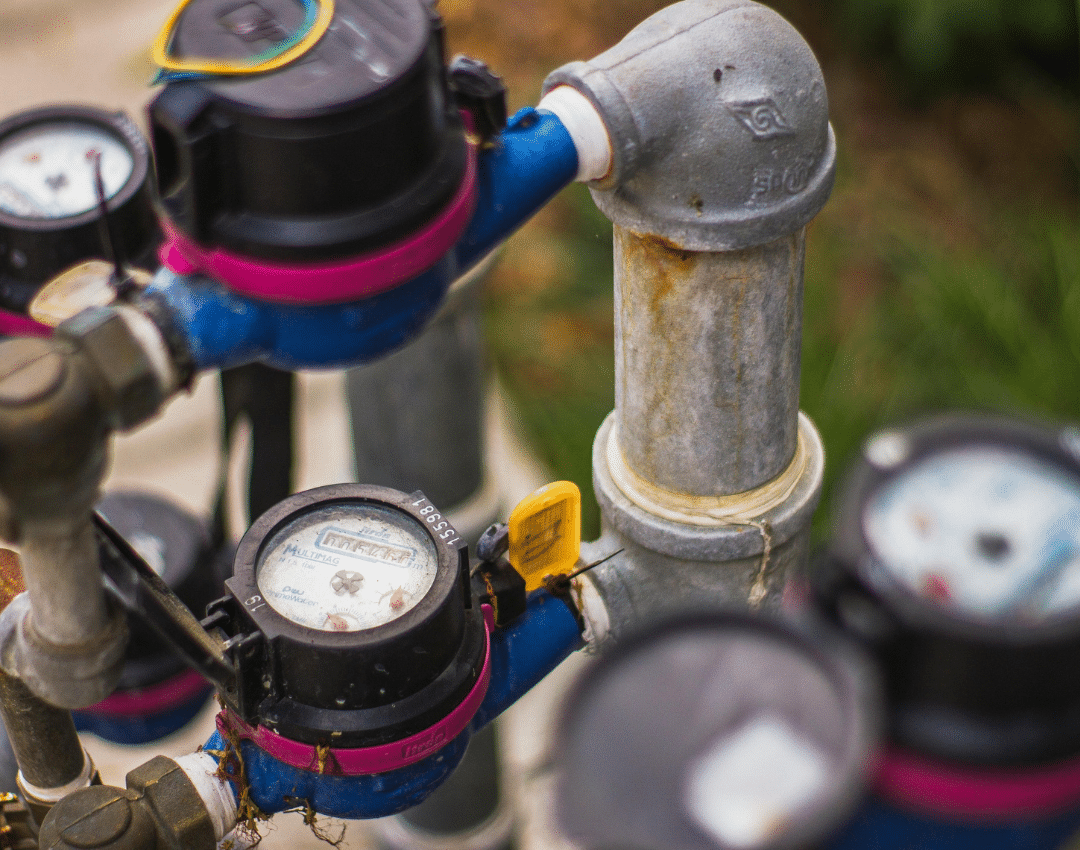
Reading the meter to rule out a leak
Where a property has a water meter, checking it with everything turned off is one of the simplest ways to see whether water is escaping somewhere along the supply. Our guide on using a water meter to check for leaks explains the exact steps.
Supply pipe restrictions and age
Older supply pipes, particularly older galvanised steel or lead pipework still found in some pre-war Scottish properties, narrow internally over decades as scale and corrosion build up on the pipe walls. The pipe still carries water, but the internal diameter has effectively shrunk, so pressure and flow both drop even though nothing is actually leaking.
A partially crushed or kinked pipe has the same effect. This turns up more than you'd think in older tenement basements and in gardens where a supply pipe runs shallow and has been disturbed by digging or root growth over the years.
This kind of restriction tends to develop slowly, over years, rather than appearing overnight. If your pressure has always been on the weaker side, this is a more likely explanation than a sudden leak.
Not sure if it's a leak or just an old pipe?
We can check whether your low pressure is down to a restriction, a fault on the mains, or water escaping somewhere along the supply pipe, without digging anything up to find out.
Scottish Water mains work
Scottish Water is responsible for the mains pipe up to your property boundary, with the property owner responsible for the pipe from the boundary into the home, according to Citizens Advice Scotland. Planned or emergency mains work, a burst nearby, or high demand at peak times can all cause a temporary pressure drop that has nothing to do with your own pipework.
Check whether neighbours are affected too. If the whole street has low pressure, it's a mains issue rather than something specific to your house. You can report a suspected mains problem to Scottish Water's 24/7 leak line on 0800 077 8778, per mygov.scot.
| Cause | Typical pattern |
|---|---|
| Part-closed stopcock | Affects whole house, fixed instantly by opening it fully |
| Restricted or scaled pipe | Gradual decline over years, affects whole house |
| Mains work or burst nearby | Sudden, affects neighbours too, usually temporary |
| Hidden leak on your supply pipe | Sudden or gradual drop, often with damp ground or a spinning meter |
When low pressure means a leak
A leak on the supply pipe between the stopcock and your home reduces pressure because water is escaping before it reaches your taps at all. This is different from a leak inside the house, which usually shows up as damp or staining rather than pressure loss, since the water has already arrived.
Watch for these signs alongside the low pressure itself.
- A wet or unusually green patch in the garden or driveway along the supply pipe route
- The water meter still turning with every tap and appliance in the house switched off
- Higher water charges than usual if you are on a metered supply, or damp and heat loss if you are not
- Pressure that has worsened gradually over weeks rather than dropping suddenly overnight
Most Scottish households pay for water through council tax rather than a meter, so a leak here often shows up as ground damage or a soggy lawn rather than a bigger bill, per mygov.scot.
How we trace pressure-loss leaks
Once a stopcock, a mains issue and an obvious pipe restriction have been ruled out, tracing a supply pipe leak without digging up the whole run is where specialist equipment earns its keep. Acoustic listening equipment picks up the sound of water escaping under pressure through soil and paving, and correlator equipment can pinpoint the location between two access points to within a small margin.
We use non-invasive methods on every job, which means finding the leak accurately before anyone lifts a slab or digs a trench. That keeps repair work targeted and avoids unnecessary damage to driveways, gardens or paths. Our water mains leak detection service covers exactly this kind of supply-pipe tracing.
If you'd rather understand the full picture of who is responsible for what along the pipe run, our guide on who is responsible for water pipes in Scotland sets out the boundary between Scottish Water's mains and your own supply pipe.
Frequently Asked Questions
A sudden drop is often mains work or a burst somewhere on Scottish Water's network. Check if neighbours are affected. If pressure stays low after mains work finishes, or neighbours have normal pressure, check your own stopcock and supply pipe.
A leak inside the house, after the water has already reached the property, usually shows as damp or staining rather than pressure loss. Low pressure typically points to something on the supply pipe before the water reaches your taps.
Yes, scale and corrosion inside older pipework narrows the internal diameter over time, restricting flow even with no leak present. This tends to develop gradually rather than appearing suddenly, unlike a new leak.
Turn off every tap and appliance in the house, note the meter reading, wait around 15 minutes without using any water, then check again. If the reading has moved, water is escaping somewhere on your supply.
The property owner is responsible for the supply pipe from the boundary into the home, according to Citizens Advice Scotland. Scottish Water is responsible for the mains pipe up to that boundary.
If the cause is a leak, yes, most leaks gradually worsen as the pipe or joint continues to fail. If the cause is scale or restriction, it typically stays stable or worsens slowly over years rather than weeks.
📍 Professional Leak Detection Across Scotland
Don't let a small problem become a big one
Weak pressure with no obvious cause is worth checking properly. Our non-invasive surveys find supply pipe leaks accurately, before any digging starts.