
A leak correlator is an instrument that places two sensors on a pipe, one on each side of a suspected leak, and measures the tiny time difference between the leak noise arriving at each sensor. Combined with the pipe's material, diameter and length, it calculates the leak's position to within a metre, even on long or buried runs where listening alone struggles.
In This Guide
What a leak correlator is
A leak correlator is one of the more precise tools in a leak detection kit. It doesn't listen for a leak the way a simple ground microphone does. Instead, it uses two sensors, one clamped or placed at each end of a stretch of pipe suspected of leaking, and a receiver unit that compares what each sensor picks up.
A leak makes a sound as water forces its way out under pressure. That sound travels in both directions along the pipe, away from the leak toward each sensor. Because the leak isn't exactly halfway between the two sensors in most real jobs, the sound reaches one sensor slightly before the other. The correlator measures that tiny time difference, sometimes just a few thousandths of a second, and uses it to calculate exactly where along the pipe the leak sits.
It's the standard tool for underground leaks on longer pipe runs, where digging a trial hole every few metres simply isn't practical.
The physics behind it
The calculation itself is straightforward once you see it laid out. The correlator needs three things: the time difference between the two sensors picking up the leak sound, the total distance between the sensors, and the speed sound travels through that specific pipe.
With those three figures, it works out how much further the sound had to travel to reach the sensor that heard it later, which tells you how much closer the leak is to the sensor that heard it first. The result is a distance from each sensor to the leak, accurate enough on most jobs to guide a small, targeted excavation rather than a long exploratory trench.
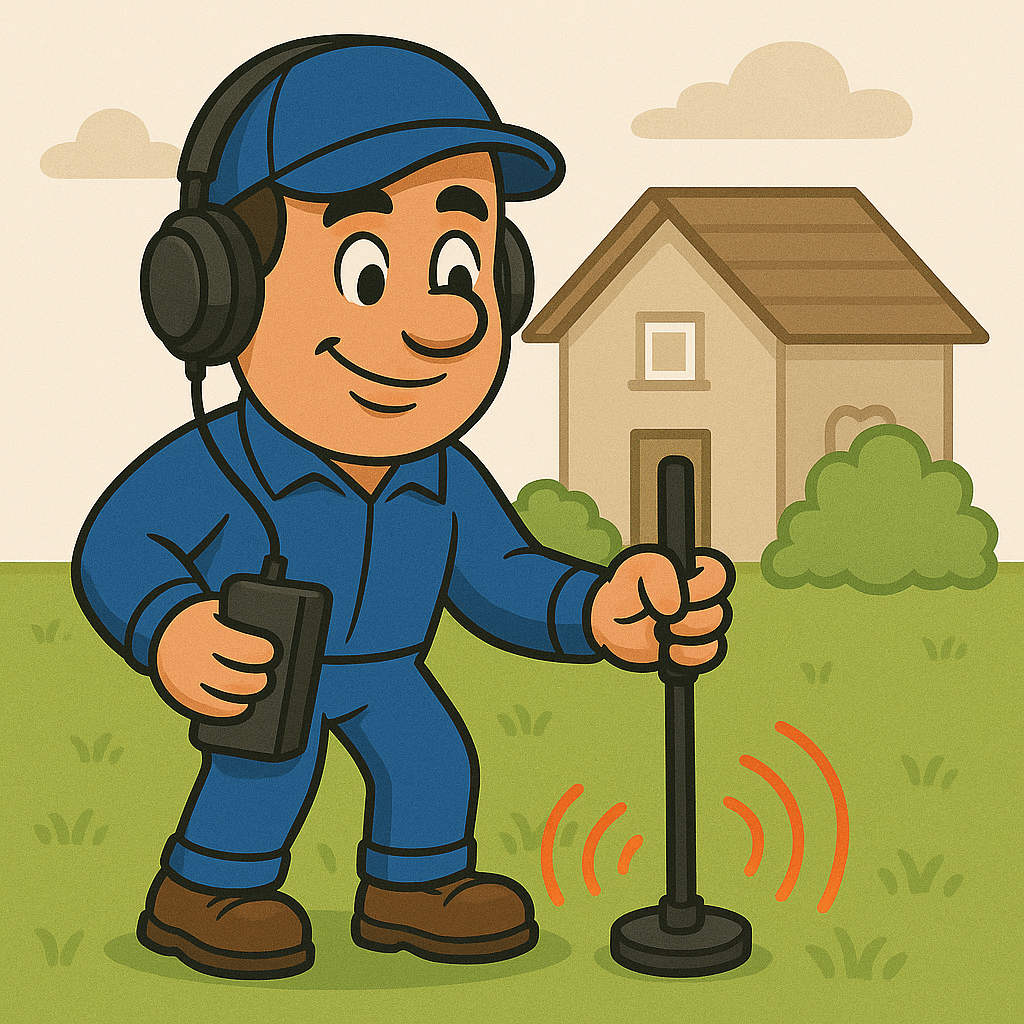
Placing sensors on a garden supply run
Sensors typically clamp onto an accessible section of pipe, a stopcock, a hydrant, or an exposed length in a valve chamber, at each end of the suspected leak zone. The distance between them is measured or estimated from plans, and the correlator does the rest.
Why sound velocity depends on the pipe
This is the part that trips people up. Sound doesn't travel at the same speed through every type of pipe. A rigid material like cast iron or steel carries the leak sound much faster than a flexible plastic pipe like MDPE. Get the pipe material wrong in the calculation, and the correlator's distance estimate will be wrong too, sometimes by a significant margin.
- Metal pipes (cast iron, steel, copper) carry sound fast and clearly, giving correlators their most accurate results.
- Plastic pipes (MDPE, uPVC) carry sound more slowly and can dampen the signal, requiring the operator to know the correct velocity setting for that specific material and diameter.
- Pipe diameter and wall thickness also affect how the sound propagates, which is why an experienced operator checks pipe records rather than assuming a generic figure.
This is why correlator work isn't just a case of clipping two sensors on and reading a number off a screen. Getting the pipe material and diameter right in the settings is what makes the result trustworthy.
Correlator versus listening alone
Ground microphones and listening sticks, the simpler acoustic tools, work by walking the suspected route and listening for the leak sound getting louder as you approach it. It's a genuinely effective method on shorter runs, in quiet conditions, with an experienced operator.
Where it struggles is distance and noise. On a long pipe run, background noise from traffic, other properties or nearby machinery can drown out a quiet leak long before you get close enough to hear it directly. A correlator doesn't need to get close to the leak itself. It only needs access to the pipe at two points, however far apart, and it does the positional work mathematically rather than by ear.
| Situation | Better suited to |
|---|---|
| Short run, quiet street, daytime access | Listening stick / ground microphone |
| Long run, busy road, background noise | Leak correlator |
| Confirming a suspected leak's exact position before digging | Leak correlator |
| Quick first-pass check across a whole property | Listening stick / ground microphone |
In practice, most professional surveys use both. Listening equipment narrows the general area first, and a correlator refines that down to a precise dig point. It's rarely one or the other on a real job.
Got a suspected leak on a long underground run?
Correlator surveys give a precise dig point before anyone breaks ground, cutting excavation down to a small, targeted area rather than a long trial trench.
Where correlators struggle
No tool is perfect for every situation, and correlators have known limits worth knowing about before you rely on one.
Correlators work well on
- Metal pipes with two accessible access points
- Longer runs where walking the route isn't practical
- Noisy environments where direct listening fails
- Continuous, steady leaks under reasonable pressure
Correlators are less reliable on
- Very short pipe runs with no useful separation between sensors
- Plastic pipe with an unknown or unusual diameter
- Very low-pressure systems where the leak makes little sound
- Runs with multiple leaks close together, which can confuse the reading
We pair correlator readings with our acoustic listening leak detection service rather than treating either as the whole answer. The combination catches far more than either method alone.
How a correlator survey runs
Step 1: Identify access points
The operator finds two points on the pipe where sensors can be placed, stopcocks, hydrants, or exposed sections, on either side of the suspected leak area.
Step 2: Confirm pipe details
Material, diameter and the distance between the two sensor points are confirmed, either from records or by measurement, since these feed directly into the calculation.
Step 3: Attach sensors and record
Sensors are attached and the correlator listens for a set period, comparing the signal from each side and calculating the time difference.
Step 4: Confirm the dig point
The unit gives a distance from each sensor to the calculated leak position, which is marked out and, where useful, cross-checked with a listening stick before digging begins.
Our broader underground water leak detection service uses correlators alongside thermal imaging and tracer gas, depending on what the specific pipe run and access allow.
Frequently Asked Questions
On metal pipe with good access and clean settings, correlators commonly pinpoint a leak to within a metre. Accuracy drops somewhat on plastic pipe or where pipe details aren't fully known, which is why an experienced operator cross-checks the reading before digging.
Yes, but it needs the correct sound velocity setting for that specific plastic and diameter, since plastic carries sound differently to metal. Results on plastic pipe are usually still useful but slightly less precise than on metal pipe.
Yes, that's exactly what it's designed for. Correlators find leaks that haven't yet reached the surface, working from the sound of the leak inside the pipe rather than any visible sign above ground.
You need two accessible points on the pipe, which are commonly stopcocks, hydrants, valve chambers or any exposed section. The exact points vary by property and pipe layout, and an experienced operator will identify what's usable on site.
Yes. Sensors clamp onto existing accessible points on the pipe, and no digging, cutting or drilling happens during the survey itself. Excavation only happens afterwards, at the precise point the correlator identifies.
Listening equipment is quick for a first-pass check and confirms a leak is present. A correlator then narrows a wide area down to a precise dig point, particularly on longer runs. Together they cut both the search time and the excavation needed.
📍 Professional Leak Detection Across Scotland
Don't let a small problem become a big one
Correlator surveys, acoustic listening and tracer gas, whatever the pipe and the job need, our non-invasive methods find the leak before anyone digs, backed by an insurance-approved report.