

Emergency leak detection starts with a phone call where we ask what you can see, hear and feel, so we arrive with the right kit already loaded. Most call-outs are same-day. On site, we isolate the area, run thermal imaging or acoustic listening, and pinpoint the source, usually within an hour or two, without lifting a single tile.
In This Guide
The phone call
Emergency leak detection begins before anyone leaves the van. When you call, we're trying to work out two things fast: how urgent is this, and what's the likely source. That shapes which kit we bring and who we send.
Expect a handful of direct questions. Is water actively flowing, or is it a stain that isn't getting worse? Have you been able to shut off the water at the stopcock? Is the property a house, a flat, or a tenement with shared pipework? Is there a specific room where it's worst, or does it seem to be everywhere?
None of this is box-ticking. A leak behind a shower wall needs different equipment to a leak under a solid concrete floor, and knowing the difference before we're on the road saves real time once we arrive.
We also ask about the age and type of the property. A modern flat with plastic push-fit pipework behaves differently to a Victorian tenement with decades of soldered joints and shared supply runs. Knowing which one we're heading to means the right connectors, adapters and access tools are already in the van rather than something we have to go back for.
If you're calling about a shared building, tell us that early. Tenements often route water through a common supply pipe before it branches off into individual flats, and the diagnosis process changes depending on whether the leak sits before or after that branch point.
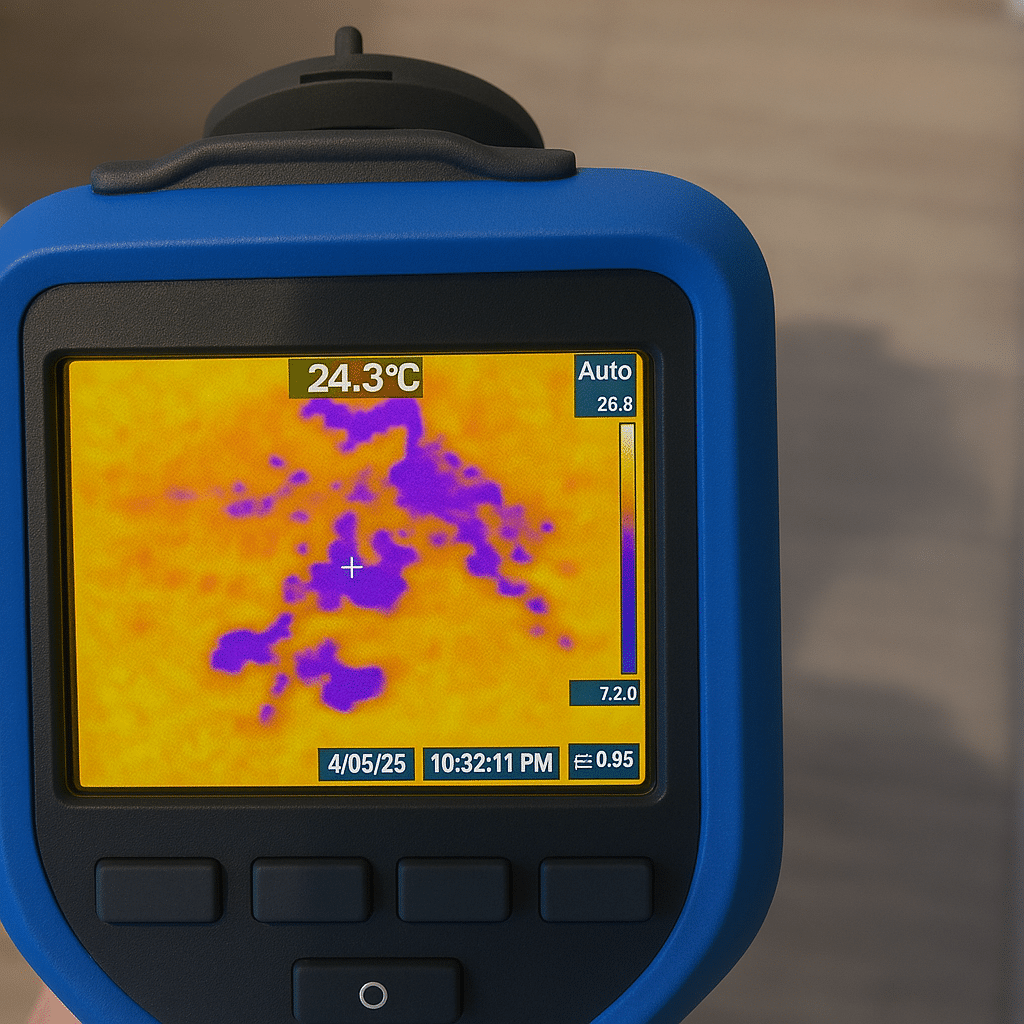
The kit that goes in the van first
Thermal imaging cameras pick up temperature differences on a wall or floor surface caused by escaping water, hot or cold. Acoustic listening devices pick up the sound of water under pressure moving through a pipe. Which one comes out first depends entirely on what you told us on the phone.
What to do before we arrive
A few sensible steps between hanging up the phone and us pulling up outside can limit the damage significantly.
- Find your stopcock and turn it off if water is actively running and you can't identify the source. This buys time without making the problem worse.
- Switch off electrics in any area where water is near sockets, switches or light fittings.
- Move what you can away from the affected area, furniture, rugs, anything that will soak up water and hold onto damage.
- Take photos of the affected area as you find it. This helps your insurer later and gives us a useful before-and-after record.
- Don't start lifting floors or opening walls yourself. It's tempting, but it can destroy evidence an insurer needs, and non-invasive detection usually makes it unnecessary anyway.
What happens on site
On arrival, we start with a walk-through and a conversation, confirming what you've already told us and asking anything that's come up since. Then the actual survey begins.
Step 1: Isolate and observe
We check the stopcock and any isolation valves, and watch the water meter (where there is one) for movement with everything else turned off. Movement on the meter with no taps running is a strong sign of an active leak somewhere in the supply.
Step 2: Thermal and acoustic survey
Thermal imaging scans walls, ceilings and floors for the temperature signature of escaping water. Acoustic equipment listens through walls and floors for the sound of water moving under pressure. Together, they narrow the search area fast.
Step 3: Tracer gas if needed
For trickier cases, especially underground or under concrete, we introduce a safe tracer gas (a mix of 5% hydrogen and 95% nitrogen) into the empty pipe. It escapes at the leak point and is picked up at the surface with a sensitive probe, pinpointing the exact spot.
Step 4: Confirm and report
Once we've pinpointed the source, we mark it, explain what we've found, and put it in writing. Our reports are built to the standard insurers expect, so you're not starting from scratch if you need to make a claim.
How fast pinpointing goes
People often ask how long this all takes, expecting the answer to be "it depends" in a way that isn't useful. Honestly, most straightforward domestic jobs are done within a couple of hours once we're on site. Tenements and larger commercial buildings with more pipework and multiple potential sources can take longer, but same-day results are the norm rather than the exception.
Same-day capability is the whole point of calling an emergency line rather than booking a routine survey. Escaping water rarely waits politely for a convenient appointment slot, so neither do we.
Water where it shouldn't be, right now?
Our water leak detection service covers emergency call-outs across Scotland with same-day availability.
What you get afterwards
A leak detection report isn't just a courtesy. It documents where the leak was, how it was found, and what caused it, in language your insurer or factor can act on. The Association of British Insurers estimates escape of water costs insurers about £1.8 million a day in payouts, and most trace-and-access policies cover the cost of finding and accessing a leak, commonly up to around £5,000, though it's always worth checking your own schedule. A proper report is what turns that cover from theoretical to actually claimable.
It also protects you if there's a dispute afterwards, particularly relevant in a tenement or rented property where more than one party might be involved. Our plumbing leak detection reports are written with exactly that in mind.
When it isn't an emergency
Not everything that looks alarming needs a 999-style response. A ceiling stain that isn't spreading, a slightly damp patch that's been there for weeks, or a small drop in boiler pressure that's stable rather than getting worse, these can usually wait for a scheduled visit rather than an emergency one.
What genuinely warrants an emergency call: water actively flowing with no obvious cause, a rapidly spreading stain, a burst pipe, or any situation where water is near electrics. If you're unsure which category you're in, call anyway. Working out urgency over the phone is part of what we do, and it costs you nothing to ask.
This distinction matters for planning too. If you're weighing up whether to call now or book something for next week, our guide on leak detection specialist vs plumber covers which type of professional actually fits your situation, since not every water problem needs the emergency line.
Honestly, most of the time it's not as dramatic as it feels standing in a wet kitchen at 9pm. A calm phone call, a few sensible precautions, and getting the right survey booked usually turns a frightening evening into a solved problem by lunchtime the next day.
Frequently Asked Questions
We offer same-day capability across Scotland for genuine emergencies. Exact arrival time depends on your location and how many call-outs are already in progress, but the moment you call, we're working out the fastest realistic route to you.
We'll ask whether water is actively flowing, whether you've shut off the stopcock, what kind of property you're in, and where the problem seems worst. These answers help us bring the right equipment and prioritise your call correctly.
If water is actively running and you don't know the source, yes, turn off the stopcock. It limits damage while you wait. If the situation is more of a stain or damp patch that isn't changing, this isn't usually necessary.
Almost never at the detection stage. Thermal imaging, acoustic listening and tracer gas all locate leaks without any invasive work. Any opening up needed afterwards for the actual repair is a separate step, done only once we know exactly where to look.
Yes. Every survey comes with an insurance-approved report documenting what we found and how we found it, which you can pass directly to your insurer or loss adjuster as part of your claim.
That's a good outcome, not a wasted call-out. We'd still confirm the source, explain what's happening, and advise whether it needs fixing urgently or can be scheduled. Better to check and find it's minor than ignore it and find out later it wasn't.
📍 Professional Leak Detection Across Scotland
Don’t let a small problem become a big one
Same-day surveys, non-invasive methods and insurance-ready reports, wherever you are in Scotland.