

A combi boiler leak usually comes from the pressure relief valve, the pump seal, or the filling loop, because everything sits inside one sealed unit. A system boiler leak more often comes from the hot water cylinder, its valves, or the pipework linking the boiler to a separate tank. Persistent pressure loss on a combi is the giveaway sign either way.
In This Guide
How the two systems actually differ
A combi boiler heats water directly from the mains, on demand, with no separate hot water cylinder or cold water tank. Everything, the heating circuit and the domestic hot water, runs through one sealed unit. A system boiler still heats water on demand for the central heating circuit, but it stores hot water in a separate cylinder, usually in an airing cupboard, ready to draw off when a tap is turned on.
That structural difference is exactly why they fail in different places. A combi's leak points are concentrated inside or right next to the boiler casing. A system boiler spreads its leak risk across a wider footprint, because there's a cylinder and its associated pipework to consider as well as the boiler itself.
Where combi boilers leak
The pressure relief valve is the most common source. It's designed to open and release water if pressure inside the sealed system gets too high, which is exactly what it should do, but a worn valve can start dripping even at normal pressure. If you're finding water pooling under the boiler with a pipe leading outside, that's often the culprit.
The pump seal is another common wear point. Circulating pumps have a seal that degrades over years of use, and once it starts to go, a small weep around the pump housing is typical. The filling loop, the flexible hose used to top up system pressure, is a third spot: its valves aren't designed to stay under pressure long-term, and a slightly worn one can leak slowly enough that you only notice the pressure gauge creeping down.
Persistent pressure loss on a combi, where the gauge keeps dropping days after you top it up, points to a leak somewhere in the sealed circuit even if you can't see water anywhere. It's worth investigating rather than just re-pressurising repeatedly.
Where system boilers leak
The hot water cylinder itself can develop a leak as it ages, particularly around the immersion heater fitting or where pipework connects to the cylinder. Because the cylinder usually sits inside an airing cupboard, a slow leak here can go unnoticed for a long time, showing up eventually as a damp patch on the cupboard floor or the ceiling of the room below.
Valves are the other common failure point on a system boiler setup: the expansion vessel valve, the pressure reducing valve, and the various isolation valves around the cylinder and pipework. Any of these can develop a slow drip as washers and seals age.
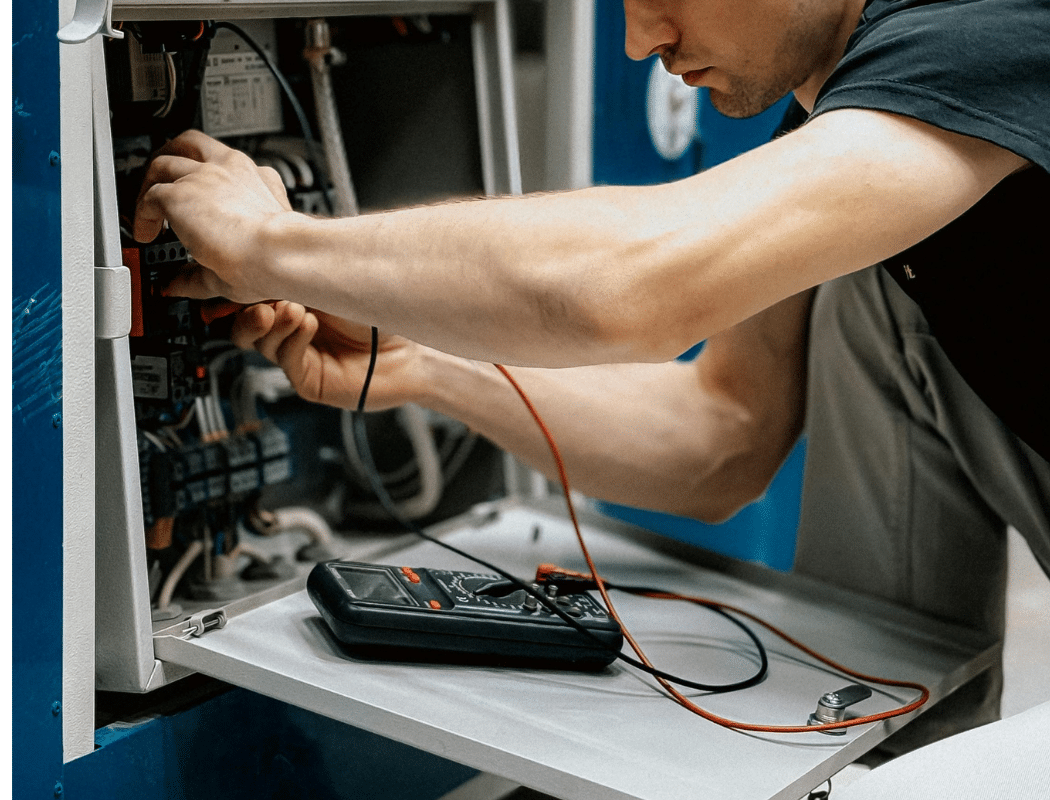
Diagnosing the actual leak point, not the boiler in general
Because combi and system boilers leak in different places, the diagnostic approach differs too. Acoustic and thermal tools let us trace pressure loss to its actual source, whether that's a valve on a cylinder cupboard three metres from the boiler, or a seal inside the unit itself.
Reading the symptoms
On a combi, the clearest symptom is pressure that won't hold. If you top it up and it drops again within days, water is leaving the system somewhere. Visible dripping from the base of the unit or from an external overflow pipe usually points to the pressure relief valve specifically.
On a system boiler, watch the airing cupboard. A damp patch on the cupboard floor, a musty smell, or staining on the ceiling below the cylinder are all signs worth checking. Because the cylinder and its pipework are separate from the boiler, a system boiler can develop a leak while the boiler itself shows no fault code at all.
Scotland's combi-conversion housing stock
A lot of older Scottish housing, particularly tenement flats and post-war semis, was originally built around a system boiler or even older gravity-fed setups, with a hot water cylinder and cold water tank in the loft. Many of these properties have since been converted to combi boilers to free up airing cupboard space and simplify the system.
That conversion history matters for leak diagnosis. A converted property can still have redundant pipework in the loft or cupboard that isn't obviously connected to anything, and it's easy to mistake a leak from an old, unused pipe run for a fault in the current combi system. Knowing a property's heating history helps narrow down where to actually look.
Boiler pressure won't hold and you can't see why?
Whether it's a combi or a system boiler, we trace the leak to its actual source using non-invasive detection, before anyone starts lifting floorboards.
Comparing the two at a glance
The table below sets the two systems side by side. It's a starting point for diagnosis, not a substitute for actually tracing the leak.
| Feature | Combi boiler | System boiler |
|---|---|---|
| Hot water storage | None, heated on demand | Separate cylinder |
| Common leak points | Pressure relief valve, pump seal, filling loop | Cylinder, immersion fitting, expansion vessel valve |
| Typical first sign | Pressure gauge won't hold | Damp in the airing cupboard |
| Leak footprint | Concentrated at the boiler | Spread across cylinder and pipework |
When to call someone
A single top-up that holds for weeks is nothing to worry about. Pressure that drops again within days, visible water anywhere near the boiler or cylinder, or a damp patch that keeps returning after you've dried it out are all reasons to get it looked at properly. Guessing at the fix on a sealed system usually means paying twice, once for the wrong repair and again for the right one.
Our central heating leak detection service is built around exactly this problem: finding where a heating system is actually losing water, whether that's inside a combi unit or somewhere in a system boiler's cylinder and pipework.
- Pressure gauge: check it daily for a week if you suspect a slow leak.
- Airing cupboard: check the floor and ceiling below for damp if you have a system boiler.
- Boiler casing: look for staining or a wet patch underneath.
- Fault codes: note any low-pressure codes and when they started appearing.
Frequently Asked Questions
The pressure relief valve is the most frequent culprit, followed by the pump seal and the filling loop. All three sit close to or inside the boiler casing, so a leak from any of them tends to show up as water pooling near the unit itself.
A musty smell in an airing cupboard often means a slow leak from the hot water cylinder or its fittings, particularly around the immersion heater. Check the cupboard floor and the ceiling of the room below for damp staining to confirm.
Most combi boilers run at a cold pressure of around 1 to 1.5 bar. A reading that keeps falling below that over several days, even after topping up, usually points to a leak somewhere in the sealed heating circuit.
Yes. Because the hot water cylinder and its pipework sit apart from the boiler, a leak there doesn't always affect the sealed heating circuit the boiler monitors. The boiler can run with no fault code while the cylinder or a nearby valve is leaking.
It's possible. Converted properties sometimes retain redundant pipework from the old tank-fed system in the loft or airing cupboard. A leak from an old, capped pipe can be mistaken for a current combi fault, so it helps to know a property's heating history before diagnosing.
Not usually dangerous on its own, but it shouldn't be ignored. A valve that drips at normal operating pressure is worn and needs replacing. If you smell gas at any point near a boiler, stop and call the National Gas Emergency line on 0800 111 999 immediately.
Neither type is inherently more leak-prone. Combi boilers concentrate their leak points around the unit itself, while system boilers spread the risk across the cylinder and its pipework too. What matters is knowing where to check for each type.
📍 Professional Leak Detection Across Scotland
Don't let a small problem become a big one
Whichever system you have, we find hidden leaks with non-invasive detection and hand over an insurance-ready report the same day where possible.