

A hot water cylinder leaking most often means the immersion heater boss seal has failed, a coil connection has worked loose, or the tank seam has corroded through with age. Vented cylinders usually show a slow drip low down; unvented cylinders can show pressure-related weeping from a valve. Check the catch tray and connections first, then get a professional look if the cylinder itself is corroded.
In This Guide
Where cylinder leaks usually start
A hot water cylinder leaking is one of the more stressful plumbing problems, because most cylinders sit inside an airing cupboard, wrapped in insulation, often above bedrooms or a kitchen ceiling. A leak here can run for a while before anyone notices, since it is easy to mistake a small drip for condensation on the outside of the tank.
There are really four places to check, in order of how often we see them: the immersion heater boss where the element screws into the tank, the coil connections if the cylinder has an internal heating coil, the tank seam itself if corrosion has taken hold, and any control valves fitted to unvented systems. Each has a distinct pattern once you know what you are looking at.
Start simply. Open the airing cupboard, dry every surface with a towel, and look again after a few hours with the hot water in normal use. Note exactly where the first bead of water appears, because that single detail usually narrows things down fast.
The immersion heater boss
The immersion heater screws into a boss welded onto the side of the cylinder, sealed with a fibre or rubber washer. This washer compresses when the element is tightened and should hold for years, but it degrades with heat cycling over time, and if the element was ever removed and refitted without a new washer, it may never have sealed properly in the first place.
A boss leak shows as water tracking down from the immersion heater’s flange, usually visible where the cable enters if you look closely, or pooling directly below that point in the catch tray. It is one of the more straightforward fixes: isolate the electrics, drain the cylinder enough to clear the boss, remove the element, fit a new washer and reseat it to the correct torque.
Always isolate the electrical supply to the immersion heater before touching it, and never work on a cylinder with the water still live to that section. If you are not confident doing this safely, this is a job for a qualified plumber rather than a DIY attempt.
Coil connections and joints
Cylinders heated indirectly by the boiler have an internal coil, and that coil connects to the primary heating circuit through fittings on the outside of the tank. These joints, whether compression or soldered, can loosen slightly over years of thermal expansion and contraction as the heating cycles on and off.
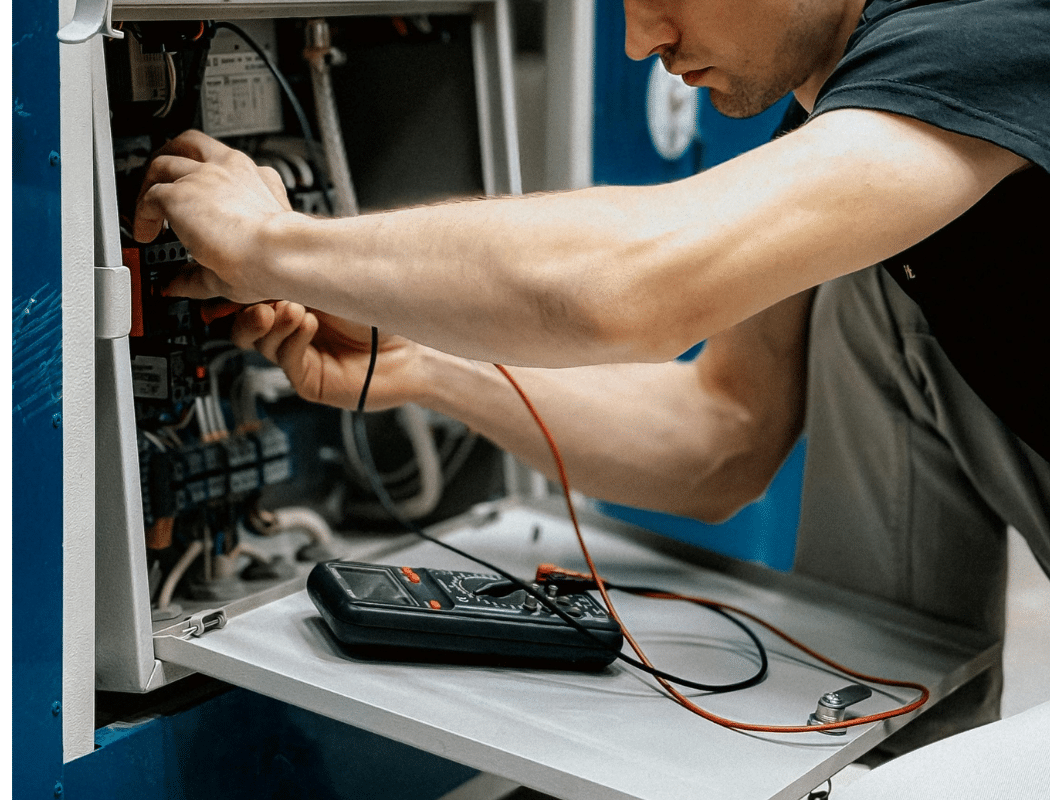
Why a proper check matters here
A loose coil connection can weep so slowly that it only shows as a faint stain on the insulation jacket rather than visible dripping. Because this joint sits on the heating side, not the hot water side, the symptom can look identical to a general heating system leak until someone traces it to this exact fitting.
If you can see a joint on the coil pipework is damp or has a mineral tide-mark from evaporated water, that connection needs retightening or resealing. Loose joints are usually simple to fix once found. Finding them without draining the whole cylinder is the harder part.
Seam corrosion: the cylinder giving up
Older copper cylinders and some steel unvented tanks can corrode at the seams over decades of service, and once that happens, there is no realistic repair. A seam leak shows as a slow, persistent weep from a joint line rather than a single fitting, often worse after the tank has been full and hot for a while.
This is the one genuine replace-not-repair scenario. A corroded seam on a cylinder that has been in service for fifteen, twenty years or more is not something worth patching, since the same corrosion is likely present elsewhere in the tank even if it has not broken through yet.
The give-away compared with a boss or coil leak is location: seam corrosion tends to show along a horizontal line around the tank’s circumference rather than at a single fitting point.
Vented vs unvented: different failure patterns
Vented cylinders, fed from a cold water storage tank in the loft, tend to leak slowly and predictably. Because they operate at low pressure, a failed washer or corroded seam usually produces a gentle drip rather than a sudden gush, which is part of why these leaks go unnoticed for so long.
Unvented cylinders work at mains pressure and have additional safety components: an expansion vessel, a pressure relief valve, a temperature relief valve. A leak here can show up differently, sometimes as water discharging from the tundish or overflow pipe rather than from the tank body itself. That is often not a tank leak at all, but a pressure or valve fault that needs the same kind of attention as a boiler pressure problem.
| Cylinder type | Typical leak pattern | Common cause |
|---|---|---|
| Vented | Slow, steady drip, low pressure | Boss washer, seam corrosion |
| Unvented | Discharge from tundish or overflow | Valve fault or expansion vessel issue |
| Either | Damp patch on coil pipework | Loose coil connection |
Not sure if it’s the cylinder or something else nearby?
Water in an airing cupboard does not always come from the cylinder itself. It can track from a pipe joint above or beside it. Our non-invasive surveys pinpoint the real source before anyone starts draining tanks or lifting floors.
What the catch tray is telling you
Most cylinders sit on or above a catch tray or drip tray designed to collect exactly this kind of leak before it reaches the floor below. If you find water in the tray, that confirms the leak is coming from the cylinder or its immediate connections, not from somewhere else in the room.
If the tray is dry but you can still see damp on the floor or ceiling below, the water is very likely coming from a different source altogether, perhaps a nearby pipe run rather than the cylinder itself. This distinction matters, because chasing the wrong culprit means the real leak keeps running while you empty and dry a tank that was never the problem.
We see this fairly often in older Scottish flats where the airing cupboard sits directly above a kitchen ceiling: a homeowner assumes the cylinder is at fault, drains and inspects it thoroughly, finds nothing, and the ceiling stain keeps spreading because the actual leak was in a pipe run passing through the same cupboard.
When to call someone in
A confirmed boss washer or a loose coil fitting is usually within reach of a competent plumber, and sometimes a confident DIYer if the electrics are isolated properly first. Seam corrosion means booking a replacement cylinder rather than a repair.
Straightforward to fix
- Confirmed immersion boss washer failure
- A single loose coil connection you can see and reach
- Water clearly confined to the catch tray, source visible
Needs a proper trace
- Dry catch tray but a ceiling stain below regardless
- Damp appearing intermittently with no clear source
- Water tracking from an unvented cylinder’s safety fittings
- Dry and inspect before assuming. A wet airing cupboard does not always mean the cylinder is the source.
- Check the catch tray first. It tells you fast whether the leak is the cylinder or something else nearby.
- Isolate electrics before touching an immersion heater. Never work on a live element.
- Treat seam corrosion as end-of-life. Repair is not realistic once a copper seam has corroded through.
If the leak trail runs down through the floor to a kitchen or bathroom below, our guide on getting access under a bath without wrecking tiles is worth a read too, since cylinder cupboards and bathrooms often share the same wall and pipe run.
Frequently Asked Questions
A leak low on the tank often points to seam corrosion, especially on older copper cylinders. Check the catch tray to confirm the water is coming from the tank itself rather than a nearby pipe passing through the same cupboard.
A failed immersion boss washer or a loose coil connection can usually be repaired. A corroded seam cannot be repaired safely and means the cylinder needs replacing, since the same corrosion is often present elsewhere in the tank.
Yes. Water near an electrical element is a genuine safety risk. Isolate the electrical supply to the immersion heater immediately if you suspect a leak at the boss, and do not touch or attempt to remove the element until it is confirmed dead.
Vented cylinders operate at low pressure and tend to leak as a slow, steady drip. Unvented cylinders operate at mains pressure with safety valves attached, so a leak can appear as discharge from a tundish or overflow rather than from the tank body itself.
Check the catch tray beneath the cylinder first. Water collected there confirms the cylinder or its fittings. A dry tray with damp still appearing elsewhere in the cupboard usually means a nearby pipe, not the tank.
There is no fixed figure, but cylinders that have been in service for well over a decade are more prone to seam corrosion. A cylinder showing seam weeping at that age is generally more sensible to replace than repair.
📍 Professional Leak Detection Across Scotland
Get certainty before you drain the tank
Don’t let a small problem become a big one. Our non-invasive thermal imaging and moisture detection confirm exactly where a cylinder or pipework leak is coming from, with insurance-approved reports if you need to make a claim.