
Leak detection accuracy means narrowing a leak down to a small, specific area, usually a section of pipe or a patch of floor, not an exact millimetre on a plan. Combining thermal imaging, acoustic listening and tracer gas gets the location tight enough that repair work is targeted rather than exploratory. Accuracy depends on the building, the pipe material, and how many methods get combined, which is why we build our reputation on a 99% success rate rather than a single guaranteed figure.
In This Guide
What accuracy actually means
When someone asks how accurate leak detection is, they usually picture a laser pointer landing on one exact spot. That’s not quite how it works, and any company promising that level of precision on every job isn’t being straight with you.
What accurate leak detection actually delivers is a confirmed, narrow search area, small enough that a repair is targeted rather than exploratory. On an exposed pipe in a plant room, that might genuinely mean a specific joint. Under a solid floor with several pipe runs nearby, it more often means a defined patch a few tiles wide, or a metre or so of a buried run. Both outcomes count as accurate. Neither one is a guess.
The honest answer is that accuracy is a range, not a point, and the size of that range depends on the building, the pipe material, and how many detection methods get combined on the job.
Why one method alone isn’t enough
Every leak detection method has blind spots. Thermal imaging reads surface temperature differences, which works brilliantly where water changes the thermal signature of a floor or wall, but struggles where insulation, thick masonry, or a busy heating system muddies the picture. Acoustic listening picks up the sound of water escaping under pressure, but background noise, pipe depth, and the type of pipe material all affect how clearly that sound travels to the surface.
Used alone, either method gives you a reasonable idea of where to look. Used together, they cross-check each other. A thermal reading and an acoustic reading pointing to the same few square metres is a far stronger result than either one on its own, and that overlap is usually what separates a rough area from a confirmed one.
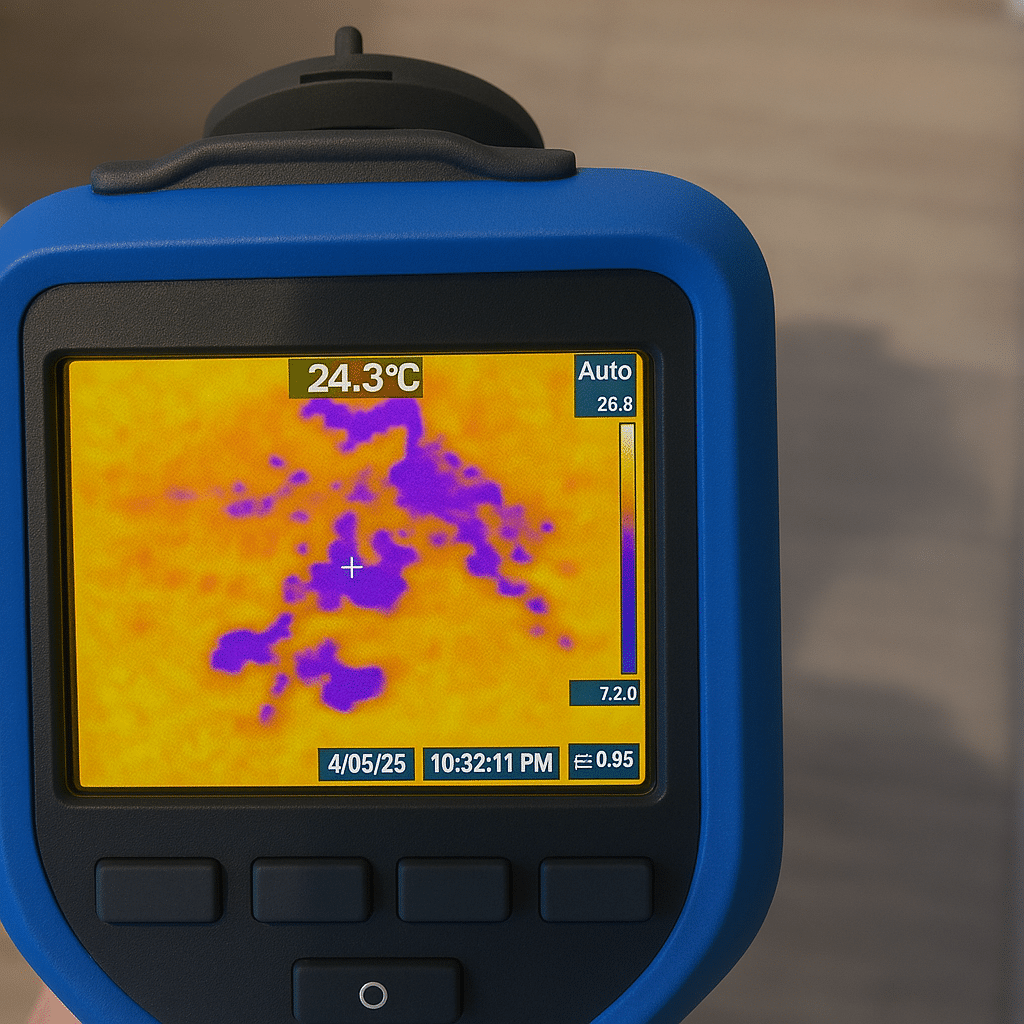
What a thermal imaging camera actually shows
A thermal imaging camera doesn’t see water directly. It shows temperature differences on the surface it’s pointed at, and escaping water changes those temperatures as it spreads through a floor, wall or ceiling void. Reading that pattern correctly, rather than just photographing a warm patch, is where experience matters as much as the equipment.
How combining methods narrows the search
Most jobs start broad and get narrower in stages, rather than jumping straight to a pinpoint.
Step 1: Establish that a leak exists
Water meter checks and a look at recent usage confirm there’s a genuine leak before any detailed survey work begins, ruling out other explanations first.
Step 2: Scan broadly with thermal imaging
Thermal cameras cover floors, walls and ceilings quickly, identifying zones worth a closer look rather than the whole building.
Step 3: Confirm with acoustic listening
Within the zones flagged by thermal imaging, acoustic equipment listens for the specific sound of water escaping, narrowing the area further.
Step 4: Confirm precisely with tracer gas where needed
For final confirmation before any opening-up work, a safe mix of 5% hydrogen and 95% nitrogen is introduced into an isolated section of pipe and detected at the surface with a sensitive probe, giving the tightest possible confirmation.
Not every job needs all four steps. A straightforward domestic leak might be confirmed after steps one and two. A commercial site with several possible pipe runs nearby might need all four before anyone’s confident enough to recommend opening up a specific spot.
What widens the search area
Several factors make pinpointing harder, and it’s worth knowing them so expectations are realistic from the start.
- Pipe depth. The deeper a pipe is buried or boxed in, the further sound and heat have to travel to reach the surface, softening the signal.
- Dense or thick materials. Solid stone, deep concrete slabs, and thick masonry, common in older Scottish buildings, all reduce how clearly thermal and acoustic signals come through.
- Multiple nearby pipe runs. Where several pipes sit close together, distinguishing which one is actually leaking takes more careful cross-referencing.
- Very slow leaks. A slow drip produces a weaker acoustic signal and a smaller thermal footprint than a significant leak, which can widen the confirmed area needed before a repair is recommended.
- Background noise or heat sources. Nearby traffic, machinery, or heating pipework can interfere with acoustic and thermal readings, requiring more careful interpretation.
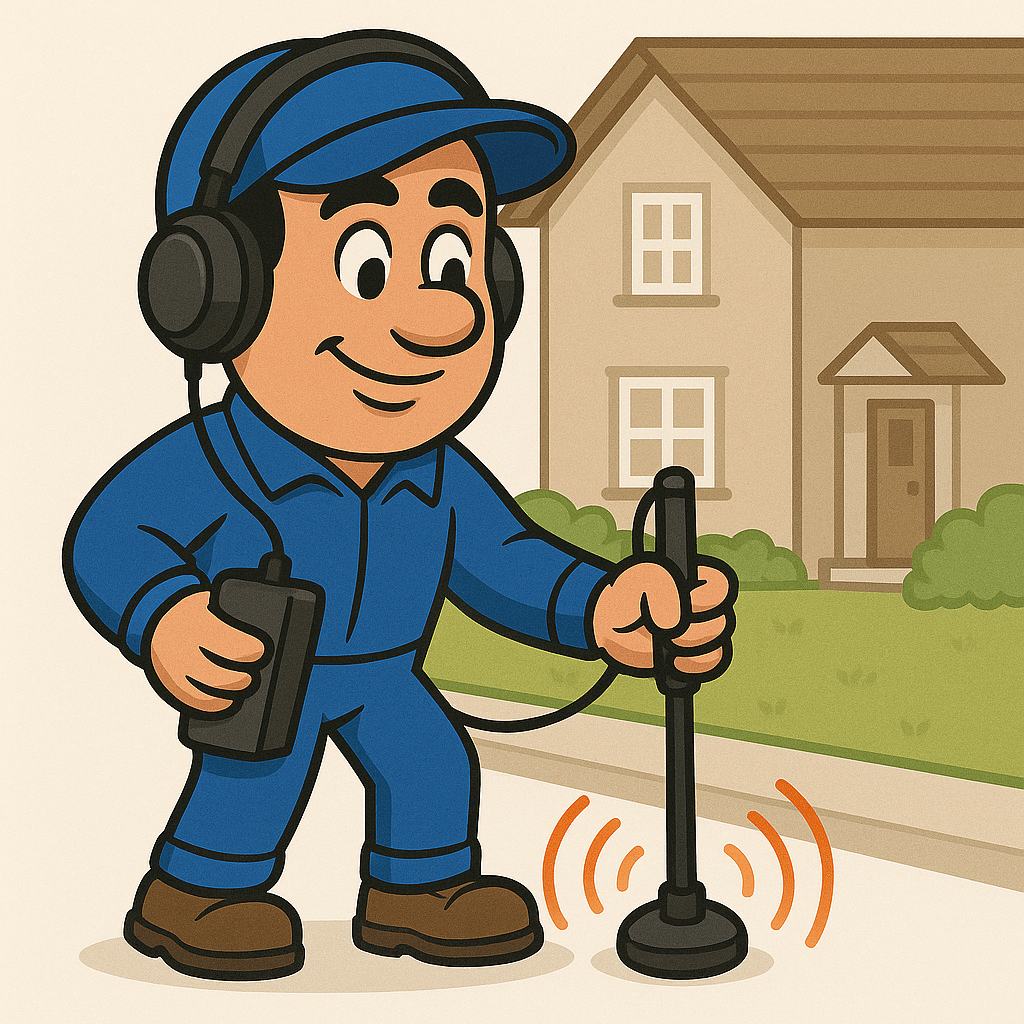
Acoustic listening on a driveway or path
Buried supply pipes under a driveway or path are a common source of the "won’t be pinned down easily" leak. Acoustic listening at multiple points along the suspected route, comparing the strength of the sound at each, narrows the leak to a short section before anyone needs to lift a slab.
What narrows it further
On the other side, several things make pinpointing tighter and faster.
Helps narrow the search
- Access to the water meter for direct usage confirmation
- A clear history of when the problem started
- Exposed or accessible pipe runs to reference against
- Combining two or more detection methods
Makes it harder
- Very old, undocumented pipework with no plans
- Deep burial or thick structural materials
- Multiple possible leak sources in one area
- Extremely slow or intermittent leaks
A building’s own history often gives useful clues too. If a resident or business owner can say roughly when a damp patch first appeared, or when a water bill first started climbing, that timeline narrows the likely leak location before any equipment comes out.
Want a straight answer on what we can find?
We combine thermal imaging, acoustic listening and tracer gas depending on your building, and we’ll tell you honestly how tight a fix we expect before any work starts.
Our 99% success rate in context
We quote a 99% success rate, built on more than 5,000 leaks found across 30-plus years in the trade. That figure means we successfully locate the leak in the very large majority of jobs we take on, using non-invasive methods first.
It doesn’t mean every single leak gets pinpointed to an exact millimetre on the first visit. Some jobs need more than one method, and a small number need a follow-up visit once initial findings narrow things down further. What it does mean is that the combination of methods we use, applied by people who’ve done this for decades, finds the leak in the end, and does so without unnecessary demolition along the way.
Every survey ends with a written report suitable for your insurer, showing what was found, where, and the confidence behind that finding. That’s part of what makes the reports genuinely useful rather than a vague summary.
Setting realistic expectations
Honestly, most jobs land somewhere between "found it exactly" and "narrowed to a small area", and that’s a good outcome, not a compromise. The goal of accurate leak detection isn’t a perfect science demonstration. It’s giving you and your tradesperson, or your insurer, enough confidence in the location that the repair happens once, in the right place, rather than several times in the wrong ones.
If a survey comes back with a defined area rather than an exact point, that’s not a failure of the method. It’s an honest reflection of what the building and the leak allow. For a fuller sense of what a typical visit looks like from start to finish, our guide on what happens during a leak detection survey walks through the process in more detail.
We built our approach around water leak detection and thermal imaging leak detection specifically because combining methods, rather than relying on one, is what gets the accuracy up without needing to dig first and ask questions later.
Frequently Asked Questions
Not always to an exact millimetre, though it often gets close. More commonly, methods narrow the leak to a small, confirmed area, a specific pipe section or patch of floor, tight enough that a repair is targeted rather than exploratory.
Each method has blind spots. Thermal imaging can struggle with thick masonry or insulation, while acoustic listening can be affected by pipe depth or background noise. Combining methods cross-checks the results, giving a far more reliable location than either alone.
Deep burial, thick concrete or stone, multiple pipe runs close together, and very slow or intermittent leaks all make pinpointing harder. Older Scottish buildings with dense stone construction are a common example where signals need more careful interpretation.
It means we successfully locate the leak in the large majority of jobs we take on, based on more than 5,000 leaks found using non-invasive methods. It reflects overall success finding the leak, not a guarantee of pinpoint precision on every single visit.
Straightforward domestic leaks are often confirmed within a single visit. More complex commercial sites, or leaks under thick concrete or multiple pipe runs, sometimes need a follow-up visit once initial findings narrow the search area further.
They serve different purposes rather than one being more accurate. Thermal imaging scans broad areas quickly, while tracer gas, a safe mix of 5% hydrogen and 95% nitrogen, gives a precise final confirmation once the search has already been narrowed down.
Treat it as a good result. A confirmed small area, rather than an exact point, still means only that section needs opening for repair, instead of guesswork across a much wider part of the building. That’s the outcome accurate leak detection is aiming for.
📍 Professional Leak Detection Across Scotland
Don’t let a small problem become a big one
We combine methods to give you an honest, well-supported answer on where a leak is, backed by an insurance-ready report and a 99% success rate.