

For frost protection, leaving heating on low all day beats switching it off completely, because it keeps pipework and the building fabric above freezing. Scottish Water’s own winter advice is to heat, insulate and protect: keep heating ticking over at a low, constant temperature rather than letting a home go cold, especially if nobody is in for long periods.
In This Guide
The debate, reframed around pipes
Most articles about heating on low versus off are really about energy bills. That is not what this one is about. From a pipe and property protection point of view in a Scottish winter, the calculation is different, and the stakes are higher than a slightly larger heating bill: a frozen pipe that splits can flood a house in minutes once it thaws.
Scotland recorded around 3,100 pipe bursts across the country in winter 2023/24, Scottish Water reported, and more than 30% of those were on customer-owned pipework rather than the mains network. That is a meaningful share of homes finding out the hard way that an empty or cold property carries a genuine risk of real damage.
What happens to pipes when heating goes off
Water expands as it freezes. When it does that inside a confined pipe, the ice pushes outward against the pipe wall with enormous force. Copper and plastic pipes both split under that pressure, and the failure often happens at a joint or a section running through an unheated space like a loft, garage or external wall.
The damage frequently is not visible until the thaw. A pipe can split while frozen and show no leak at all, because the ice is still plugging the gap. It is only once temperatures rise and the ice melts that water starts pouring through the crack, sometimes into a property that has been standing empty, so nobody is there to catch it early.
A frozen pipe that has already split will not necessarily drip while still frozen. If you know a pipe has frozen, treat it as a likely failure point once it thaws, even if there is no visible leak yet.
The case for heating on low
Keeping the heating on at a low, constant setting all day does two things a full shutdown cannot. First, it keeps the building fabric, walls, floors and the pipes running through them, above the point where water inside them can freeze. Second, it avoids the big swing between cold and hot that stresses joints and seals in an older heating system.
- Steadier wall and floor temperature. Pipes in walls and under floors stay warmer than the air outside, reducing freeze risk during cold snaps.
- Less thermal stress on joints. A system running gently rather than cycling hard from cold reduces expansion and contraction on solder joints and fittings.
- Lower risk during unexpected absences. If plans change and nobody gets home until later than expected, the property is already protected.
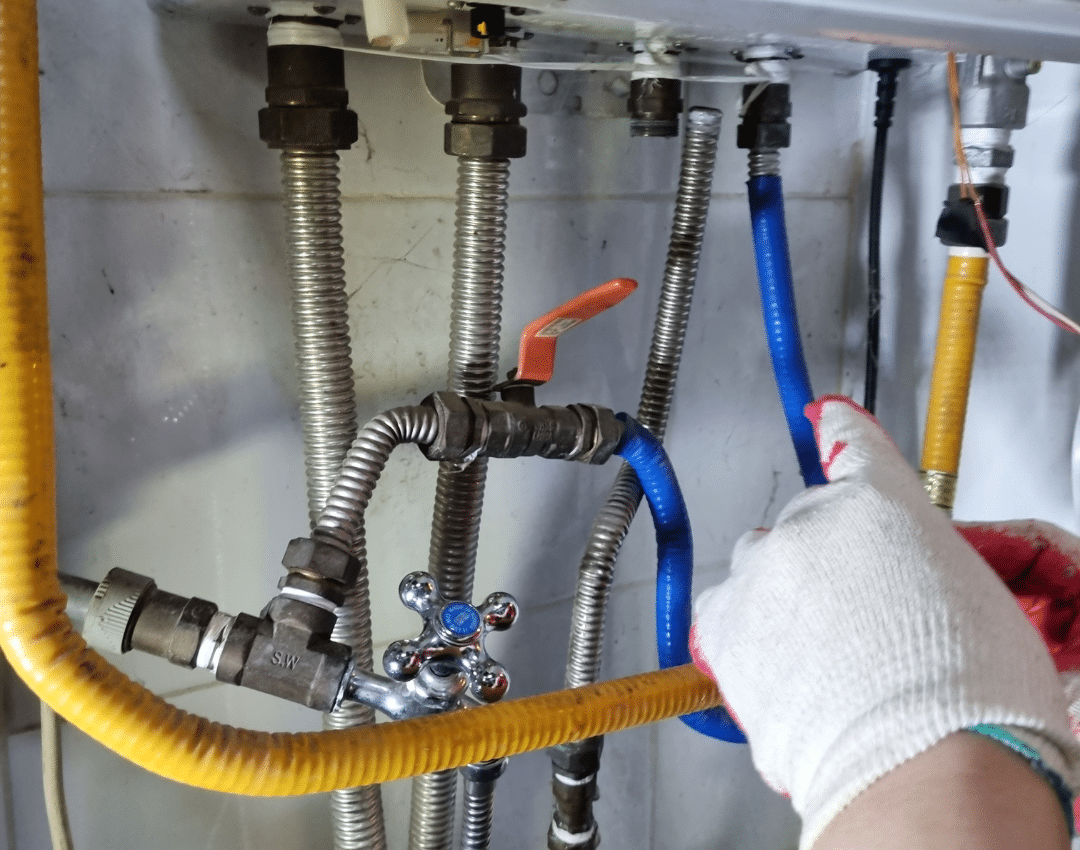
Watch the filling loop as well as the thermostat
Whichever setting you choose, keep an eye on boiler pressure. Combi boiler pressure typically sits around 1 to 1.5 bar when cold; a system that keeps losing pressure through a cold snap can be losing water somewhere in the circuit, which the filling loop pictured here is used to top back up, though repeated topping up points to a leak rather than normal behaviour.
The case people make for switching off
The argument for switching heating off entirely when out is almost always about cost, not pipe safety. It assumes a well-insulated, modern property where room temperature will not drop far enough to freeze pipes during a normal working day, even with no heating running.
That assumption holds up reasonably well in a well-insulated new-build over a mild afternoon. It holds up far less well in an older stone-built or tenement property with draughtier windows, higher ceilings and pipe runs through cold voids, especially during a hard freeze or if the property is going to be empty for more than a day.
Worried a pipe has already frozen or split?
We use thermal imaging to trace pipe runs and spot temperature anomalies before a hidden split turns into a flooded room once the thaw sets in.
Scottish Water’s own advice
Scottish Water’s winter guidance is straightforward: heat, insulate and protect. That means keeping heating ticking over at low temperatures rather than switching it off, insulating exposed pipes and tanks, arranging checks on properties left empty, and draining down properties that will be vacant for extended periods.
Heating on low, all day
- Matches Scottish Water’s freeze-prevention advice
- Protects pipes during unpredictable cold snaps
- Lower risk if you are delayed getting home
Heating off when out
- Can work in a well-insulated, occupied-most-of-the-day home
- Higher freeze risk in older or draughtier properties
- Riskier during a hard freeze or an unplanned late return
Empty and second homes: a different rule
Everything above assumes someone is coming home later the same day. A property standing empty for days or weeks, a second home, a rental between tenants, or a holiday let out of season, needs a different approach entirely. Low-level heating alone is not always enough protection if nobody is checking the property regularly.
For properties standing empty
Arrange for someone to check the property periodically through winter, keep heating running at a genuinely low but non-zero setting, and consider draining the system down completely if it will be empty for an extended spell, which removes the freeze risk altogether. If the property has a private water supply rather than a mains connection, that adds another layer to think about, since private water supply leaks often go unnoticed for far longer without a metered bill to flag them.
Our verdict
For most Scottish homes, heating on low all day is the safer default through winter, particularly during cold snaps and particularly in older properties with pipework running through unheated spaces. We see this most weeks in winter: the calls that come in after a hard freeze are almost always from a property that was left cold, not one that was ticking over gently.
Whichever approach you choose, insulating exposed pipework in lofts, garages and under-stair cupboards makes both options safer, and it is one of the cheapest jobs you can do before winter properly sets in. Our guide on pipe lagging as cheap insurance against winter bursts covers exactly where to focus that effort, and frost protection for Scottish homes goes into thermostat settings in more depth. If a pipe has already frozen, our piece on frozen condensate pipes covers the single most common boiler failure of the season, worth ruling out first if your boiler has stopped altogether.
Frequently Asked Questions
This guide focuses on pipe safety rather than running costs, since the two questions have different answers. For frost protection specifically, a low, constant setting reduces the risk of a frozen and burst pipe, which can cost far more to put right than any heating saved by switching off.
Many boilers and thermostats have a dedicated frost protection setting, which keeps the system ticking over just enough to prevent freezing without heating the home to full comfort temperature. Check your thermostat’s manual for the specific frost or holiday mode setting.
Yes, particularly pipes running through unheated spaces like lofts, garages or external walls that central heating does not reach effectively. Insulating those exposed sections is just as important as keeping the heating on, since warm air in living rooms will not protect a pipe in a cold loft.
You often cannot tell while it is still frozen, since the ice plugs the split and stops water escaping. Once it thaws, watch closely for damp patches, dripping, or a boiler that suddenly loses pressure, and treat any known frozen section as a likely failure point.
For an extended empty period, draining the system removes the freeze risk completely and is often safer than relying on heating alone. For shorter absences, low-level heating combined with insulated pipework and a periodic check by someone nearby is usually sufficient.
Most Scottish households pay for water through council tax rather than a meter, per mygov.scot, so a domestic leak usually will not inflate a water bill the way it might elsewhere. The real cost is property damage and wasted heat, which is the bigger reason to prevent one.
Its advice is to heat, insulate and protect: keep heating ticking over at low temperatures, insulate exposed pipes and tanks, arrange checks on empty properties, and drain down properties that will stand vacant for extended periods over winter.
📍 Professional Leak Detection Across Scotland
Get ahead of the freeze this winter
Don’t let a small problem become a big one. If you suspect a frozen or already-split pipe, we can scan the run non-invasively and confirm it before the thaw causes real damage.